


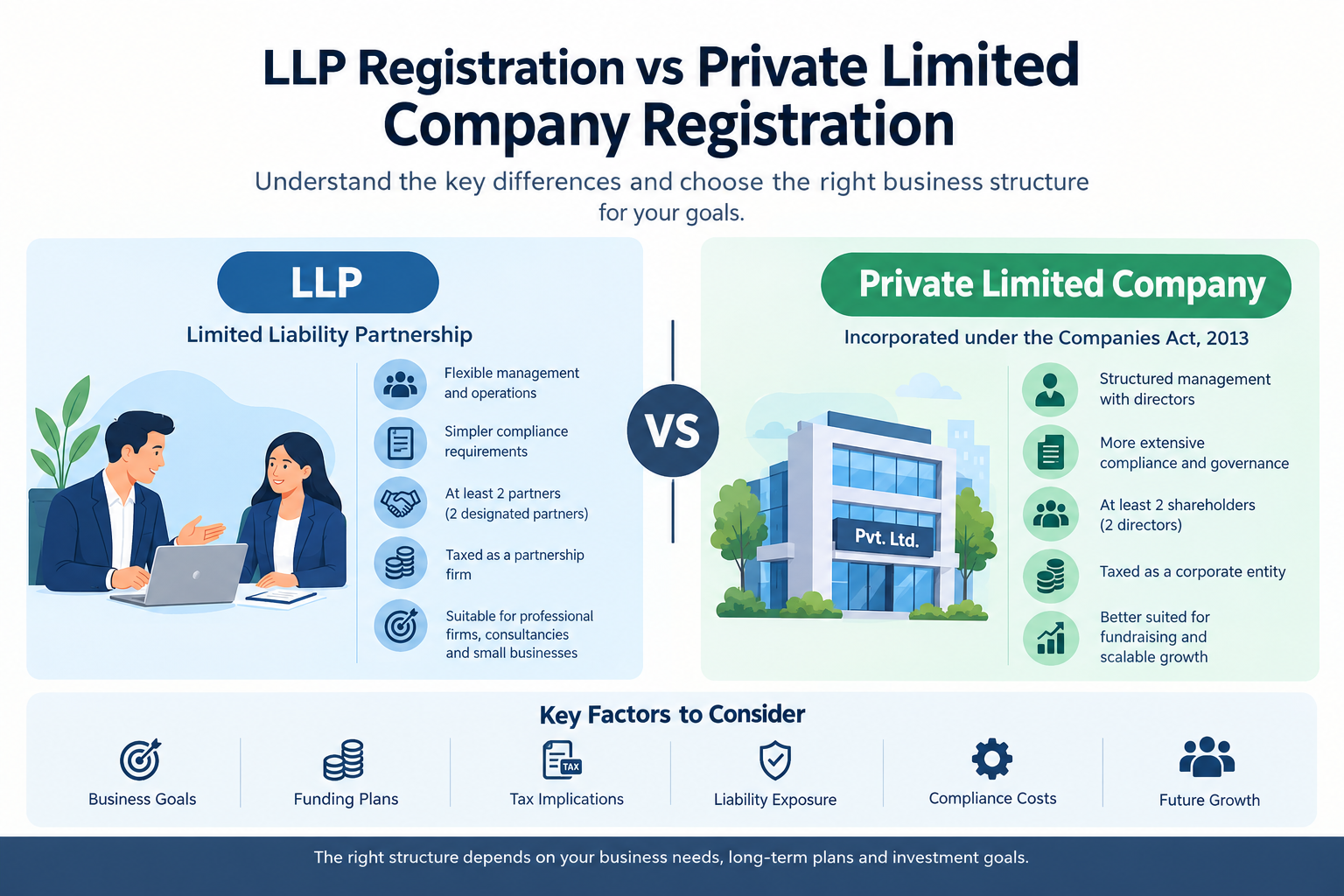
Introduction Choosing the right business structure is one of the most important decisions when starting a business in India. Entrepreneurs often compare Limited Liability Partnership (LLP) registration with Private Limited Company registration because both structures offer limited liability protection but differ in ownership, management, compliance, and fundraising opportunities. An LLP is generally suitable for businesses that prefer flexible management and relatively simpler ongoing compliance. A private limited company may be more appropriate for startups planning to raise investment, issue shares, and expand their operations. Understanding the difference between LLP registration and private limited company registration can help business owners choose a structure that aligns with their business goals, financial plans, and long-term growth strategy.
What Is LLP Registration? LLP registration is the legal process of incorporating a Limited Liability Partnership under the Limited Liability Partnership Act, 2008.
An LLP combines certain features of a traditional partnership with the benefit of limited liability. It is a separate legal entity, meaning it can own property, enter into contracts, and conduct business in its own name.
The partners generally have limited liability, subject to applicable law and exceptions such as their own wrongful acts, fraud, or personal guarantees.
Key Features of LLP Registration: An LLP must have at least two partners.
It must have at least two designated partners, with at least one satisfying the applicable Indian residency requirement.
Partners can agree on how the business will be managed and how profits will be shared.
The LLP has a separate legal identity from its partners.
Partner contributions and profit-sharing arrangements can be defined in the LLP agreement.
Ongoing compliance is generally less extensive than that of a private limited company, although statutory filings and accounting obligations still apply.
LLP registration is often considered by professional service providers, consultants, small businesses, and entrepreneurs who want a flexible business structure.
What Is Private Limited Company Registration? Private limited company registration is the process of incorporating a company under the Companies Act, 2013.
A private limited company is a separate legal entity owned by its shareholders and managed by its directors. It is a popular choice for startups and businesses that intend to attract investors, issue shares, or establish a scalable corporate structure.
Key Features of Private Limited Company Registration: A private company generally requires at least two shareholders and two directors.
At least one director must satisfy the applicable Indian residency requirement.
Shareholders generally have limited liability, subject to applicable law and exceptions.
Ownership is represented by shares.
The company must comply with applicable annual filing, accounting, and corporate governance requirements.
It can issue or transfer shares subject to the Companies Act, its articles of association, and other applicable restrictions.
Private limited companies are commonly used by technology startups, growing enterprises, product businesses, and businesses seeking equity investment.
Difference Between LLP Registration and Private Limited Company Registration The following table highlights the major differences between these two business structures in India.
Basis LLP Registration Private Limited Company Registration Governing law Limited Liability Partnership Act, 2008 Companies Act, 2013 Minimum owners Two partners Two shareholders Management Managed by partners under the LLP agreement Managed by directors under company law Ownership Partner interests and agreed contribution arrangements Ownership represented by shares Limited liability Generally limited to agreed contribution, subject to legal exceptions Generally limited to unpaid share capital, subject to legal exceptions Compliance Generally simpler ongoing corporate compliance More extensive corporate compliance and governance Annual filings Applicable LLP annual returns and statements Applicable annual financial statements and annual returns Fundraising Equity investment is less straightforward Better suited to conventional equity investment Ownership changes Governed by the LLP agreement and applicable law Governed by share transfer rules and company documents Statutory audit Generally required when turnover exceeds ₹40 lakh or contribution exceeds ₹25 lakh, subject to applicable rules Statutory audit generally required regardless of turnover, subject to applicable law Suitable for Professional firms, consultancies, and closely held businesses Startups, growing businesses, and investment-oriented ventures Important: Compliance thresholds and requirements should be checked against current legislation and applicable rules before making a business decision.
LLP vs Private Limited Company: Registration Process. Both structures require incorporation through the Ministry of Corporate Affairs (MCA), but the documentation and statutory requirements differ.
LLP Registration Process: The general steps for registering an LLP are:
Step 1: Obtain Digital Signature Certificates (DSCs)
The relevant individuals need digital signatures to authenticate electronic incorporation documents, as required.
Step 2: Apply for Name Reservation
Choose a suitable name and apply for approval through the applicable MCA process.
Step 3: File Incorporation Documents
Submit the required incorporation application, partner details, registered office information, and supporting documents.
Step 4: Receive the Certificate of Incorporation
Once the Registrar approves the application, the LLP receives its Certificate of Incorporation.
Step 5: Execute and File the LLP Agreement
Prepare the LLP agreement setting out partner rights, contributions, responsibilities, and profit-sharing arrangements. File the prescribed form within the applicable statutory deadline, generally 30 days from incorporation.
Private Limited Company Registration Process: The general steps for private limited company registration are:
Step 1: Obtain Digital Signature Certificates
The proposed directors and other relevant individuals obtain DSCs as required for electronic filing.
Step 2: Apply for Name Approval
Select a compliant company name and apply through the MCA's prescribed incorporation process.
Step 3: File the Incorporation Application
Submit the prescribed incorporation forms, memorandum and articles of association, and required declarations and supporting information.
Step 4: Receive the Certificate of Incorporation
After approval, the company receives its Certificate of Incorporation and applicable identification details.
Step 5: Complete Post-Incorporation Formalities
Complete applicable requirements, such as opening a bank account, depositing subscribed share capital where required, and filing the commencement of business declaration within the prescribed period when Section 10A applies.
Both registration processes require accurate documentation and compliance with the applicable MCA procedures.
What Is the Difference in Registration Cost? The cost of LLP registration and private limited company registration depends on several factors, including government fees, stamp duty, professional fees, digital signature costs, and the complexity of the incorporation.
An LLP may be less expensive to maintain because it generally has fewer corporate governance requirements. A private limited company may involve higher ongoing compliance expenses because of its statutory audit and corporate filing obligations.
However, there is no single fixed registration cost applicable to every business. Government charges can vary depending on the state, contribution or share capital, and the applicable filing requirements.
Before registering, request a cost breakdown that separates government fees, stamp duty, professional charges, and annual compliance costs.
Taxation: LLP vs Private Limited Company Tax treatment is another important factor when choosing between LLP registration and private limited company registration.
Taxation of an LLP An LLP is generally taxed as a partnership firm under the Income-tax Act, 1961. The applicable income-tax rate, surcharge, cess, and deductions depend on the law in force and the LLP's circumstances.
Payments such as partner remuneration and interest on capital may be deductible only when the applicable statutory conditions are satisfied.
Taxation of a Private Limited Company: A private limited company is generally taxed under the corporate tax provisions. Eligible domestic companies may be able to opt for concessional tax regimes, subject to the relevant conditions.
The overall tax outcome depends on the applicable tax regime, deductions, business profits, and the way profits are distributed to owners.
Which structure is more tax-efficient? There is no universal answer. Compare the current tax rules, expected profits, remuneration, distributions, and reinvestment plans with a qualified tax professional before deciding.
Which Business Structure Is Better for Startups? The right choice depends on the startup's funding strategy, ownership arrangements, and operational needs.
When Should You Choose an LLP? An LLP may be suitable when:
You are starting a consultancy or professional services firm.
Two or more partners want flexible management arrangements.
You prefer a comparatively simpler compliance structure.
You do not expect to raise conventional equity funding in the near future.
You want to define responsibilities and profit-sharing through an LLP agreement.
When Should You Choose a Private Limited Company? A private limited company may be suitable when:
You plan to raise funding from angel investors or venture capital firms.
You want to issue shares to co-founders, employees, or investors, subject to applicable law.
You plan to scale operations across multiple markets.
You want a corporate structure that supports equity-based ownership arrangements.
You expect future ownership changes or investment rounds.
A private limited company is often preferred by investment-oriented startups, but an LLP may still be the better choice for businesses prioritising flexibility and simpler administration.
Can an LLP Be Converted into a Private Limited Company? An LLP may be able to convert into a company under the applicable provisions of the Companies Act, 2013, and related rules, subject to eligibility, procedural requirements, and the circumstances of the business.
Conversion may involve documentation, approvals, filing requirements, and consequences for existing contracts, assets, liabilities, licences, and tax positions.
Business owners should evaluate these matters before choosing an initial structure. Conversion should not be assumed to be automatic or free of legal and tax implications.
Common Mistakes to Avoid When Choosing a Business Structure: Before proceeding with LLP registration or private limited company registration, avoid these common mistakes:
Choosing only on registration cost: Consider long-term compliance and administrative expenses.
Ignoring fundraising plans: Equity investment may be easier to structure through a private limited company.
Overlooking tax implications: Compare the expected tax treatment under current law.
Not documenting ownership clearly: Prepare an appropriate LLP agreement or company constitutional documents.
Ignoring annual compliance: Both structures have continuing statutory obligations.
Selecting a structure without professional advice: Consider your business model, liability exposure, ownership plans, and regulatory requirements.
Frequently Asked Questions (FAQs)
-
Is an LLP better than a private limited company? An LLP may suit professional firms, consultants, and businesses that prefer flexible management and simpler compliance. A private limited company may suit businesses seeking equity funding and scalable, share-based ownership. The best choice depends on individual business needs.
-
What is the minimum number of partners required for an LLP? An LLP requires at least two partners and at least two designated partners. At least one designated partner must satisfy the applicable residency requirement under Indian law.
-
What is the minimum number of directors required for a private limited company? A private limited company generally requires at least two directors and at least two members or shareholders. At least one director must meet the applicable Indian residency requirement.
-
Which has lower compliance requirements: LLP or private limited company? An LLP generally has fewer corporate governance and filing requirements. However, it must still comply with applicable annual filings, accounting requirements, tax laws, and audit rules.
-
Can a private limited company raise investment more easily than an LLP? A private limited company is generally better suited to conventional equity fundraising because investors can acquire shares. An LLP can accept funding through legally permitted arrangements, but its structure may be less convenient for some institutional investors.
-
Is an audit mandatory for an LLP? An LLP's accounts are generally subject to statutory audit when its turnover exceeds ₹40 lakh or its contribution exceeds ₹25 lakh, subject to applicable rules and exemptions. A private limited company is generally subject to statutory audit regardless of turnover.
-
Can a small business register as a private limited company? Yes. A small business can register as a private limited company if it meets the applicable incorporation requirements. The owners should consider the ongoing compliance obligations before selecting this structure.
-
Can I change my business from an LLP to a private limited company later? Conversion may be possible under the applicable legal framework, but it involves prescribed procedures and eligibility conditions. Legal, tax, contractual, and regulatory implications should be assessed beforehand.
Conclusion: Both LLP registration and private limited company registration provide a recognised legal structure for operating a business in India. The main difference lies in ownership, management, compliance, fundraising flexibility, and long-term business objectives.
An LLP may suit partners seeking flexible management and comparatively simpler compliance. A private limited company may be more appropriate for startups and businesses planning to attract equity investors or expand through share-based ownership.
Before making a final decision, evaluate the registration process, ongoing compliance costs, taxation, liability exposure, and future funding requirements.
Planning to start a business in India? Consult a qualified company secretary, chartered accountant, or legal professional to determine which structure best fits your business goals.