



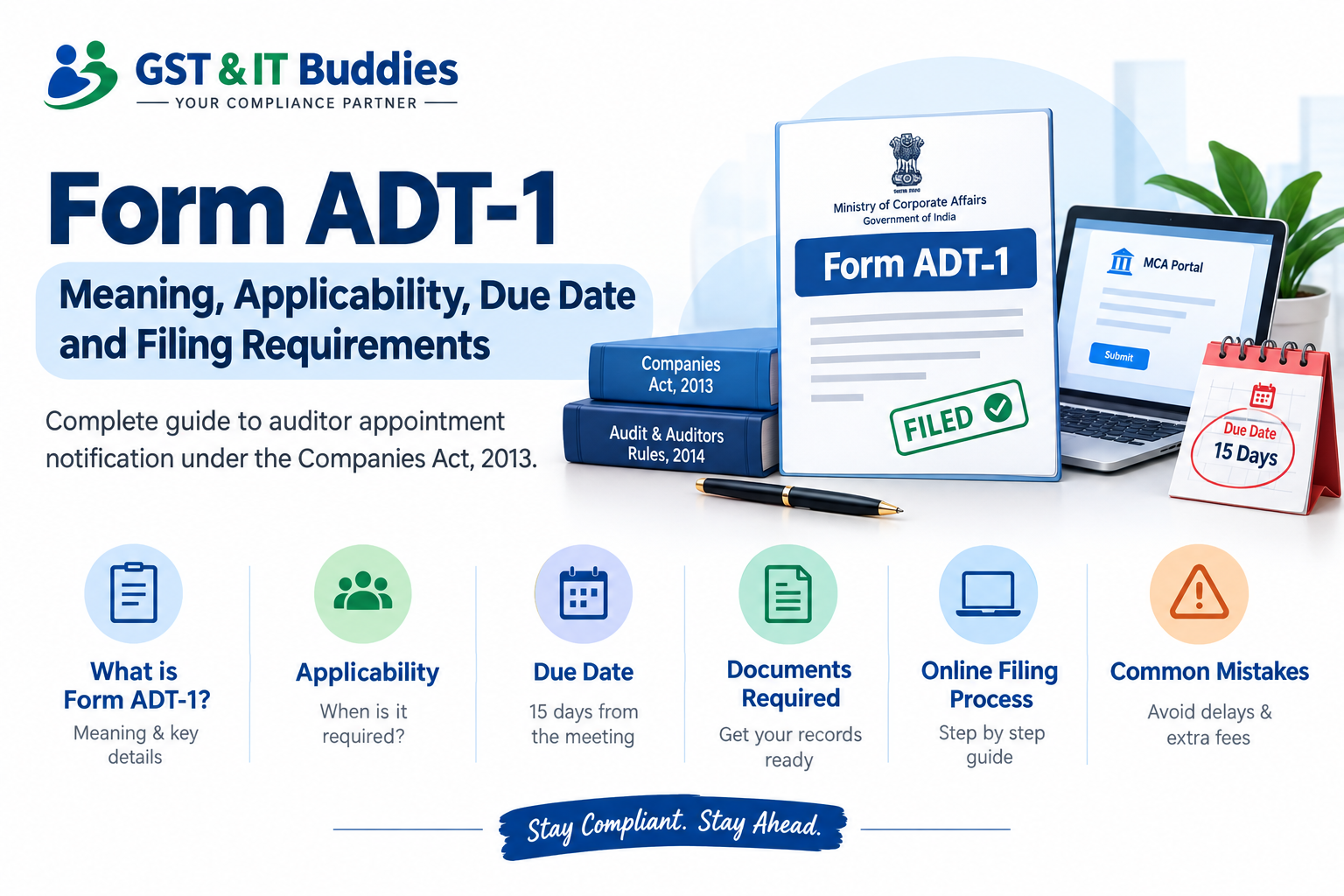
Introduction Appointing a statutory auditor is an important compliance requirement for companies in India. After appointing an auditor, a company may also need to notify the Registrar of Companies (ROC) by filing the prescribed form with the Ministry of Corporate Affairs (MCA). Form ADT-1 is the prescribed form for notifying the ROC of an auditor appointment. It is governed by Section 139 of the Companies Act, 2013, read with Rule 4(2) of the Companies (Audit and Auditors) Rules, 2014. Directors, business owners, accountants, and company compliance professionals should understand Form ADT-1. Incorrect filing or missing a statutory deadline can result in additional filing fees and compliance complications. In this guide, we explain the meaning of Form ADT-1, its applicability, due date, documents required, and the online filing process
What Is Form ADT-1? Form ADT-1 is an electronic form filed with the Registrar of Companies to communicate the appointment of a company's statutory auditor.
It helps the ROC maintain records of the auditor appointed by the company for the relevant financial year or period.
The form generally contains information about:
The company and its Corporate Identification Number (CIN).
The date and nature of the auditor's appointment.
The auditor's name and professional membership details.
The auditor's firm details, where applicable.
The period for which the auditor has been appointed.
Other information required by the applicable e-form.
Legal provisions: Section 139 of the Companies Act, 2013, and Rule 4(2) of the Companies (Audit and Auditors) Rules, 2014.
The MCA revised Form ADT-1 through the Companies (Audit and Auditors) Amendment Rules, 2025, effective from 14 July 2025. Companies should therefore use the applicable revised form and its current instruction kit when filing.
Applicability of Form ADT-1: Form ADT-1 is relevant when a company is required to notify the ROC about the appointment of its statutory auditor under the applicable provisions of the Companies Act, 2013.
Common appointment situations include:
- Appointment of an Auditor at the AGM: Under Section 139(1), members appoint an auditor at the company's first Annual General Meeting (AGM) and subsequently in accordance with the applicable auditor appointment and rotation provisions.
The company is required to inform the ROC of the appointment within the prescribed period.
-
Reappointment of an Auditor: When an auditor is reappointed at an AGM, the company should examine the applicable filing requirements and submit Form ADT-1 where required.
-
Appointment or Reappointment in Other Circumstances The revised ADT-1 includes options for different appointment situations, such as appointments involving the CAG, a casual vacancy, non-reappointment or removal, and certain appointments by the Central Government or Tribunal.
However, the appearance of an option in the form should not automatically be treated as proof that filing is legally mandatory in every situation. The applicable statutory provision must be checked.
Important clarification regarding the first auditor: The appointment of the first auditor by the Board is governed by Section 139(6), while the appointment by members in certain circumstances is governed by the relevant provisions of Section 139.
The traditional interpretation of Rule 4(2) links the prescribed ADT-1 filing requirement to appointments under Section 139(1). The revised 2025 form introduced options for first-auditor appointments, creating uncertainty about the filing requirement in some cases.
On 16 April 2026, the Institute of Company Secretaries of India (ICSI) sought clarification from the MCA regarding the applicability of ADT-1 to the first auditor and certain casual-vacancy appointments.
Therefore, companies should verify the latest MCA clarification and applicable legal requirements before deciding whether ADT-1 is required for these appointments.
Who Needs to File Form ADT-1? The responsibility for filing Form ADT-1 rests with the company, where filing is required.
The company's directors and authorised representatives should ensure that the auditor's appointment is properly documented and that the prescribed e-form is filed within the applicable timeline.
The statutory auditor provides the professional details and other information required for completing the form. However, the company's filing obligation should not be confused with the auditor's professional responsibilities.
Form ADT-1 Due Date: The prescribed deadline for notifying the ROC of an auditor's appointment under Section 139(1) is within 15 days of the meeting in which the auditor is appointed.
For an appointment made at an AGM, the deadline is calculated with reference to the date of that AGM.
Example of ADT-1 Due Date: Suppose ABC Private Limited holds its AGM on 30 September 2026 and appoints its statutory auditor at that meeting.
Date of appointment: 30 September 2026
Prescribed filing period: 15 days
Illustrative filing deadline: 15 October 2026
The company should complete the filing within the applicable statutory period, taking account of the relevant rules for calculating deadlines.
For first-auditor appointments, casual vacancies and other appointment situations, the deadline and filing obligation should be determined separately after checking the applicable statutory provisions and current MCA guidance.
Documents and Information Required for Form ADT-1: Before starting the filing process, the company should keep the following information and supporting records ready, as applicable.
Company details: Corporate Identification Number (CIN).
Company name and registered office address.
Company email address.
Auditor details: Name of the auditor or audit firm.
Membership number of the individual auditor.
Firm Registration Number (FRN), where applicable.
PAN and contact details, as required by the form.
Registered or professional address details.
Appointment details: Date of appointment.
Date of the AGM, where applicable.
Nature of the appointment.
Period for which the auditor has been appointed.
Number of financial years covered by the appointment.
Details of previous tenure, where required.
Supporting documents: Depending on the nature of the appointment and the current form requirements, relevant documents may include:
Copy of the resolution or other appointment record.
Auditor's consent to act as auditor.
Certificate of eligibility or other prescribed declarations, where applicable.
Other attachments specified in the current MCA instruction kit.
The company should check the latest ADT-1 form and instruction kit before submission because mandatory fields and attachment requirements may vary with the appointment type.
How to File Form ADT-1 Online on the MCA Portal: Companies can follow these general steps to file Form ADT-1 electronically.
Step 1: Visit the MCA Portal. Open the official Ministry of Corporate Affairs website at https://www.mca.gov.in/ and access the company e-filing services.
Step 2: Select Form ADT-1. Locate Form ADT-1 under the applicable company filing services and open the current version of the form.
Step 3: Enter Company Information. Provide the company's CIN and verify the company name, registered office address, and email address.
Step 4: Enter Appointment Details. Select the applicable nature of appointment and enter the relevant meeting date, appointment date, and audit period.
Step 5: Provide Auditor Information. Enter the auditor's name, membership number, PAN, and address. If an audit firm has been appointed, provide the firm's details and FRN wherever required.
Step 6: Attach the Required Documents. Upload the prescribed supporting documents in the format and size permitted by the portal.
Step 7: Verify and Submit. Review the form carefully before submission. Check the appointment details, professional information, and attachments for accuracy.
Step 8: Complete Authentication and Payment. Complete the prescribed digital authentication and filing process, including payment of the applicable government fee.
Save the Service Request Number (SRN) and filing acknowledgement for the company's compliance records.
Government Fees and Additional Fees for Delayed Filing: The government filing fee depends on the applicable fee rules and the company's prescribed filing category.
Late filing may attract additional fees under the Companies (Registration Offices and Fees) Rules, 2014, as applicable.
The precise amount should be checked against the current MCA fee schedule and the portal's calculation at the time of filing. Avoid relying on outdated fee tables or assuming that all companies pay the same amount.
Common Mistakes to Avoid While Filing Form ADT-1: Companies should avoid the following errors when preparing and submitting Form ADT-1:
-
Missing the filing deadline: Calculate the deadline from the relevant appointment meeting and verify the applicable legal provision.
-
Entering incorrect auditor details: Confirm the auditor's membership number, PAN, and other professional information.
-
Selecting the wrong appointment category: Choose the category that matches the actual appointment and supporting resolution.
-
Providing an incorrect audit period: Ensure that the period entered in the form matches the appointment decision.
-
Missing supporting documents: Review the current instruction kit and attach all documents required for the particular appointment.
-
Ignoring revised MCA forms: Use the current version of Form ADT-1 rather than an outdated downloaded copy.
-
Assuming every appointment has identical filing requirements: Check the applicable provisions for first auditors, AGM appointments, casual vacancies, and other special cases.
Why Is Form ADT-1 Important for Companies? Timely and accurate filing of Form ADT-1 helps a company maintain proper statutory records and demonstrate compliance with the applicable auditor appointment requirements.
It also helps reduce the risk of additional filing fees, incomplete compliance records, and avoidable difficulties during future corporate filings.
Companies should maintain a copy of the appointment resolution, auditor consent, submitted form and filing acknowledgement in their statutory records, as applicable.
Frequently Asked Questions About Form ADT-1
-
What is the full form of ADT-1? ADT-1 is the prescribed e-form used by a company to notify the Registrar of Companies about the appointment of an auditor.
-
Under which section is Form ADT-1 filed? Form ADT-1 is prescribed under Rule 4(2) of the Companies (Audit and Auditors) Rules, 2014, read with the applicable provisions of Section 139 of the Companies Act, 2013.
-
What is the due date for filing Form ADT-1? For an auditor appointed under Section 139(1), the company must notify the ROC within 15 days of the meeting at which the appointment is made.
-
Is Form ADT-1 required for reappointment of an auditor? Where the auditor is reappointed at an AGM under Section 139(1), the company must comply with the applicable ADT-1 filing requirement.
-
Is Form ADT-1 mandatory for the first auditor? The requirement should be checked carefully. The revised 2025 form includes a first-auditor appointment category, but questions have been raised regarding the underlying statutory filing obligation. Companies should verify the latest MCA clarification before deciding whether filing is required in their specific circumstances.
-
What happens if Form ADT-1 is filed late? Late filing may attract additional government fees under the applicable fee rules. The company should calculate the applicable amount using the current MCA requirements.
-
Can Form ADT-1 be filed online? Yes. Form ADT-1 is filed electronically through the Ministry of Corporate Affairs portal.
-
Who is responsible for filing Form ADT-1? The company is responsible for filing the form where it is required. Directors, authorised representatives or compliance professionals may coordinate the filing on the company's behalf.
Conclusion: Form ADT-1 is an important part of statutory auditor appointment compliance under the Companies Act, 2013. Companies should understand when the form applies, calculate the relevant filing deadline, verify the auditor's details, and use the latest MCA form.
While the general deadline for appointments under Section 139(1) is 15 days from the appointment meeting, special cases—including first-auditor appointments—require careful consideration of the applicable legal provisions and current MCA guidance.
For accurate compliance, businesses should review the latest statutory requirements before submitting the form.
Need help with company compliance and ROC filings?
GST & IT Buddies provides professional support for business compliance, accounting, taxation, and corporate filing requirements. Contact our team to discuss your company's compliance needs.
Website: https://gstnitbuddies.com/
Email: sales@gstnitbuddies.com
Disclaimer: This article is for general informational purposes and is not a substitute for professional legal or company-secretarial advice. Verify the latest MCA rules, forms, fee schedule, and clarifications before filing.