

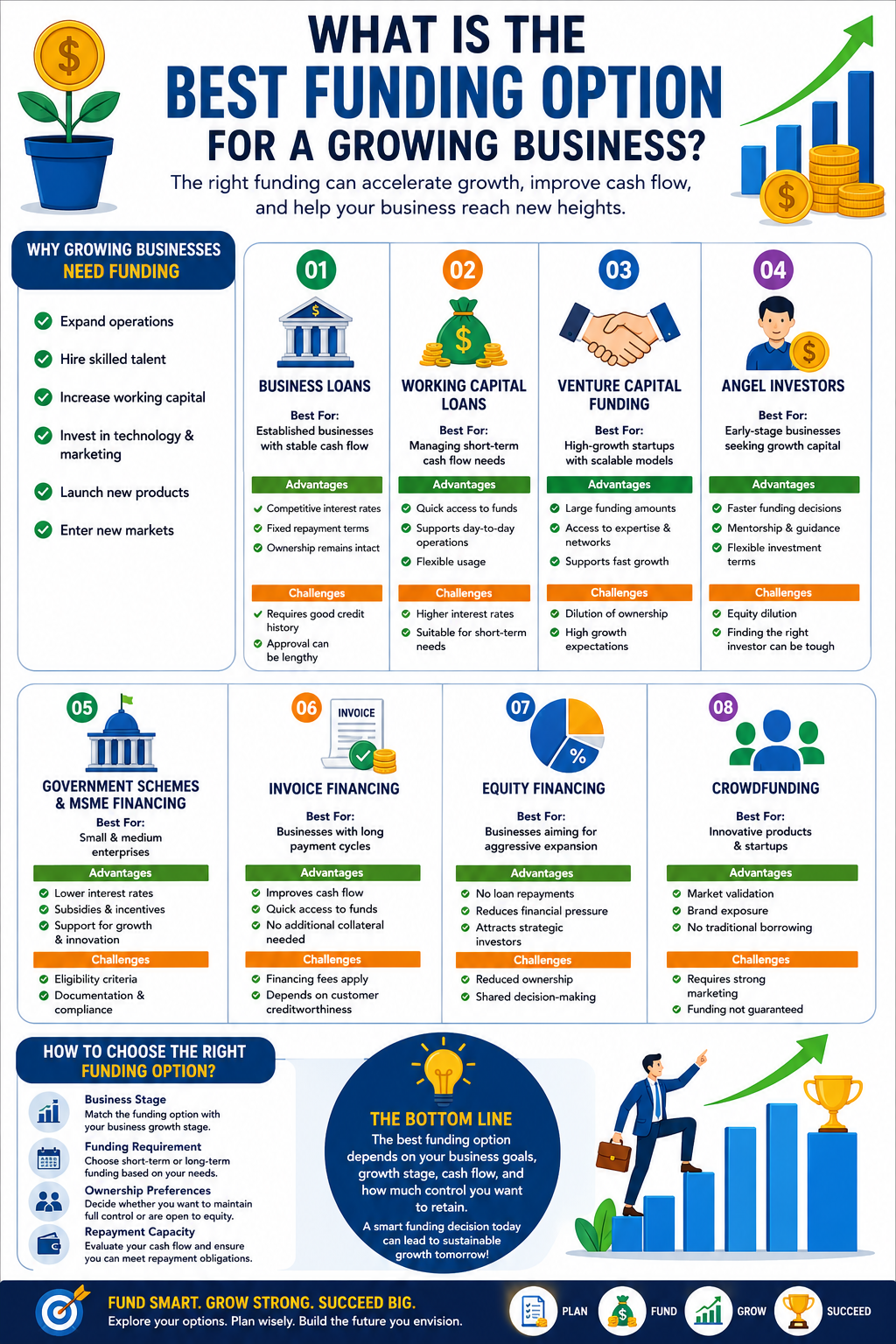
Every growing business reaches a stage where additional capital becomes essential to expand operations, hire talent, purchase equipment, increase inventory, or enter new markets. While growth is exciting, choosing the right funding option can significantly impact a company's financial health and future success.
Why Growing Businesses Need Funding
As a business expands, expenses often increase faster than revenue. Additional funding can help businesses:
- Expand operations
- Launch new products or services
- Increase working capital
- Purchase machinery and equipment
- Hire skilled employees
- Invest in marketing and technology
- Enter new geographical markets
Without adequate funding, growth opportunities may be missed, limiting business potential.
1. Business Loans
Best For:
Established businesses with predictable cash flow.
Business loans remain one of the most popular funding options for growing companies. Banks and financial institutions provide term loans that can be used for expansion, equipment purchases, or operational expenses.
Advantages:
✅ Fixed repayment schedule
✅ Ownership remains intact
✅ Competitive interest rates
✅ Suitable for long-term investments
Challenges:
❌ Requires good credit history
❌ Documentation and approval process can be lengthy
❌ Regular EMI obligations
2. Working Capital Loans
Best For:
Businesses facing short-term cash flow gaps.
Working capital loans help companies manage daily operational expenses such as salaries, rent, inventory, and supplier payments.
Advantages:
✅ Quick access to funds
✅ Supports day-to-day operations
✅ Flexible usage
Challenges:
❌ Higher interest rates compared to traditional loans
❌ Generally suitable for short-term requirements
3. Venture Capital Funding
Best For:
High-growth startups with scalable business models.
Venture capital firms invest in businesses with significant growth potential in exchange for equity ownership.
Advantages:
✅ Large funding amounts
✅ Access to industry expertise
✅ Valuable business networks
Challenges:
❌ Dilution of ownership
❌ Investor involvement in decision-making
❌ High growth expectations
4. Angel Investors
Best For:
Early-stage businesses seeking growth capital.
Angel investors are individuals who invest personal funds into promising startups.
Advantages:
✅ Faster funding decisions
✅ Mentorship opportunities
✅ Flexible investment structures
Challenges:
❌ Equity dilution
❌ Finding the right investor can be difficult
5. Government Schemes and MSME Financing
Best For:
Small and medium-sized enterprises.
Governments offer various funding programs to support business growth, innovation, and employment generation.
Examples include:
- MSME Loans
- Credit Guarantee Schemes
- Startup Funding Programs
- Export Promotion Schemes
Advantages:
✅ Lower interest rates
✅ Subsidies and incentives
✅ Easier access for small businesses
Challenges:
❌ Eligibility requirements
❌ Documentation and compliance obligations
6. Invoice Financing
Best For:
Businesses with long payment cycles.
Invoice financing allows companies to receive funds against unpaid customer invoices.
Advantages:
✅ Improves cash flow
✅ Quick access to working capital
✅ No need for additional collateral
Challenges:
❌ Financing fees apply
❌ Depends on customer creditworthiness
7. Equity Financing
Best For:
Businesses aiming for aggressive expansion.
Equity financing involves raising capital by selling shares of the company.
Advantages:
✅ No loan repayments
✅ Reduces financial pressure
✅ Can attract strategic investors
Challenges:
❌ Reduced ownership percentage
❌ Shared decision-making authority
8. Crowdfunding
Best For:
Innovative products and startups.
Crowdfunding platforms enable businesses to raise small amounts from a large number of people.
Advantages:
✅ Market validation
✅ Brand awareness
✅ No traditional borrowing requirements
Challenges:
❌ Requires strong marketing efforts
❌ Funding success is not guaranteed
How to Choose the Right Funding Option
Before selecting a funding source, consider:
Business Stage
- Startup → Angel Investors, Crowdfunding
- Growing Business → Business Loans, Working Capital Loans
- High-Growth Startup → Venture Capital
Funding Requirement
- Short-term needs → Working Capital Loan
- Long-term expansion → Business Loan or Equity Funding
Ownership Preferences
- Want full control? → Debt financing
- Comfortable sharing ownership? → Equity financing
Repayment Capacity
Evaluate cash flow carefully before taking on debt obligations.
Which Funding Option Is Best?
There is no one-size-fits-all answer.
For most growing businesses, a combination of business loans, working capital financing, and government-backed MSME schemes offers the best balance between affordability and control.
High-growth startups may benefit more from venture capital or angel investment, while businesses with strong receivables can leverage invoice financing to improve cash flow.
The ideal funding strategy aligns with your growth objectives, financial position, and risk tolerance.
Conclusion
Funding is often the fuel that drives business growth. Whether you're expanding operations, launching new products, or entering new markets, choosing the right financing option can accelerate success while maintaining financial stability.
Before making a decision, assess your business needs, compare funding alternatives, and evaluate both short-term and long-term implications. The right funding choice today can lay the foundation for sustainable growth tomorrow.
Frequently Asked Questions (FAQs)
1. What is the cheapest funding option for a business?
Government-backed MSME loans and traditional bank loans generally offer the lowest interest rates.
2. Is equity financing better than a loan?
It depends. Equity financing avoids repayments but reduces ownership, while loans preserve ownership but require regular repayments.
3. Can startups get funding without revenue?
Yes. Angel investors, venture capital firms, and crowdfunding platforms often fund promising startups before they generate revenue.
4. What is working capital financing?
It is short-term funding used to manage daily operational expenses and cash flow requirements.
5. How much funding should a growing business raise?
Businesses should raise enough capital to achieve growth objectives while avoiding excessive debt or ownership dilution.