
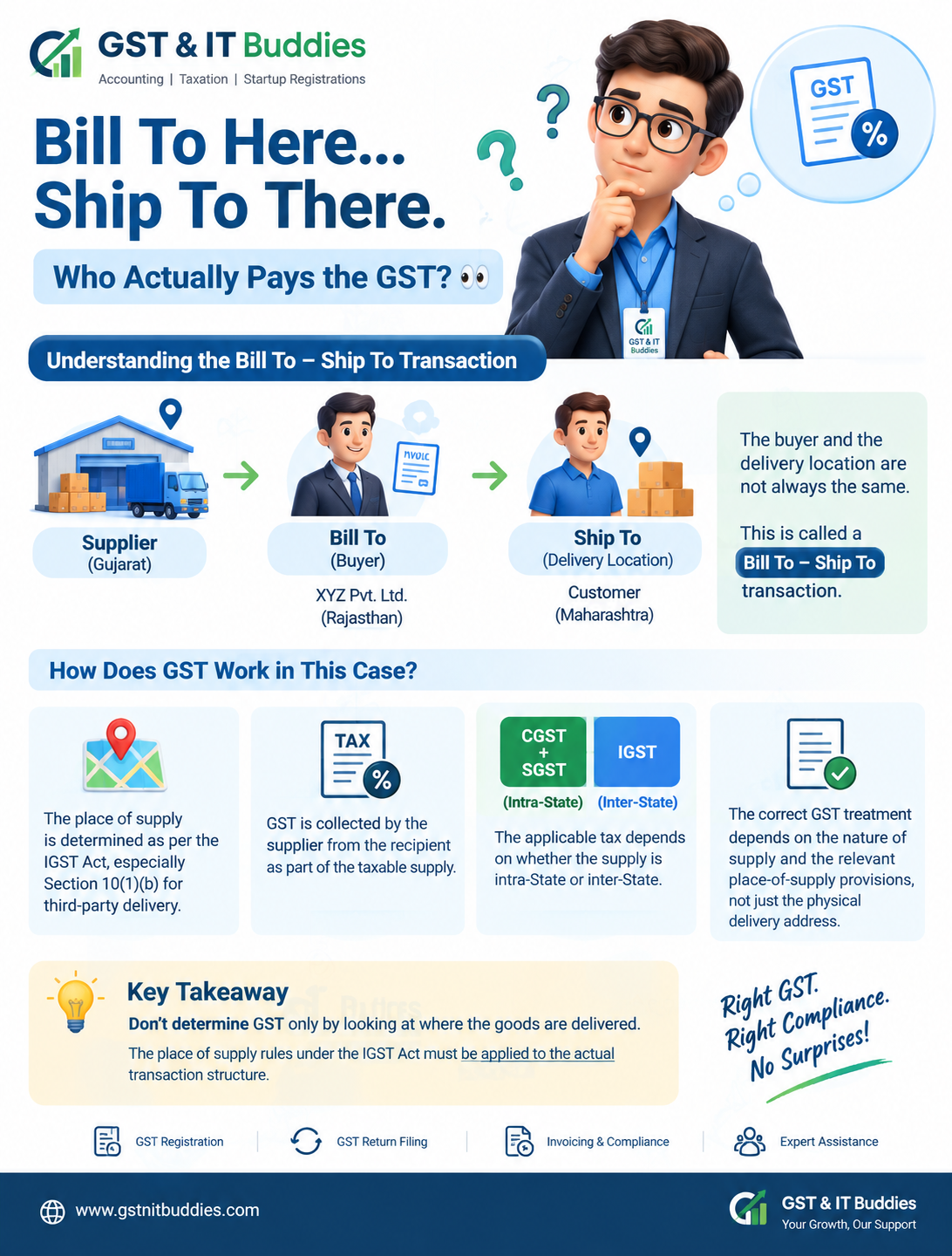
Bill To Here… Ship To There. Who Actually Pays the GST? 👀 In business transactions, the person who receives the invoice and the location where the goods are physically delivered are not always the same. This is commonly known as a “Bill To – Ship To” transaction. For example, a company in Rajasthan may purchase goods from a supplier in Gujarat but instruct the supplier to deliver those goods directly to its customer in Maharashtra. In such cases, businesses often ask:
Which state determines the GST? Should the supplier charge CGST + SGST or IGST? Which address matters for GST?
The answer depends on the place of supply rules under GST and the specific structure of the transaction.
What Is a Bill To – Ship To Transaction?
A Bill To – Ship To transaction occurs when:
- The Bill To party is the person who purchases the goods and receives the invoice.
- The Ship To party is the person or location where the goods are actually delivered.
- The supplier may deliver the goods directly to the Ship To location on the instructions of the Bill To party.
The Bill To and Ship To addresses can therefore be different.
Simple Example
Suppose:
- Supplier: ABC Traders, Gujarat
- Buyer / Bill To: XYZ Pvt. Ltd., Rajasthan
- Delivery / Ship To: XYZ's customer in Maharashtra
XYZ purchases the goods from ABC Traders and asks ABC Traders to ship them directly to its customer in Maharashtra.
Here, the billing party and delivery location are different.
This is where GST place of supply rules become important.
How Does GST Work in a Bill To – Ship To Transaction?
Under Section 10(1)(b) of the IGST Act, where goods are delivered by the supplier to the recipient or another person on the direction of a third person, the third person is deemed to have received the goods for determining the place of supply. The place of supply is generally linked to the principal place of business of that third person.
In simple terms:
Supplier → Bill To Party → Ship To Party
The GST treatment does not automatically depend only on where the goods physically end up.
The specific statutory place-of-supply rule applicable to the transaction must be examined.
Who Actually Pays the GST?
A common misunderstanding is that the person receiving the goods physically must always bear or determine the GST.
That is not necessarily the case.
GST is generally collected by the supplier from the recipient as part of the taxable supply, and the applicable tax type—CGST + SGST or IGST—depends on whether the supply is intra-State or inter-State after applying the place-of-supply rules.
CBIC describes GST as a destination-based tax, with the place of supply helping determine the jurisdiction to which the tax accrues.
Therefore, businesses should not determine GST merely by looking at the physical delivery address.
Bill To vs Ship To: Why the Difference Matters
| Particular | Bill To | Ship To |
|---|---|---|
| Who is it? | Person purchasing the goods | Person/location receiving the goods |
| Receives invoice? | Yes | Not necessarily |
| Makes commercial purchase? | Generally yes | May simply receive delivery |
| Determines GST by itself? | No | No |
| Relevant for documentation? | Yes | Yes |
| Relevant to place of supply? | Depends on transaction structure | Physical delivery location may be relevant under applicable rules |
The correct GST treatment depends on the legal structure of the supply and the applicable place-of-supply provisions.
CGST + SGST or IGST?
This is one of the most important questions in a Bill To – Ship To transaction.
Generally:
Intra-State Supply
If the location of the supplier and the applicable place of supply are in the same State or Union Territory, the supply is generally treated as intra-State and CGST + SGST/UTGST applies.
Inter-State Supply
If the location of the supplier and the applicable place of supply are in different States or Union Territories, the supply is generally treated as inter-State and IGST applies.
CBIC explains that the place of supply is used to determine whether a transaction is intra-State or inter-State and therefore whether CGST/SGST or IGST applies.
Example of a Bill To – Ship To Transaction
Let's understand this with a practical example.
Transaction
ABC Ltd. is located in Gujarat.
ABC purchases goods from Supplier X, also located in Gujarat.
ABC asks Supplier X to deliver the goods directly to ABC's customer in Maharashtra.
The structure is:
Supplier X – Gujarat
↓
Bill To: ABC Ltd. – Gujarat
↓
Ship To: Customer – Maharashtra
At first glance, someone may assume that IGST must apply because the goods physically travel from Gujarat to Maharashtra.
However, under the specific Bill To – Ship To provision, the place of supply is determined with reference to the third person who directed the delivery, subject to the statutory conditions.
Therefore, businesses should examine the applicable place-of-supply provision rather than determining GST solely from the physical movement of goods.
What Should Be Mentioned on the GST Invoice?
GST invoice documentation is important in these transactions.
CBIC's invoice rules require prescribed details such as the supplier's GSTIN, recipient details, description and value of goods, tax rate and amount, and place of supply where applicable. The rules also provide for the delivery address where it differs from the place of supply.
For a Bill To – Ship To transaction, businesses should ensure that:
- Bill To details are correctly recorded.
- Ship To/delivery details are correctly recorded.
- GSTINs are entered accurately where applicable.
- Place of supply is correctly determined.
- Correct GST—CGST + SGST/UTGST or IGST—is charged.
- Supporting documents and transportation details are consistent.
What About the E-Way Bill?
The Bill To – Ship To structure is also relevant while generating an e-way bill.
The e-way bill system provides separate fields for Billing To and Ship To information.
CBIC's e-way bill FAQ specifically explains that the Billing To GSTIN and trade name are entered separately from the Ship To destination address. It also states that where the Ship To State differs from the Bill To State, the tax components are entered according to the applicable billing-party/place-of-supply treatment rather than simply following the physical movement of goods.
This makes accurate documentation especially important.
Common Mistakes in Bill To – Ship To Transactions
Businesses should avoid these common errors:
1. Looking Only at the Delivery Address
The physical destination alone may not determine the GST treatment.
2. Automatically Charging IGST
Goods moving across State borders do not mean that IGST should automatically be charged in every Bill To – Ship To arrangement.
The applicable place-of-supply provision must be checked.
3. Incorrect GSTIN
Incorrect Bill To or Ship To details can create reconciliation and compliance problems.
4. Mismatch Between Invoice and E-Way Bill
The invoice and e-way bill should contain consistent transaction information.
5. Ignoring Place of Supply
Place of supply is critical because it helps determine the nature of the supply and applicable tax.
6. Confusing Bill To With Ship To
The person receiving the invoice and the person/location receiving the goods may be different.
Bill To – Ship To vs Bill From – Dispatch From
These terms are sometimes confused.
Bill To – Ship To
This concerns the recipient/buyer and delivery destination.
Example:
Bill To: Buyer A
Ship To: Customer B
Bill From – Dispatch From
This concerns the supplier and the location from which the goods are physically dispatched.
For example:
Bill From: Supplier's registered business
Dispatch From: Supplier's warehouse
The e-way bill system provides separate fields for these situations.
Why Is Place of Supply So Important?
The place of supply determines the appropriate GST treatment for a transaction.
It can affect:
- Whether the transaction is intra-State or inter-State
- Whether CGST + SGST/UTGST or IGST applies
- Tax reporting
- Invoice preparation
- E-way bill details
- Input tax credit documentation
- GST reconciliation
For this reason, businesses should determine the place of supply before finalising the tax treatment.
Quick Checklist for Businesses
Before issuing an invoice for a Bill To – Ship To transaction, check:
✅ Who is the actual recipient/buyer?
✅ Who instructed the supplier to deliver the goods?
✅ Where is the Bill To party located?
✅ Where are the goods being delivered?
✅ What is the applicable place of supply?
✅ Is the transaction intra-State or inter-State?
✅ Should CGST + SGST/UTGST or IGST be charged?
✅ Are the invoice and e-way bill details consistent?
✅ Are the GSTIN and delivery details correct?
Final Takeaway
A Bill To – Ship To transaction can look simple, but its GST treatment requires careful consideration.
The key point is:
Don't determine GST only by looking at where the goods are physically delivered.
The place of supply rules under the IGST Act must be applied to the actual transaction structure. In the specific third-party delivery situation covered by Section 10(1)(b), the law provides a special rule for determining the place of supply.
For businesses regularly dealing with distributors, dealers, customers, warehouses or third-party deliveries, getting the Bill To – Ship To structure right can help avoid GST reporting and documentation issues.
Need help with GST registration, GST return filing, invoicing or tax compliance? Connect with GST & IT Buddies for professional assistance.
Frequently Asked Questions
1. What does Bill To – Ship To mean in GST?
It means the party receiving the invoice or purchasing the goods (Bill To) is different from the person or location where the goods are delivered (Ship To).
2. Does the Ship To address decide the GST rate?
Not by itself. The applicable GST treatment depends on the nature of the supply and the relevant place-of-supply provisions.
3. Is IGST always applicable when Bill To and Ship To States are different?
No. Businesses should apply the relevant place-of-supply rules rather than assuming IGST solely because the Bill To and Ship To locations are different.
4. Can Bill To and Ship To have different addresses?
Yes. GST invoice rules recognise situations where the delivery address can differ from the place of supply.
5. Is Bill To – Ship To allowed under GST?
Yes, GST law specifically provides for situations where goods are delivered to a recipient or another person on the direction of a third person.
6. What is the most important factor in determining GST?
The place of supply, along with the location of the supplier and the applicable GST provisions, is critical for determining the nature and tax treatment of the supply.