

Investing helps you grow your wealth, but it also comes with tax responsibilities. Whether you invest in stocks, mutual funds, bonds, fixed deposits, or other financial instruments, keeping the right financial reports is essential for accurate income tax filing. Maintaining organized investment records not only simplifies tax filing but also helps you avoid errors, penalties, and notices from the Income Tax Department.In this guide, we'll discuss the important reports every investor should save for future tax filing.
Why Is It Important to Save Investment Reports?
Keeping investment reports allows you to:
- File your Income Tax Return (ITR) accurately
- Calculate capital gains correctly
- Claim eligible deductions and exemptions
- Report dividend and interest income
- Respond quickly to tax notices if required
- Maintain proper financial records
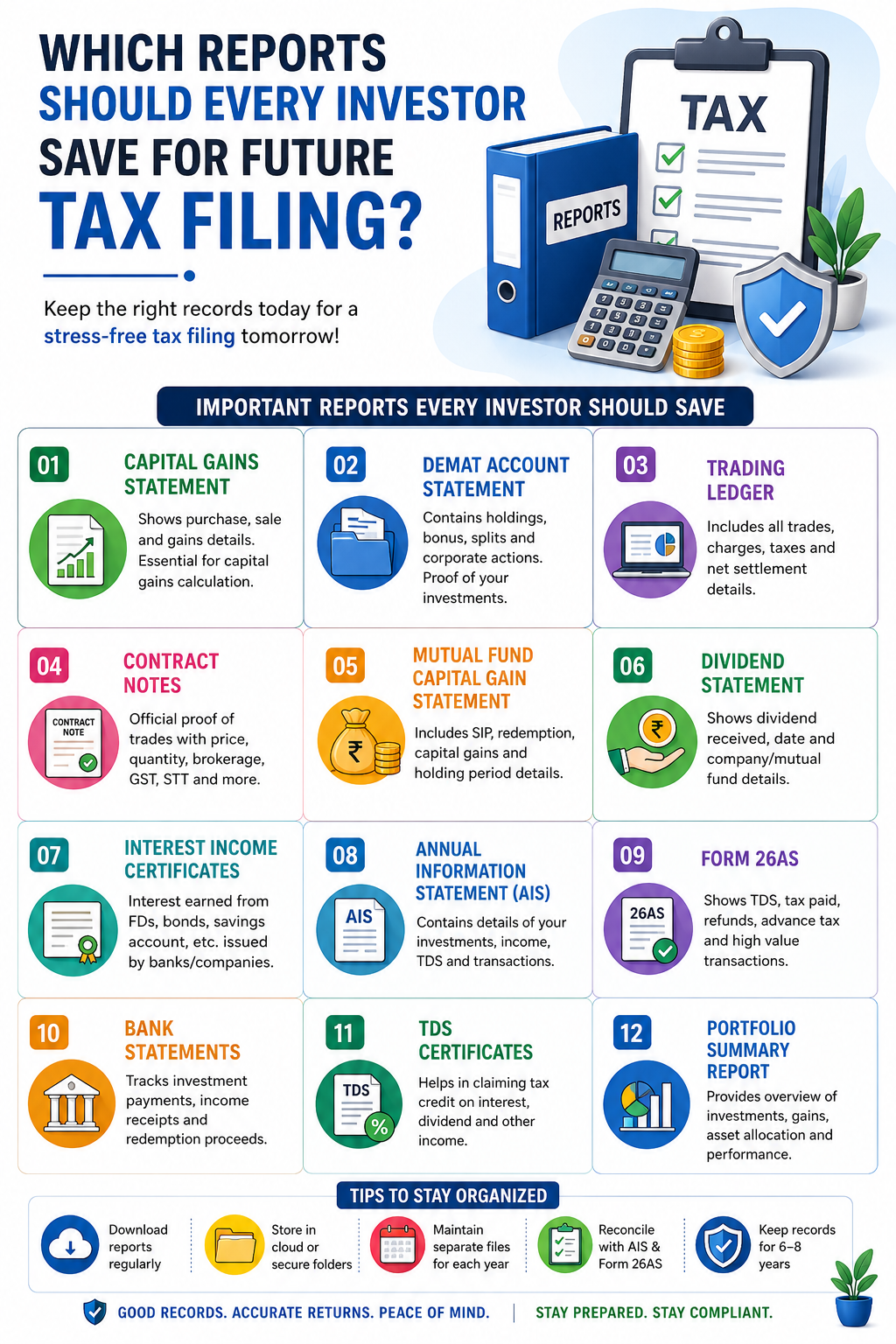
Essential Reports Every Investor Should Save
1. Capital Gains Statement
A Capital Gains Statement is one of the most important tax documents for investors.
It contains details such as:
- Purchase date
- Sale date
- Buy price
- Selling price
- Short-Term Capital Gains (STCG)
- Long-Term Capital Gains (LTCG)
This report is necessary for calculating tax on investments.
2. Demat Account Statement
Your Demat statement records all securities held in your account.
It includes:
- Shares held
- Bonus shares
- Stock splits
- Corporate actions
- Transfer details
This statement acts as proof of your investment holdings.
3. Trading Ledger
If you trade in shares or derivatives, save your Trading Ledger.
It provides details of:
- Buy and sell transactions
- Brokerage charges
- Taxes
- Exchange charges
- Net settlement
This report helps calculate business income or capital gains.
4. Contract Notes
Every stock market transaction generates a Contract Note.
It includes:
- Order number
- Trade price
- Quantity
- Brokerage
- GST
- STT
- Transaction charges
These are official proof of stock market transactions.
5. Mutual Fund Capital Gain Statement
Mutual fund investors should save annual capital gain reports.
These reports include:
- SIP transactions
- Redemption details
- Capital gains
- Tax classification
- Holding period
This makes ITR filing much easier.
6. Dividend Statement
Dividends are taxable in the hands of investors.
Save dividend reports showing:
- Dividend received
- Date of payment
- Company name
- Mutual fund dividend (if applicable)
These figures must be reported while filing your income tax return.
7. Interest Income Certificates
Interest earned from:
- Fixed Deposits (FDs)
- Recurring Deposits (RDs)
- Bonds
- Savings Accounts
- Corporate Deposits
should be supported by interest certificates issued by banks or financial institutions.
8. Annual Information Statement (AIS)
The AIS available on the Income Tax Portal contains:
- Investment transactions
- Dividend income
- Interest income
- Securities transactions
- Mutual fund purchases
- TDS details
Always compare your records with AIS before filing your return.
9. Form 26AS
Form 26AS helps verify:
- TDS deducted
- Advance tax paid
- Self-assessment tax
- Refund status
- High-value transactions
Ensure your tax records match Form 26AS.
10. Bank Statements
Maintain bank statements showing:
- Investment payments
- Dividend credits
- Redemption proceeds
- Interest credits
These act as supporting documents during assessments.
11. Tax Deducted at Source (TDS) Certificates
If TDS has been deducted on:
- Interest income
- Dividend income
- Certain investment proceeds
Keep the corresponding TDS certificates safely for claiming tax credit.
12. Portfolio Summary Report
Many brokers provide annual portfolio summaries containing:
- Total investments
- Current holdings
- Realized gains
- Unrealized gains
- Asset allocation
These reports are useful for both tax filing and financial planning.
How Long Should You Keep Investment Records?
It is advisable to preserve investment and tax-related documents for at least 6–8 years, as they may be required during tax assessments, audits, or while verifying past transactions.
Tips for Organizing Investment Reports
- Download annual reports before the financial year ends.
- Store documents securely in cloud storage or encrypted digital folders.
- Maintain separate folders for each financial year.
- Reconcile broker reports with AIS and Form 26AS.
- Keep both digital and backup copies of important documents.
Common Mistakes Investors Should Avoid
- Ignoring capital gain reports
- Not reporting dividend income
- Losing contract notes
- Filing ITR without checking AIS
- Forgetting to include interest income
- Misreporting short-term and long-term gains
- Not preserving supporting documents
Final Thoughts
Proper documentation is the foundation of smooth and accurate tax filing. Reports such as Capital Gains Statements, Demat Statements, Trading Ledgers, Contract Notes, Mutual Fund Reports, Dividend Statements, Interest Certificates, AIS, Form 26AS, and Bank Statements ensure that your tax return is complete and compliant.
By organizing these reports throughout the year, investors can save time, reduce filing errors, and stay prepared for any future tax verification or assessment.
Frequently Asked Questions (FAQs)
1. Which report is most important for investors during tax filing?
The Capital Gains Statement is one of the most important reports because it helps calculate taxable gains from investments.
2. Is Form 26AS enough for filing investment income?
No. Form 26AS should be used along with AIS, broker statements, capital gains reports, and bank statements.
3. Should mutual fund investors save transaction statements?
Yes. Mutual fund transactions and capital gain statements are crucial for accurately reporting gains.
4. How many years should investment records be kept?
Generally, investors should retain records for at least 6 to 8 years.
5. Can a tax professional help reconcile investment reports?
Yes. A qualified tax professional can reconcile your investment reports with AIS and Form 26AS to ensure accurate and compliant tax filing.