



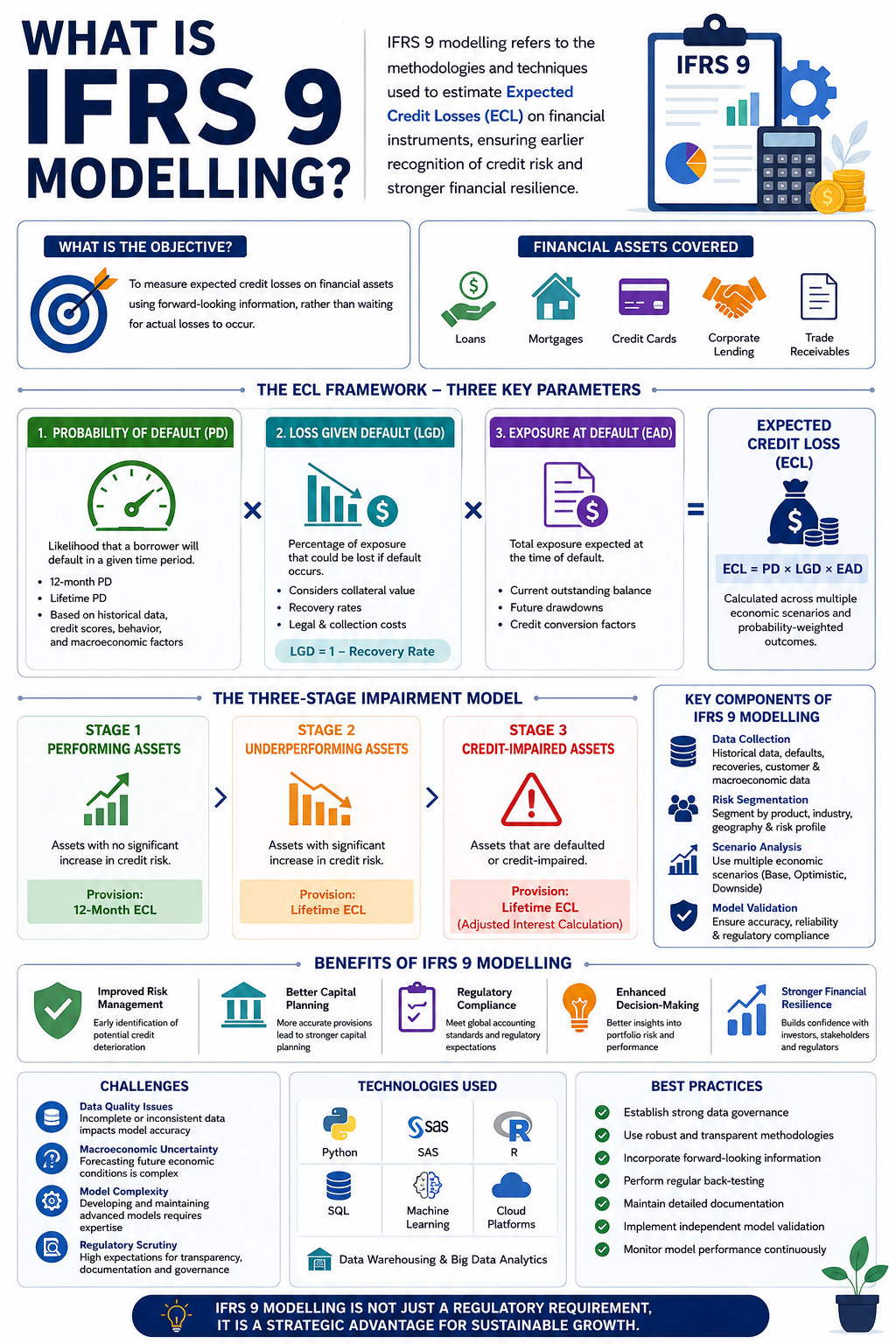
In today's risk-driven financial environment, banks and financial institutions must accurately assess credit risk and maintain adequate provisions for potential loan losses. This is where IFRS 9 Modelling plays a critical role. Introduced by the International Accounting Standards Board (IASB), IFRS 9 transformed the way organizations recognize and measure credit losses by replacing the incurred loss approach with an Expected Credit Loss (ECL) framework. As a result, financial institutions need sophisticated modelling techniques to estimate future credit losses more accurately.
What Is IFRS 9?
IFRS 9 (International Financial Reporting Standard 9) is an accounting standard that governs the classification, measurement, impairment, and hedge accounting of financial instruments.
One of its most significant requirements is the implementation of an Expected Credit Loss (ECL) model, which requires institutions to estimate credit losses before they occur.
Unlike the previous IAS 39 standard, IFRS 9 encourages proactive risk management by considering future economic conditions and potential defaults.
What Is IFRS 9 Modelling?
IFRS 9 modelling refers to the quantitative and statistical methodologies used to estimate expected credit losses on financial assets such as:
- Loans
- Mortgages
- Credit cards
- Corporate lending portfolios
- Trade receivables
- Debt securities
The objective is to calculate the amount of credit loss that should be recognized in financial statements based on future expectations rather than historical events alone.
Understanding the Expected Credit Loss (ECL) Framework
The Expected Credit Loss framework under IFRS 9 is built around three key risk parameters:
1. Probability of Default (PD)
Probability of Default measures the likelihood that a borrower will default on their obligations within a specified period.
Examples:
- 12-month PD
- Lifetime PD
PD models typically use:
- Historical default data
- Credit scores
- Macroeconomic indicators
- Customer behavior patterns
2. Loss Given Default (LGD)
Loss Given Default represents the percentage of exposure likely to be lost if a borrower defaults.
Factors influencing LGD include:
- Collateral value
- Recovery rates
- Legal costs
- Collection efficiency
Formula:
LGD = 1 − Recovery Rate
3. Exposure at Default (EAD)
Exposure at Default estimates the outstanding balance expected at the time of default.
EAD calculations consider:
- Current balance
- Future drawdowns
- Credit conversion factors
- Loan repayment behavior
IFRS 9 ECL Formula
The standard Expected Credit Loss formula is:
ECL = PD × LGD × EAD
Financial institutions often calculate ECL across multiple economic scenarios and apply probability-weighted outcomes to arrive at a final estimate.
The Three-Stage IFRS 9 Impairment Model
Stage 1: Performing Assets
Assets that have not experienced a significant increase in credit risk.
Provision Requirement:
- 12-Month Expected Credit Loss
Stage 2: Underperforming Assets
Assets that have experienced a significant increase in credit risk.
Provision Requirement:
- Lifetime Expected Credit Loss
Stage 3: Credit-Impaired Assets
Assets that are considered defaulted or impaired.
Provision Requirement:
- Lifetime Expected Credit Loss with adjusted interest calculations
Key Components of IFRS 9 Modelling
Successful IFRS 9 implementation requires several modelling components:
Data Collection
Institutions gather:
- Historical loan data
- Default history
- Recovery information
- Customer demographics
- Macroeconomic variables
Risk Segmentation
Portfolios are segmented based on:
- Product type
- Industry
- Geography
- Risk characteristics
Scenario Analysis
Multiple economic scenarios are incorporated, such as:
- Base Case
- Optimistic Scenario
- Downside Scenario
Common variables include:
- GDP growth
- Inflation
- Interest rates
- Unemployment rates
Model Validation
Regular validation ensures:
- Model accuracy
- Regulatory compliance
- Reduced model risk
Challenges in IFRS 9 Modelling
Data Quality Issues
Poor-quality data can significantly impact model performance and ECL estimates.
Macroeconomic Forecasting
Predicting future economic conditions accurately remains one of the biggest challenges.
Model Complexity
Developing and maintaining PD, LGD, and EAD models requires advanced analytics and statistical expertise.
Regulatory Scrutiny
Regulators expect transparent methodologies, governance frameworks, and comprehensive documentation.
Benefits of IFRS 9 Modelling
Organizations that implement effective IFRS 9 models gain several advantages:
Improved Risk Management
Early identification of potential credit deterioration.
Better Capital Planning
More accurate provisioning improves capital allocation decisions.
Regulatory Compliance
Ensures adherence to global accounting standards.
Enhanced Decision-Making
Provides management with better insights into portfolio risk.
Technologies Used in IFRS 9 Modelling
Modern institutions increasingly leverage:
- Python
- SAS
- R
- SQL
- Machine Learning
- Cloud Analytics Platforms
- Data Warehousing Solutions
These technologies help automate calculations, improve accuracy, and accelerate reporting.
Best Practices for IFRS 9 Model Development
To build robust IFRS 9 models:
✔ Establish strong data governance
✔ Use statistically sound methodologies
✔ Incorporate forward-looking information
✔ Perform regular back-testing
✔ Maintain detailed documentation
✔ Implement independent model validation
✔ Monitor model performance continuously
Conclusion
IFRS 9 modelling is a cornerstone of modern credit risk management. By combining Probability of Default (PD), Loss Given Default (LGD), and Exposure at Default (EAD), financial institutions can estimate expected credit losses more accurately and comply with regulatory requirements.
As financial markets become increasingly complex, organizations that invest in robust IFRS 9 modelling frameworks gain a significant advantage through better risk visibility, improved capital management, and stronger regulatory compliance.
Whether you are a risk analyst, data scientist, finance professional, or banking executive, understanding IFRS 9 modelling is essential for navigating today's credit risk landscape.
Frequently Asked Questions (FAQs)
What is IFRS 9 modelling used for?
IFRS 9 modelling is used to estimate expected credit losses and determine impairment provisions for financial assets.
What are the three key IFRS 9 parameters?
Probability of Default (PD), Loss Given Default (LGD), and Exposure at Default (EAD).
Why is IFRS 9 important for banks?
It helps banks recognize credit losses earlier, improve risk management, and comply with accounting regulations.
What is the difference between IAS 39 and IFRS 9?
IAS 39 used an incurred loss approach, while IFRS 9 uses an expected credit loss approach that incorporates forward-looking information.