

Value-Added Tax (VAT) is an indirect tax levied on the value added to goods and services at each stage of production and distribution. It is widely used globally because it ensures transparency, reduces tax evasion, and prevents the cascading effect of taxation.In this blog, we'll discuss the key features of Value-Added Tax (VAT) and why it is considered an efficient tax system.
Key Features of Value-Added Tax (VAT)
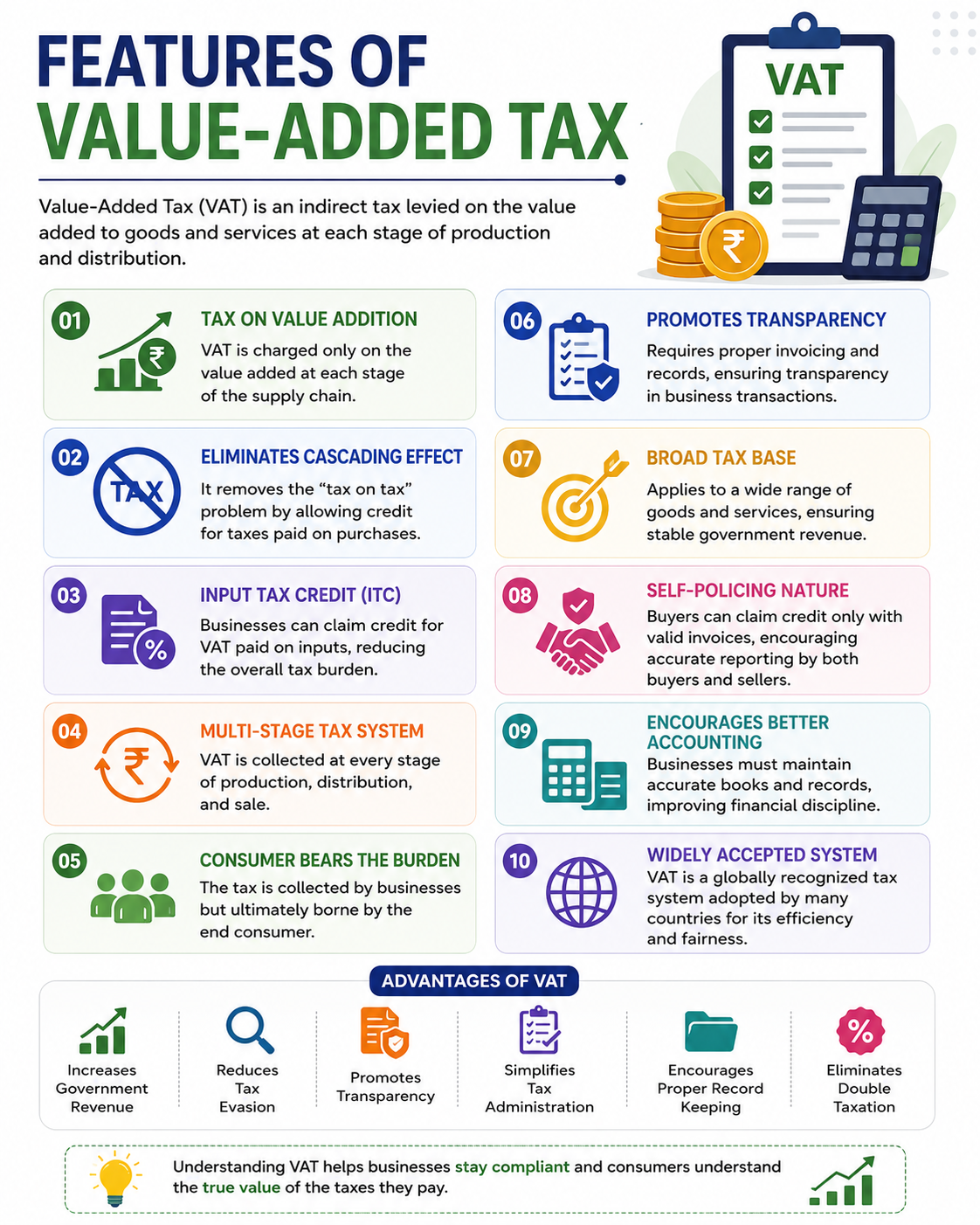
1. Tax on Value Addition
The most important feature of VAT is that tax is charged only on the value added at each stage of the supply chain.
For example, a manufacturer pays VAT only on the value added during production, while a retailer pays VAT only on the profit margin added before selling to the customer.
2. Eliminates Cascading Effect
VAT prevents the "tax on tax" problem.
Under traditional sales tax systems, tax may be charged on an amount that already includes tax. VAT allows businesses to claim credit for taxes paid on purchases, thereby eliminating double taxation.
3. Input Tax Credit (ITC) Mechanism
Businesses can claim credit for the VAT paid on inputs used in producing goods or services.
This feature reduces the overall tax burden and ensures that only the final consumer bears the tax cost.
4. Multi-Stage Tax System
VAT is collected at every stage of production, distribution, and sale.
From manufacturer to wholesaler, wholesaler to retailer, and retailer to consumer, VAT is applied at each stage based on the value added.
5. Consumer Bears the Final Tax Burden
Although businesses collect and remit VAT to the government, the ultimate burden of the tax falls on the end consumer.
This makes VAT an indirect tax.
6. Promotes Transparency
VAT requires proper invoicing and record-keeping.
Businesses must maintain detailed purchase and sales records, making transactions more transparent and reducing the chances of tax evasion.
7. Broad Tax Base
VAT applies to a wide range of goods and services, which helps governments generate stable and predictable revenue.
A broader tax base also allows for lower tax rates compared to some other tax systems.
8. Self-Policing Nature
Since buyers can claim tax credits only when sellers provide valid tax invoices, both parties have an incentive to report transactions accurately.
This creates a built-in compliance mechanism.
9. Encourages Better Accounting Practices
Businesses operating under a VAT system are required to maintain accurate books of accounts and documentation, improving overall financial discipline.
10. Widely Accepted Tax System
VAT is one of the most commonly used indirect tax systems globally and has been adopted by many countries due to its efficiency and fairness.
Advantages of VAT
- Eliminates double taxation
- Increases government revenue
- Promotes transparency
- Reduces tax evasion
- Encourages proper record-keeping
- Simplifies tax administration
Conclusion
Value-Added Tax (VAT) is an effective taxation system that taxes only the value added at each stage of production and distribution. Its key features, such as input tax credit, elimination of cascading taxes, transparency, and broad coverage, make it one of the most efficient indirect tax systems in the world.
Understanding VAT helps businesses maintain compliance while enabling consumers to better understand how indirect taxes affect the prices they pay.