

If you are running a business in India, you may eventually face a situation where you need to close your GST registration. Many taxpayers get confused between GST cancellation and GST surrender. Although these terms are often used interchangeably, they refer to slightly different situations under the Goods and Services Tax (GST) law. In this blog, we will explain the difference between GST cancellation and GST surrender, the reasons behind them, and the procedure to close a GST registration properly.
What is GST Cancellation?
GST cancellation refers to the termination of GST registration by the GST department or the taxpayer under specific circumstances. Once the registration is cancelled, the business can no longer collect GST or file GST returns.
GST cancellation can happen in three ways:
-
Cancellation by the taxpayer
-
Cancellation by the GST officer
-
Cancellation by legal heirs (in case of the death of the proprietor)
After cancellation, the taxpayer must stop charging GST on invoices and cannot claim Input Tax Credit (ITC).
Common Reasons for GST Cancellation
Some of the most common reasons include:
-
Business has been closed or discontinued
-
Business transferred due to merger, sale, or amalgamation
-
Change in the constitution of the business
-
Turnover falls below the GST threshold limit
-
GST registration obtained voluntarily, but is no longer required
-
Non-compliance, such as failure to file GST returns
What is GST Surrender?
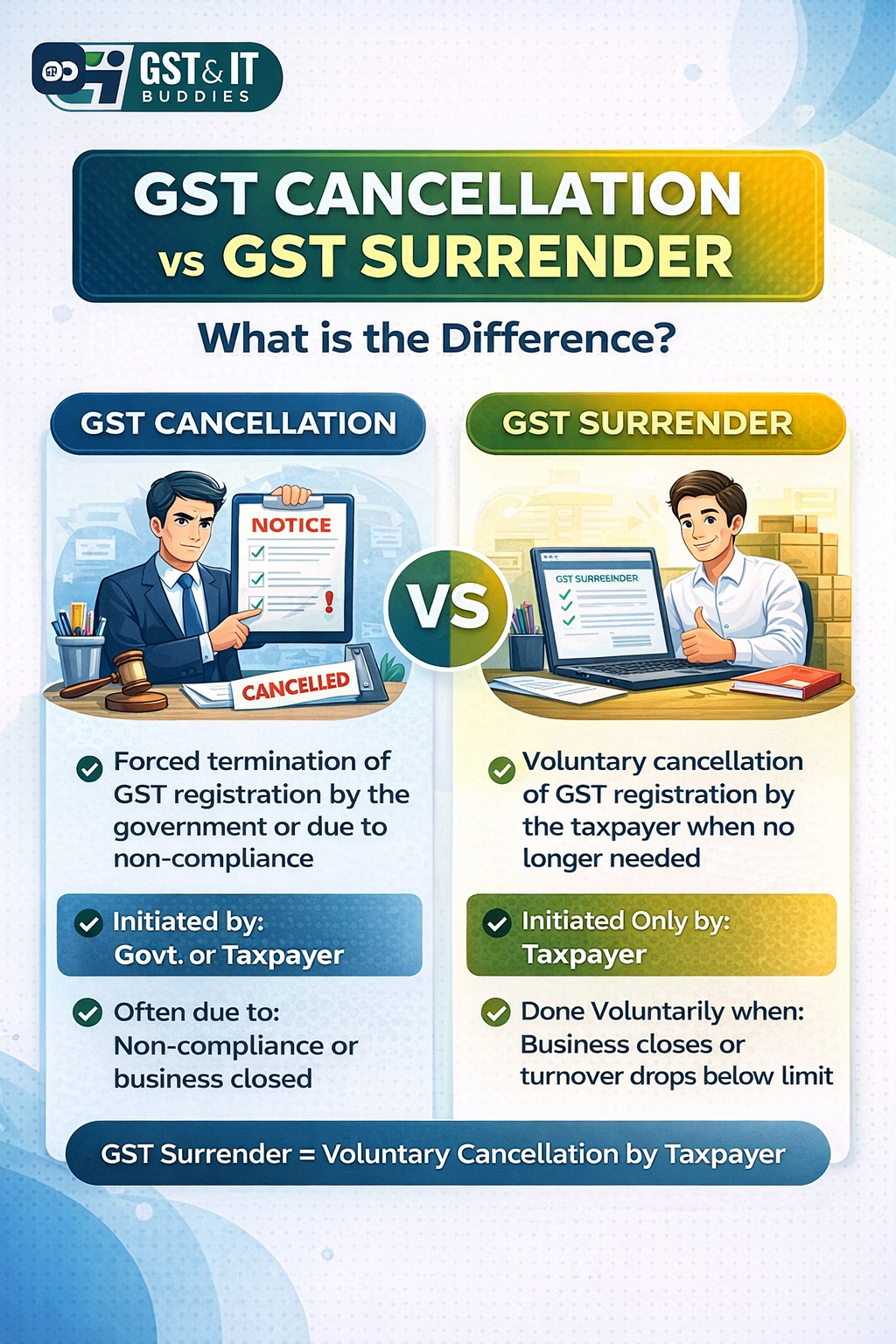
GST surrender is generally used when the taxpayer voluntarily requests cancellation of GST registration because it is no longer required.
In simple words:
👉 GST surrender is a voluntary form of GST cancellation initiated by the taxpayer.
For example, if a business owner’s annual turnover falls below the GST threshold limit, they may choose to surrender their GST registration.
Situations Where GST Surrender Happens
Businesses may surrender GST registration when:
-
The business stops operations
-
Turnover drops below ₹40 lakh (goods) or ₹20 lakh (services) threshold
-
Business was registered voluntarily, but no longer needs GST
-
The business switches to a composition scheme
-
The proprietor retires or shuts down operations
GST Cancellation vs GST Surrender: Key Differences
| Basis | GST Cancellation | GST Surrender |
|---|---|---|
| Meaning | Termination of GST registration | Voluntary cancellation by taxpayer |
| Initiated By | Taxpayer or GST officer | Only by taxpayer |
| Reason | Non-compliance, closure, legal reasons | Business closure or turnover below limit |
| Process | An officer may issue a notice before cancelling | Taxpayer applies through the GST portal |
| Control | Department or taxpayer | Taxpayer decision |
In short, GST surrender is a type of GST cancellation initiated voluntarily by the taxpayer.
Procedure for GST Cancellation / Surrender
The process to cancel GST registration can be completed online through the GST portal.
Step-by-Step Process
-
Log in to the GST portal
-
Go to Services → Registration
-
Click Application for Cancellation of Registration
-
Fill in details such as:
-
Reason for cancellation
-
Date of cancellation
-
Details of stock and liabilities
-
-
Upload supporting documents if required
-
Submit the application using DSC or EVC
After submission, the GST officer will review the application and issue a cancellation order.
Important Things to Remember
Before applying for GST cancellation or surrender, businesses must:
✔ File all pending GST returns
✔ Clear any tax liabilities
✔ Reverse applicable Input Tax Credit (ITC)
✔ File GSTR-10 (Final Return) after cancellation
Failure to complete these steps may lead to penalties or rejection of the application.
Conclusion
Understanding the difference between GST cancellation and GST surrender is important for businesses planning to close their GST registration.
-
GST cancellation may happen due to compliance issues or by order of the GST department.
-
GST surrender is a voluntary cancellation initiated by the taxpayer when GST registration is no longer required.
Before applying for cancellation, ensure that all GST returns are filed and tax dues are cleared to avoid future legal issues.
If you are unsure about the process, consulting a GST professional or tax expert can help you complete the procedure smoothly.