
An offshore bank account by itself is not tax evasion. Lakhs of Indians legally hold money abroad: students, NRIs who came back, employees with US stock (RSUs/ESOPs), and families who send money under LRS. It becomes tax evasion when you hide the money or the income from it. In practice that means one of three things: 1. You don't report the account in your ITR (Schedule FA). 2. You don't pay Indian tax on the interest, dividends or gains it earns. 3. The money itself came from income that was never taxed in India. If you are a resident of India, the tax department is already likely to know about your foreign account. Over 100 countries now share bank data with India automatically. So the real question is not "will they find out?" but "is my ITR telling the same story?"
When an offshore account is 100% legal
Your foreign account is fine as long as two things are true: the money came from a legal, explained source, and you report it properly every year.
Common legal ways Indians end up with money abroad:
- LRS remittance: resident individuals can send up to USD 2,50,000 per financial year abroad under RBI's Liberalised Remittance Scheme, through a bank, with TCS where it applies.
- Income earned while you were an NRI: salary or savings from your years abroad, kept in that country after you return.
- Foreign employer stock: RSUs and ESOPs from a US or other foreign parent company.
- Gifts or inheritance from relatives abroad, with documents.
What "reporting properly" means
If you are a Resident and Ordinarily Resident (ROR) in India, you must:
- Fill Schedule FA (Foreign Assets) in your ITR: every foreign bank account, shares, ESOPs, insurance policy, property, trust interest and signing authority. Schedule FA follows the calendar year (Jan–Dec), not the April–March year.
- Fill Schedule FSI (Foreign Source Income) for interest, dividends and capital gains earned abroad, and pay Indian tax on it.
- File Form 67 before your ITR if you want credit for tax already paid abroad.
- File an ITR even if your income is below the basic exemption limit, because you hold a foreign asset.
NRIs and RNORs (Resident but Not Ordinarily Resident) do not need to fill Schedule FA. Many returning NRIs get caught exactly when they turn ROR and keep their old accounts without reporting them.
When it crosses the line into tax evasion
The line is crossed when the account, or the money in it, is kept away from the tax department on purpose. These are the situations the law treats most seriously:
|
Situation |
Why it is a problem |
|---|---|
|
Account never shown in Schedule FA |
Non-disclosure of a foreign asset is an offence by itself, even if the money is clean |
|
Interest, dividends or gains abroad not taxed in India |
A resident is taxed on worldwide income; skipping it is under-reporting |
|
Money sent abroad from cash or unaccounted business income |
The source is untaxed income, which is classic black money |
|
Account held in a relative's, employee's or friend's name |
Benami or nominee holding to hide the real owner |
|
Money routed through a shell company or trust in a tax haven |
Layering to hide ownership |
|
Money "round-tripped" back to India as fake foreign investment or loan |
Disguising Indian black money as foreign money |
|
Sending money outside LRS or through hawala |
Breaks FEMA rules as well as tax law |
Mistake vs evasion: forgetting to report a small, legally funded account is still a default, but the law now treats it far more lightly than deliberate hiding. The intent and the source of funds are what separate an honest error from evasion.
Penalties under the Black Money Act, 2015
Undisclosed foreign income and assets are dealt with under the Black Money (Undisclosed Foreign Income and Assets) and Imposition of Tax Act, 2015, not just the regular Income-tax Act. It is one of the harshest tax laws in India.
|
What happens |
Consequence |
|---|---|
|
Tax on undisclosed foreign asset or income |
Flat 30% of its value, with no deductions or set-off |
|
Penalty for undisclosed asset or income |
3 times the tax (90%), so total outgo can reach 120% of the asset's value |
|
Not filing ITR, or not reporting the asset in Schedule FA |
Fixed penalty of ₹10 lakh per year (Sections 42 and 43) |
|
Wilful failure to disclose |
Prosecution, with jail of 6 months to 7 years |
|
Time limit for the department to act |
No fixed time limit; old cases can be reopened years later |
Relief for small accounts: the ₹20 lakh rule
The Finance (No. 2) Act, 2024 raised the safe limit from ₹5 lakh to ₹20 lakh, from 1 October 2024. If the total value of your foreign assets other than immovable property (bank accounts, shares, ESOPs and so on) stays within ₹20 lakh at all times in the year, the ₹10 lakh penalty does not apply. The Finance Act, 2026 extended this relief to prosecution as well.
This relief only covers the reporting penalty. Tax on the income is still payable, and foreign property gets no such relief.
What changes with the new Income-tax Act, 2025?
The Income-tax Act, 2025 replaced the 1961 Act from 1 April 2026. The Black Money Act continues as a separate law. Income up to 31 March 2026 (FY 2025-26) is still governed by the old Act.
How the tax department finds out
The department does not need a raid to spot a foreign account. It gets the data automatically.
- CRS (Common Reporting Standard): banks in partner countries report accounts held by Indian residents to their tax authority, which shares them with India every year.
- FATCA: a similar data-sharing deal with the US.
- Your own trail in India: LRS remittances and TCS collected by your bank show up in your AIS and Form 26AS.
The CBDT then matches this data with your ITR. Under its NUDGE campaign, launched in November 2024, taxpayers whose foreign data didn't match their returns got SMS and emails asking them to correct it. 24,678 taxpayers revised their returns in that first round. A second NUDGE round started on 28 November 2025 for AY 2025-26, again targeting gaps in Schedule FA and Schedule FSI.
If you got such a message, treat it as a final friendly reminder, not spam.
Already missed reporting? Fix it before 31 December 2026
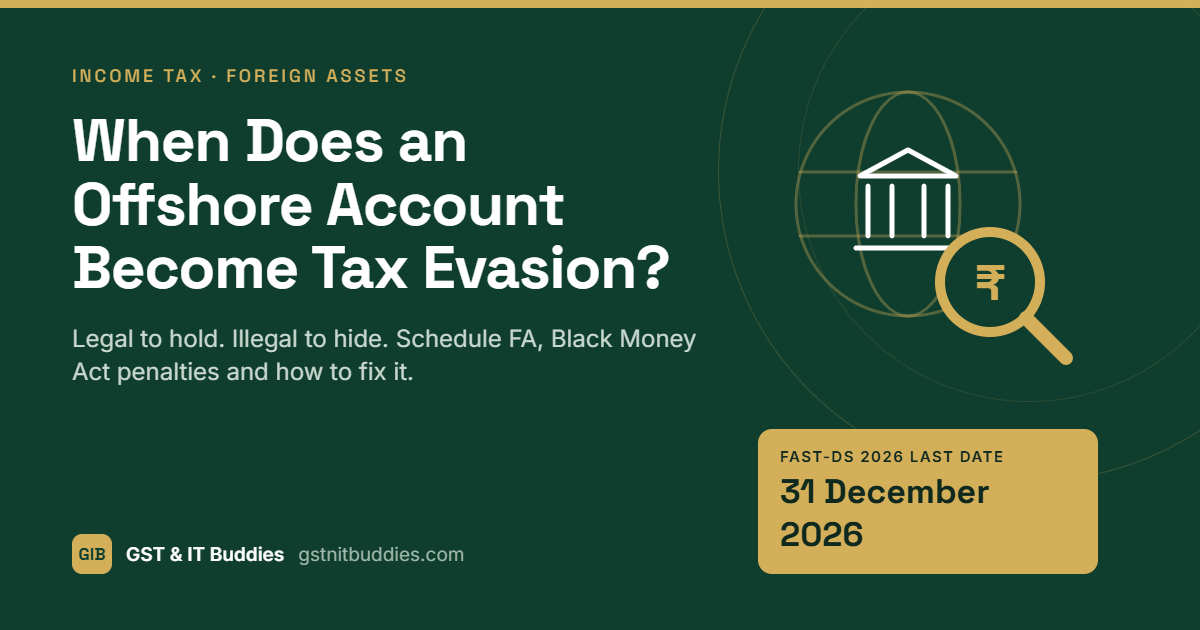
If you held a foreign account and didn't report it, you have a one-time way out right now: the Foreign Assets of Small Taxpayers Disclosure Scheme, 2026 (FAST-DS 2026). It opened on 16 August 2026 and the last date to file a declaration is 31 December 2026. No declaration can be filed after that.
|
Category |
Who it is for |
Limit |
What you pay |
|---|---|---|---|
|
A: Undisclosed foreign asset or income |
Source not explained, or income never taxed |
Up to ₹1 crore in total |
30% tax + equal additional amount (60% in all) |
|
B: Specified foreign asset not reported |
Source is clean (already-taxed income, or earned while NRI) but missed in Schedule FA |
Up to ₹5 crore in total |
Flat fee of ₹1 lakh |
In exchange, you get immunity from penalty and prosecution under the Black Money Act for what you declare. Under Category B, if the same asset stayed unreported for several years, the ₹1 lakh fee is charged only once. Assets are valued as on 31 March 2026, and the declaration is filed online on the e-filing portal (Form 1).
Example: Rohan worked in the US till 2021, came back, and kept his US savings account and RSUs worth about ₹60 lakh. He never filled Schedule FA. His money is clean, so under Category B he can settle the reporting lapse with a ₹1 lakh fee instead of facing a possible ₹10 lakh penalty for each year.
Other ways to correct your return
- Revised return: for the latest year, if the time limit to revise is still open.
- Updated return (ITR-U): to add missed foreign income for earlier years, with extra tax.
Which route is cheaper depends on your years, amounts and source of funds. Get it checked before you file.
Quick checklist to stay on the right side
- Check your residential status every year (ROR, RNOR or NRI)
- List every foreign account, share, ESOP/RSU, policy and property you hold
- Report them in Schedule FA on a calendar-year basis
- Show foreign interest, dividends and gains in Schedule FSI and pay tax
- File Form 67 before the ITR to claim foreign tax credit
- Keep proof of source: LRS slips, salary slips, gift deeds, vesting statements
- Missed something? Look at FAST-DS before 31 December 2026
FAQs
Is it illegal for an Indian resident to have a foreign bank account? No. It is legal if the money was sent through proper channels like LRS or earned legally, and the account is reported in your ITR.
My foreign account has only ₹50,000. Do I still need to report it? Yes. Reporting in Schedule FA is required for every foreign asset. The ₹20 lakh rule only protects you from the ₹10 lakh penalty if you miss it; it does not remove the duty to report.
I am an NRI. Do I fill Schedule FA? No. Schedule FA applies to Resident and Ordinarily Resident taxpayers. It starts applying once you become ROR after returning to India.
Can the department act on an account from 10 years ago? Yes. The Black Money Act has no fixed time limit for starting proceedings.
What is the last date for FAST-DS 2026? 31 December 2026. There is no extension announced.
Need help with foreign assets in your ITR?
GST & IT Buddies helps residents, returning NRIs and salaried employees with RSUs report foreign assets correctly, file revised or updated returns, and check FAST-DS eligibility before the deadline. Talk to our tax team today.
Disclaimer: This article is for general information only and is not legal or tax advice. Rules and limits can change; consult a qualified tax professional for your case.