

Introduction Invoice processing is an important part of accounts payable and financial management. Businesses receive invoices from multiple vendors, verify the information, match invoices with purchase orders and receipts, and finally approve them for payment. However, not every invoice moves through the process smoothly. Some invoices contain incorrect amounts, missing information, mismatched purchase orders, duplicate entries, tax discrepancies, or other issues. These cases are generally known as invoice exceptions. As businesses adopt artificial intelligence, OCR, workflow automation, and accounting software, an important question is emerging: Will invoice exception handling eventually become mostly automated, or will finance teams always need to investigate these cases manually? The answer likely involves both automation and human expertise. Technology can handle many routine exceptions, but complex or unusual cases may still require human judgment.
What Is Invoice Exception Handling?
Invoice exception handling is the process of identifying, investigating, correcting, and resolving problems that prevent an invoice from being processed normally.
For example, a business may receive an invoice for ₹1,20,000 when the purchase order shows ₹1,00,000. The system may flag the transaction because the invoice amount does not match the approved purchase order.
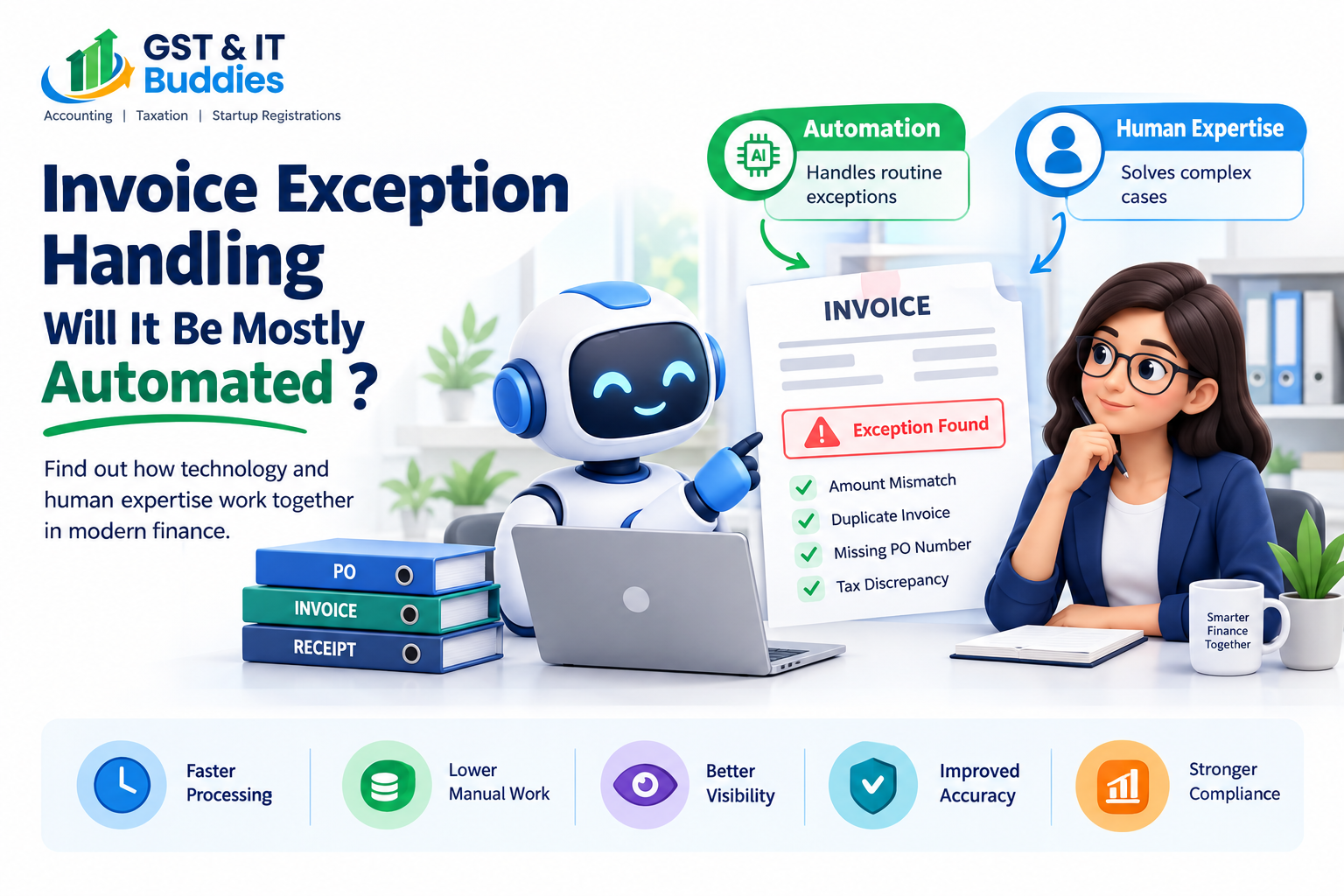
Common invoice exceptions include:
- Incorrect invoice amounts
- Purchase order mismatches
- Quantity differences
- Incorrect tax calculations
- Missing purchase order numbers
- Duplicate invoices
- Missing vendor information
- Incorrect bank details
- Unapproved purchases
- Goods or services not received
- Incorrect invoice dates
- Missing supporting documents
These exceptions need to be resolved before the invoice can be approved and paid.
Why Invoice Exceptions Matter
Invoice exceptions can create additional work for accounts payable and finance teams.
When exception volumes are high, businesses may experience:
- Delays in invoice approval
- Increased administrative work
- Higher processing costs
- Payment delays
- Duplicate payments
- Vendor disputes
- Incorrect accounting records
- Difficulty maintaining accurate cash-flow information
For growing businesses, manually investigating every invoice exception can consume significant employee time.
This is one reason why companies are increasingly exploring accounts payable automation.
How Invoice Automation Works
Modern invoice automation systems can perform several steps without requiring manual data entry.
A typical automated workflow may look like this:
Invoice Received → Data Extraction → Validation → PO Matching → Exception Detection → Approval → Payment
Technologies such as OCR, machine learning, rule-based workflows, and AI-powered document processing can help identify information from invoices and compare it with existing financial records.
For example, software may automatically compare:
Invoice: ₹50,000
Purchase Order: ₹50,000
Goods Receipt: ₹50,000
If everything matches, the invoice can potentially move forward without manual intervention.
But if the amounts differ, the system can flag the invoice for further review.
Which Invoice Exceptions Can Be Automated?
A significant portion of routine exception handling can potentially be automated when clear rules and reliable data are available.
1. Duplicate Invoice Detection
Automation can compare invoice numbers, vendor details, dates, amounts, and other information to identify potential duplicates.
For example:
- Vendor: ABC Pvt. Ltd.
- Invoice No.: INV-1056
- Amount: ₹75,000
If the same invoice appears twice, the system can flag the second entry.
2. Purchase Order Mismatch
Automated systems can compare invoice details with purchase orders.
If the invoice amount exceeds the approved purchase order amount, the system can automatically create an exception.
This reduces the need for employees to manually compare documents.
3. Tax and Calculation Checks
Software can perform predefined checks on:
- Tax rates
- Tax amounts
- Subtotals
- Discounts
- Total invoice value
For businesses operating under GST, automated systems can also support checks involving GST-related invoice information, subject to the applicable rules and system configuration.
4. Missing Information
An automated workflow can detect whether required fields are missing.
For example:
Invoice received → PO number missing → System flags exception
The invoice can then be routed to the appropriate person or department.
Where Human Investigation Is Still Important
Automation does not necessarily mean that finance teams will disappear from the invoice exception process.
Some exceptions require context and business judgment.
Example: Price Difference
Suppose a purchase order shows:
100 units × ₹500 = ₹50,000
But the invoice shows:
100 units × ₹550 = ₹55,000
An automated system can identify the difference. However, determining why the price changed may require human investigation.
Perhaps:
- The vendor increased the price under a new agreement.
- The purchase order was not updated.
- The business approved the revised price through email.
- The invoice contains an actual error.
The system can identify the problem, but a person may need to understand the circumstances.
AI Can Change the Role of Finance Teams
The future of invoice exception handling may not simply be automation versus humans.
Instead, the role of finance professionals may shift from repetitive checking toward exception management and decision-making.
Instead of manually reviewing hundreds of invoices, a finance employee could focus on:
- High-value exceptions
- Unusual transactions
- Vendor disputes
- Contract-related differences
- Compliance concerns
- Fraud indicators
- Policy violations
- Exceptions requiring business approval
This can make the finance function more focused on analysis and control rather than repetitive data entry.
Will Invoice Exception Handling Become Mostly Automated?
For many businesses, routine and rule-based invoice exceptions are likely to become increasingly automated.
However, complete automation is more difficult because invoices can involve different vendors, contracts, purchasing arrangements, tax requirements, approval policies, and business circumstances.
A useful way to think about the future is:
Routine Exceptions
High automation potential
Examples:
- Duplicate invoice
- Missing field
- Simple amount mismatch
- Standard PO mismatch
- Basic validation failure
Complex Exceptions
Human review may remain important
Examples:
- Contract disputes
- Unusual pricing arrangements
- Vendor disagreements
- Suspected fraud
- Complex tax questions
- Exceptions requiring management approval
Therefore, automation is more likely to reduce manual investigation than eliminate human involvement completely.
Benefits of Automating Invoice Exception Handling
Businesses can potentially gain several benefits from automation.
Faster Processing
Automated systems can identify common problems immediately rather than waiting for manual review.
Lower Administrative Work
Finance teams can spend less time performing repetitive comparisons and data-entry tasks.
Better Visibility
Exception dashboards can help managers understand:
- Number of exceptions
- Exception types
- Vendors generating frequent issues
- Average resolution time
- Pending approvals
Improved Consistency
Automated rules can apply the same validation criteria to invoices consistently.
Better Audit Trails
Digital workflows can record actions, approvals, corrections, and exception resolutions, helping businesses maintain documentation.
Challenges of Invoice Automation
Automation also has limitations.
Poor Data Quality
If purchase orders, vendor records, or receipts contain incorrect information, automation may generate incorrect exceptions.
Complex Business Rules
Different departments may follow different purchasing and approval policies.
System Integration
Invoice automation works best when it can connect with accounting, ERP, procurement, purchase order, and payment systems.
False Exceptions
An automated system may flag a transaction that is actually valid.
Human Judgment
Some financial decisions depend on business context that cannot easily be represented through simple rules.
The Future: Human + AI Collaboration
The future of invoice exception management is likely to focus on human-AI collaboration.
A possible workflow could look like this:
AI receives invoice
↓
Extracts invoice information
↓
Matches invoice with PO and receipt
↓
Identifies potential exception
↓
Classifies exception by risk and complexity
↓
Automatically resolves straightforward cases
↓
Routes complex cases to finance professionals
↓
Human reviews and approves the resolution
This approach allows technology to manage repetitive work while finance teams retain control over important decisions.
How Businesses Can Prepare for Automated Invoice Processing
Businesses interested in invoice automation should first establish a strong financial process.
1. Standardize Invoice Data
Use consistent vendor and invoice information wherever possible.
2. Define Exception Rules
Clearly identify which discrepancies can be automatically resolved and which require approval.
3. Maintain Accurate Vendor Records
Incorrect vendor information can lead to unnecessary exceptions.
4. Integrate Financial Systems
Connecting procurement, accounting, ERP, and payment systems can improve the flow of information.
5. Create Approval Workflows
Define who should review different types and values of exceptions.
6. Monitor Automation Performance
Businesses should regularly review false exceptions, unresolved cases, and processing times.
Conclusion
Invoice exception handling is likely to become increasingly automated, but human investigation will continue to have an important role.
Technology can efficiently handle repetitive and predictable problems such as duplicate invoices, missing fields, and straightforward purchase order mismatches. More complicated situations involving contracts, disputes, unusual transactions, compliance questions, or business judgment may still require finance professionals.
The goal of automation should therefore not necessarily be to remove humans from invoice processing. Instead, businesses can use automation to reduce repetitive work and allow finance teams to concentrate on exceptions that genuinely require human judgment.
For businesses looking to improve accounting and financial processes, the combination of automation, strong internal controls, accurate data, and skilled finance professionals can create a more efficient invoice management system.
Frequently Asked Questions
What is invoice exception handling?
Invoice exception handling is the process of identifying and resolving problems that prevent an invoice from being processed normally, such as amount mismatches, duplicate invoices, missing information, or purchase order differences.
Can invoice exceptions be fully automated?
Some routine exceptions can be automated effectively. However, complex exceptions may still require human review because they can involve business context, contracts, disputes, or judgment.
How does AI help with invoice processing?
AI can help extract invoice information, identify unusual patterns, compare invoice data with purchase orders and receipts, classify exceptions, and route cases to the appropriate person.
What is the role of finance teams in automated invoice processing?
Finance professionals can focus more on complex exceptions, approvals, compliance, fraud controls, vendor disputes, and financial analysis instead of repetitive invoice checking.
Is invoice automation suitable for small businesses?
It can be, especially when invoice volumes are growing and manual processing takes significant time. The appropriate level of automation depends on transaction volume, existing accounting systems, processes, and business requirements.