

A Purchase Order (PO) is an important document used by businesses when purchasing goods or services from a supplier. It helps the buyer clearly communicate what they want to purchase, including the quantity, price, delivery requirements, and payment terms. Although a Purchase Order and an Invoice may contain similar information, they serve completely different purposes. Understanding the difference between a purchase order and an invoice can help businesses maintain accurate records, control expenses, and manage their accounting processes efficiently.
In this blog, we will explain what a purchase order is, how a PO works, what information it contains, and the key differences between a purchase order and an invoice.
What Is a Purchase Order (PO)? A Purchase Order (PO) is an official document created by a buyer and sent to a supplier to request goods or services.
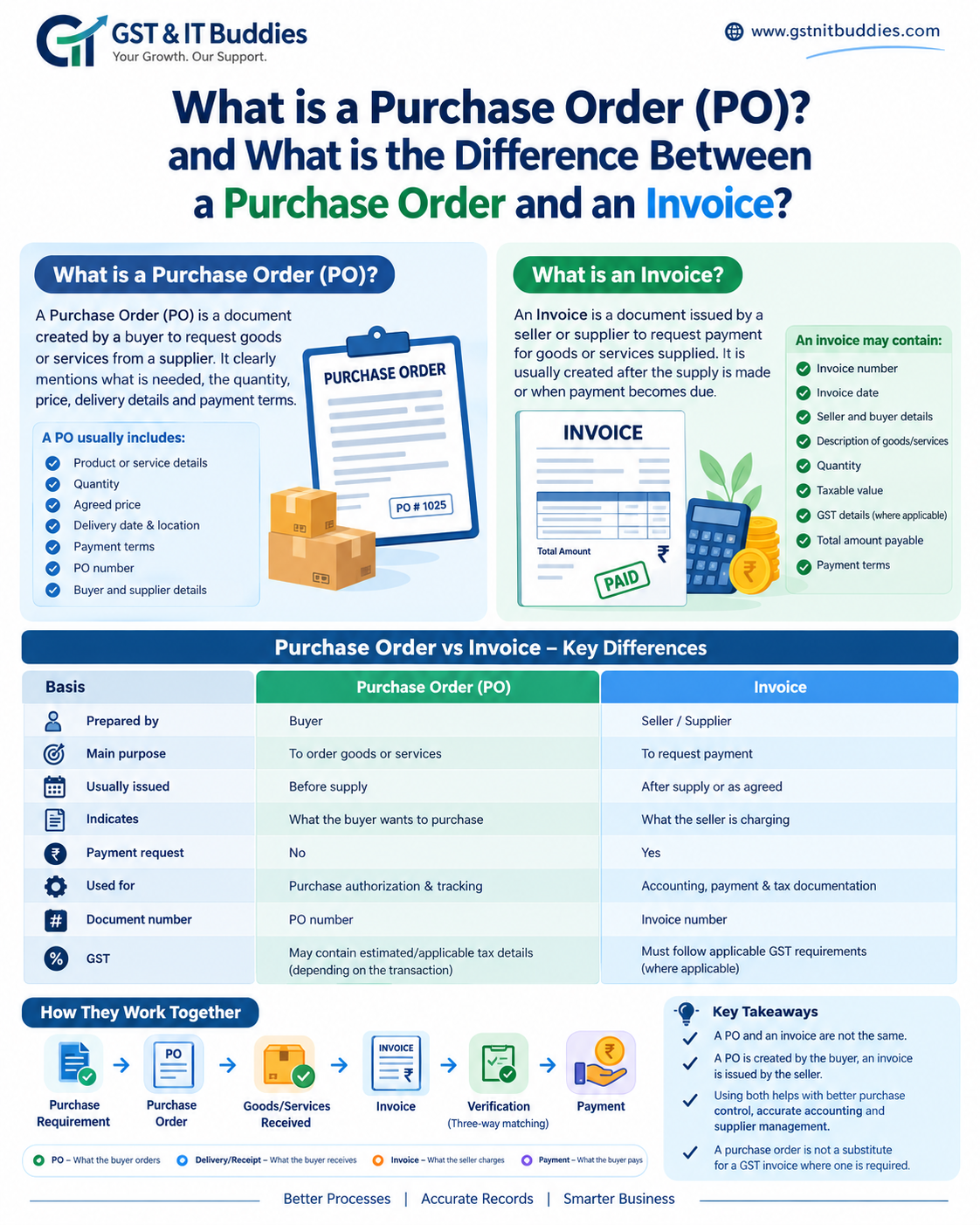
It usually includes details such as:
Products or services required
Quantity
Agreed price
Delivery date
Delivery location
Payment terms
Purchase order number
Buyer and supplier details
For example, suppose a company needs 50 office chairs. The company can create a PO specifying the type of chairs, quantity, agreed price, delivery date, and other terms and send it to the supplier.
Once the supplier accepts the purchase order, it becomes an important reference for fulfilling the order and checking the transaction later.
Why Is a Purchase Order Important? Purchase orders can help businesses create a more organized purchasing process.
-
Controls Business Purchases A PO allows a business to document purchases before they are made. This can help management monitor spending and avoid unnecessary purchases.
-
Creates a Clear Record The purchase order provides a written record of what the buyer requested from the supplier.
-
Reduces Communication Errors Details such as quantity, price, product specifications, and delivery requirements can be clearly documented.
-
Helps With Invoice Verification When the supplier sends an invoice, the buyer can compare it with the PO to check whether the billed goods or services match what was ordered.
-
Supports Internal Approval Businesses can use purchase orders as part of an internal approval process before committing to a purchase.
What Information Does a Purchase Order Contain? A typical PO may include:
Buyer Details: Business name, address, GSTIN, and contact information.
Supplier Details: Supplier's name, address, GSTIN, and contact information.
PO Number: A unique number used to identify the purchase order.
Order Details: Description of products or services, quantity, unit price, and applicable taxes.
Delivery Information: Expected delivery date and location.
Payment Terms: Agreed payment period or other payment conditions.
Terms and Conditions: Additional conditions relating to the purchase.
What Is an Invoice? An Invoice is a document issued by a seller or supplier to a buyer requesting payment for goods or services supplied.
Unlike a purchase order, which is generally created before the purchase is fulfilled, an invoice is generally issued when the supplier has supplied the goods or services or when payment becomes due under the agreed arrangement.
An invoice may contain:
Invoice number
Invoice date
Seller details
Buyer details
Description of goods or services
Quantity
Taxable value
GST rate and amount, where applicable
Total amount payable
Payment terms
Other legally required particulars
For GST-registered businesses in India, the tax invoice also needs to comply with applicable GST invoicing requirements.
Purchase Order vs Invoice: Key Difference The simplest way to understand the difference is:
Purchase Order = Buyer places an order
Invoice = Seller requests payment
Here is a quick comparison:
Basis Purchase Order (PO) Invoice Prepared by Buyer Seller/Supplier Main purpose To order goods or services To request payment Usually issued Before supply Usually after supply or as agreed Indicates What the buyer wants to purchase What the seller is charging Payment request No Yes Used for Purchase authorization and order tracking Accounting, payment, and tax documentation Document number PO number Invoice number GST May contain estimated/applicable tax details depending on the transaction GST tax invoice must follow applicable GST requirements where applicable Purchase Order vs Invoice Example Let's understand this with a simple example.
Suppose ABC Pvt. Ltd. wants to purchase 100 units of packaging material from a supplier.
Step 1: Purchase Order ABC Pvt. Ltd. sends a PO to the supplier:
Product: Packaging Material
Quantity: 100 units
Agreed price: ₹500 per unit
Delivery: 15 September
Payment terms: 30 days
The PO communicates the buyer's requirements to the supplier.
Step 2: Supplier Supplies the Goods The supplier delivers the 100 units according to the agreed terms.
Step 3: Supplier Issues an Invoice The supplier issues an invoice for the supplied goods, including the applicable GST and total amount payable.
Step 4: Buyer Verifies the Documents The buyer's accounts team can compare:
Purchase Order → Goods Received → Invoice
This process is commonly known as three-way matching and can help identify incorrect quantities, prices, or unauthorized charges.
Is a Purchase Order the Same as an Invoice? No. A purchase order and an invoice are not the same document.
A PO communicates the buyer's intention and requirements for a purchase, while an invoice records the seller's charge for goods or services and establishes the amount payable according to the transaction terms.
A business may use both documents as part of its procurement and accounting process.
Is a Purchase Order Mandatory? A purchase order is not universally mandatory for every business purchase. Whether a PO is required can depend on the company's internal policies, contractual arrangements, industry practices, and the nature of the transaction.
Many businesses use POs because they provide better control over purchasing and create a clear audit trail.
However, businesses should distinguish the internal procurement role of a PO from the legal and tax requirements applicable to invoices and other transaction documents.
Purchase Order and GST A common question among businesses is whether a PO itself is a GST document.
A purchase order is primarily a commercial/procurement document. It is not a substitute for a GST tax invoice where a tax invoice is required under GST law.
Businesses should ensure that their invoices meet the applicable GST requirements, including relevant details such as GSTIN, invoice number, date, taxable value, tax rate, and tax amount, as applicable to the transaction.
Benefits of Using Purchase Orders A structured PO system can provide several benefits:
Better Budget Control Businesses can review and approve purchases before placing orders.
Improved Supplier Management POs provide suppliers with clear instructions regarding products, quantities, pricing, and delivery.
Easier Accounting Accounts teams can use POs to verify invoices and maintain organized purchase records.
Reduced Risk of Duplicate or Unauthorized Purchases Unique PO numbers and approval processes can help businesses track purchases more effectively.
Better Audit Trail POs can connect the purchasing decision with the subsequent supply and invoice.
Purchase Order, Invoice and Payment: How They Connect A typical purchase cycle can look like this:
Purchase Requirement → Purchase Order → Goods/Services Received → Invoice → Verification → Payment
Each document has a different role:
PO: What the buyer orders
Delivery/Receipt Record: What the buyer receives
Invoice: What the seller charges
Payment Record: What the buyer pays
Keeping these records properly can make financial management and reconciliation easier.
Common Mistakes Businesses Should Avoid Businesses should be careful about:
Creating POs without proper approval
Entering incorrect quantities or prices
Not assigning unique PO numbers
Paying invoices without checking the underlying purchase
Failing to match invoices with purchase orders and receipt records
Maintaining incomplete supplier records
Treating a PO as a replacement for a required tax invoice
Ignoring applicable GST invoicing requirements
Conclusion A Purchase Order (PO) and an Invoice are both important business documents, but they have different purposes.
A PO is generally created by the buyer to communicate and authorize a purchase, while an invoice is issued by the seller to document the amount payable for goods or services supplied.
Using purchase orders along with proper invoice verification can help businesses improve purchase control, accounting accuracy, supplier management, and financial record-keeping.
For growing businesses, establishing a clear procurement and accounting process can make it easier to track purchases and reduce errors.
Frequently Asked Questions (FAQs)
-
What is a purchase order? A purchase order is a document issued by a buyer to a supplier specifying the goods or services the buyer wants to purchase.
-
What is the main difference between a PO and an invoice? A PO is used to place or authorize a purchase, while an invoice is used by the seller to request payment for goods or services.
-
Who creates a purchase order? The buyer or purchasing department generally creates the purchase order.
-
Who issues an invoice? The seller or supplier generally issues the invoice.
-
Can a purchase order replace an invoice? No. A purchase order does not replace an invoice where an invoice is required for accounting or tax purposes.
-
What is three-way matching? Three-way matching is the process of comparing the purchase order, receipt of goods/services, and supplier invoice before approving payment.
-
Is a PO required for every purchase? No. PO requirements depend on the business's internal policies, contracts, and transaction circumstances.