


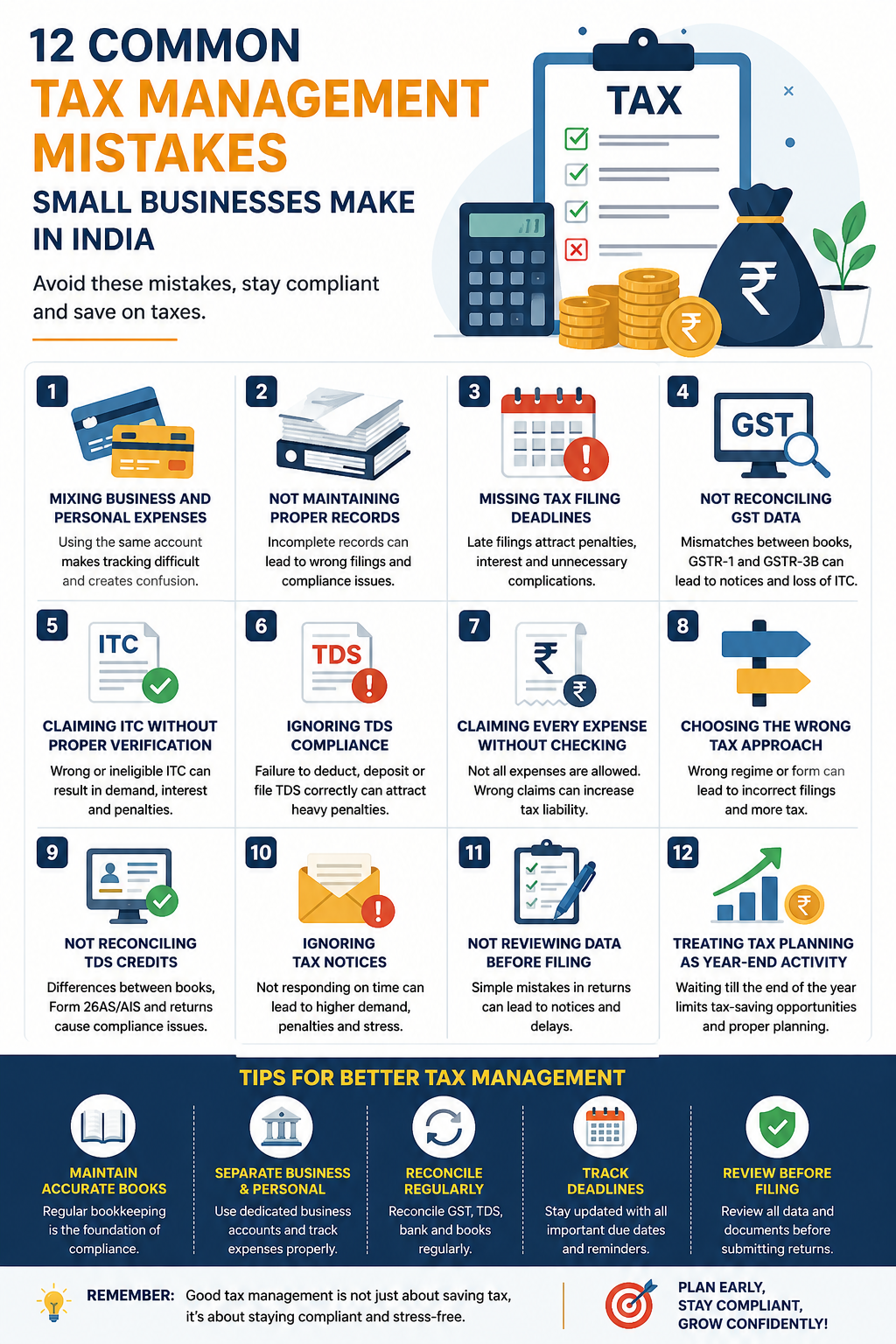
Running a small business in India involves much more than generating sales and managing customers. Business owners also need to stay on top of income tax, GST, TDS, accounting records, invoices, deductions, and filing deadlines. Tax management mistakes are often not intentional. They can occur due to incomplete records, missed deadlines, incorrect data, poor coordination between the accounting and tax teams, or simply a lack of awareness. The good news is that many of these mistakes can be avoided with proper planning and regular review. In this article, we discuss the most common tax management mistakes made by small businesses in India and practical ways to avoid them.
1. Mixing Business and Personal Expenses
One of the most common mistakes is using the same bank account or records for both personal and business expenses.
When personal and business transactions are mixed, it becomes difficult to determine the actual business expenses, profit, cash flow, and tax position.
How to avoid it
- Maintain a separate business bank account.
- Record business expenses regularly.
- Keep invoices and supporting documents.
- Avoid paying personal expenses from business funds whenever possible.
- Reconcile bank transactions with your accounting records.
Good bookkeeping makes tax preparation significantly easier.
2. Not Maintaining Proper Accounting Records
Some small businesses focus heavily on sales but do not maintain their books consistently.
Missing purchase invoices, sales records, expense bills, bank entries, and payment records can create problems during tax preparation.
The Income Tax Department also identifies incomplete business financial information as one type of issue that can result in a defective return.
How to avoid it
Maintain updated records for:
- Sales
- Purchases
- Business expenses
- Bank transactions
- Receivables
- Payables
- Fixed assets
- Loans
- GST transactions
- TDS transactions
Do not wait until the end of the financial year to organize everything.
3. Missing Tax Filing Deadlines
Another common tax management mistake is waiting until the last moment to complete compliance.
Businesses may have multiple recurring obligations, including GST returns, TDS-related compliance, advance tax where applicable, and income-tax return filing.
Missing a deadline can result in additional interest, late fees, or other consequences depending on the applicable provision.
How to avoid it
Create a tax compliance calendar containing:
- GST filing dates
- TDS compliance dates
- Advance tax dates, where applicable
- Income-tax return deadlines
- Annual return requirements
- Other business-specific compliance dates
Set reminders several days before each deadline.
4. Not Reconciling GST Data
GST-related mismatches can become a major problem when businesses do not regularly compare their accounting records with GST returns.
For example, differences can occur between:
Books → Sales invoices → GSTR-1 → GSTR-3B
Businesses should regularly review taxable value, GST amounts, credit/debit notes, and other relevant details.
The GST system also provides processes and tools involving information from returns such as GSTR-1 and GSTR-3B, making accurate reporting and reconciliation important.
How to avoid it
Perform regular reconciliation of:
- Sales register with GSTR-1
- Tax liability with GSTR-3B
- Purchase records with available GST data
- Input tax credit
- Credit notes and debit notes
- E-invoice information, where applicable
Early reconciliation is much easier than correcting several months of accumulated differences.
5. Claiming Input Tax Credit Without Proper Verification
Input Tax Credit can reduce a business's GST liability, but businesses should not treat every purchase invoice as automatically eligible for credit.
Errors can occur because of incorrect GSTINs, missing invoices, duplicate entries, ineligible expenses, or differences between books and GST records.
How to avoid it
Before claiming ITC, establish a process to verify:
- Supplier details
- GSTIN
- Invoice number
- Invoice date
- Taxable value
- GST amount
- Nature of purchase
- Eligibility of the credit
- Availability of supporting documentation
A proper reconciliation process can reduce the risk of incorrect claims.
6. Ignoring TDS Compliance
Businesses often remember income tax and GST but overlook their TDS responsibilities.
Depending on the nature of payments, TDS may apply to payments such as professional fees, contractor payments, rent, commission, and other specified transactions.
From 1 April 2026, the Income Tax Act, 2025 replaced the Income Tax Act, 1961, and TDS provisions were reorganized under the new framework. The Income Tax Department notes that the applicable Act depends on when the relevant payment or credit event occurred.
How to avoid it
Before making specified payments:
- Identify whether TDS applies.
- Determine the applicable rate and threshold.
- Deduct tax at the appropriate time.
- Deposit it within the applicable deadline.
- File the relevant TDS statement.
- Provide the required documentation to the payee.
TDS errors can create additional tax, interest, penalties, and reporting problems.
7. Claiming Every Expense Without Checking Its Tax Treatment
Some business owners assume that every expense appearing in their books automatically reduces taxable income.
That is not always the case.
Expenses need to be reviewed according to the applicable tax rules, and certain expenses may be subject to specific conditions, documentation requirements, payment restrictions, or disallowance provisions.
How to avoid it
Keep supporting documents such as:
- Invoices
- Receipts
- Contracts
- Payment proofs
- Bank statements
- Agreements
- Expense approvals
Also separate personal expenses from genuine business expenses.
8. Choosing the Wrong Tax or Filing Approach
Small businesses sometimes choose a tax regime, return form, or filing approach without considering whether it actually applies to their circumstances.
The correct filing form depends on factors such as the taxpayer's income, business activity, and other applicable conditions. The Income Tax Department specifically advises taxpayers to choose the correct ITR form.
How to avoid it
Before filing, review:
- Business structure
- Nature of business
- Sources of income
- Turnover
- Applicable tax provisions
- Tax regime, where relevant
- Applicable ITR form
- Books and financial statements
When the situation is complicated, professional tax advice can help avoid costly errors.
9. Not Reconciling TDS Credits
A business may deduct or receive TDS, but the amount recorded in the books may not always match the information reflected in the relevant tax records.
The Income Tax Department identifies mismatches between TDS credits and reported income/receipts as one cause of defective returns.
How to avoid it
Regularly compare:
Books → TDS records → Form 26AS/AIS → Income-tax return
Investigate differences before filing the return instead of waiting for a notice.
10. Ignoring Tax Notices
Some business owners receive an income-tax or GST communication and postpone responding because they are unsure what it means.
Ignoring a notice can make the situation more complicated.
For example, the Income Tax Department states that where a defective return is not corrected or responded to within the applicable period, the return can be treated as invalid.
How to avoid it
Whenever you receive a tax communication:
- Read the notice carefully.
- Check the relevant assessment/tax period.
- Identify the issue.
- Check the response deadline.
- Collect supporting documents.
- Seek professional assistance when necessary.
- Submit the response through the appropriate portal/process.
11. Not Reviewing Tax Data Before Filing
Rushing through a return can lead to simple but important errors.
The Income Tax Department highlights issues such as incorrect taxpayer details, incorrect bank information, failure to claim applicable deductions, choosing the wrong ITR form, and confusion between financial/assessment periods among common filing mistakes.
How to avoid it
Before submitting a return, review:
- PAN details
- Business details
- Bank account
- Turnover
- Income
- Expenses
- TDS
- Tax payments
- Deductions
- GST information where relevant
- Financial statements
- Tax computation
A final review can prevent avoidable corrections later.
12. Treating Tax Planning as a Year-End Activity
Tax planning should not begin only when the return filing deadline approaches.
Waiting until the end of the year can make it harder to identify legitimate tax-saving opportunities, manage cash flow, or correct accounting issues.
Better approach
Review your tax position throughout the year.
A quarterly review can cover:
Revenue → Expenses → Profit → GST → TDS → Tax liability → Cash flow
This gives the business owner a much clearer picture of upcoming tax obligations.
How Small Businesses Can Improve Tax Management
A simple tax-management system can significantly reduce compliance problems.
Follow these five steps:
1. Maintain accurate books
Update accounting records regularly.
2. Separate personal and business transactions
Use dedicated business accounts and proper expense records.
3. Reconcile regularly
Compare books with GST, TDS, bank, and other relevant records.
4. Track deadlines
Maintain a compliance calendar with reminders.
5. Review before filing
Never submit a tax return without checking the underlying data.
Tax Management Checklist for Small Businesses
Before closing a financial period, ask:
☑ Are all sales recorded?
☑ Are purchase and expense invoices available?
☑ Are bank transactions reconciled?
☑ Are GST returns consistent with the books?
☑ Has eligible ITC been properly reviewed?
☑ Have applicable TDS obligations been checked?
☑ Do TDS records match the books?
☑ Are tax payments properly recorded?
☑ Are financial statements updated?
☑ Have tax notices, if any, been reviewed?
☑ Are upcoming compliance deadlines tracked?
Final Thoughts
Effective tax management is not simply about paying less tax. It is about paying the correct amount of tax, maintaining proper records, meeting compliance deadlines, and reducing avoidable errors.
For small businesses in India, regular bookkeeping, GST reconciliation, TDS review, accurate income reporting, and timely filing can make tax compliance much more manageable.
As tax laws and compliance requirements can change, businesses should verify the applicable rules for their specific situation and tax period before taking action.
Frequently Asked Questions
What are the most common tax mistakes made by small businesses?
Common mistakes include poor bookkeeping, mixing personal and business expenses, missing deadlines, GST mismatches, incorrect TDS compliance, inadequate documentation, incorrect ITR selection, and failing to respond to tax notices.
How can a small business avoid tax mistakes?
Maintain accurate books, separate business and personal transactions, reconcile GST and TDS information regularly, track deadlines, keep supporting documents, and review tax returns before filing.
Why is GST reconciliation important for small businesses?
GST reconciliation helps identify differences between accounting records and GST filings, allowing businesses to investigate and correct discrepancies before they become larger compliance issues.
Is tax planning important for small businesses?
Yes. Regular tax planning helps businesses understand potential tax liabilities, manage cash flow, maintain documentation, and make informed financial decisions throughout the year.
Should a small business hire a tax professional?
Businesses with complex transactions, multiple tax obligations, significant turnover, or recurring compliance issues may benefit from professional tax and accounting assistance