

Introduction For many business owners, profit and cash flow may appear to mean the same thing. However, they measure two very different aspects of a business's financial health. A company can report a healthy profit but still struggle to pay its bills because cash has not yet been collected from customers. Similarly, a business may have plenty of cash available while generating little or no profit. Understanding cash flow vs profit is therefore essential for making better financial decisions, managing working capital, and maintaining the long-term stability of a business. In this article, we explain the difference between cash flow and profit, how they are calculated, why both matter, and how businesses can monitor them effectively.
What Is Profit?
Profit is the amount left after a business deducts its expenses from its revenue over a particular accounting period.
Basic Profit Formula
Profit = Revenue – Expenses
For example, suppose a business generates:
- Revenue: ₹10,00,000
- Business expenses: ₹7,00,000
The business's profit would be:
₹10,00,000 – ₹7,00,000 = ₹3,00,000
Profit indicates whether the business is economically generating more revenue than it spends.
However, profit does not necessarily mean that the business has ₹3,00,000 sitting in its bank account.
What Is Cash Flow?
Cash flow refers to the movement of actual money into and out of a business.
Cash inflows may include:
- Customer payments
- Business loans
- Investment received
- Sale of assets
Cash outflows may include:
- Salaries
- Rent
- Supplier payments
- Loan repayments
- Taxes
- Purchase of equipment
Cash flow is generally divided into three categories:
1. Operating Cash Flow
Cash generated or used through the company's regular business operations.
2. Investing Cash Flow
Cash related to purchasing or selling assets, investments, equipment, or property.
3. Financing Cash Flow
Cash received or paid through activities such as loans, investments, or repayment of borrowings.
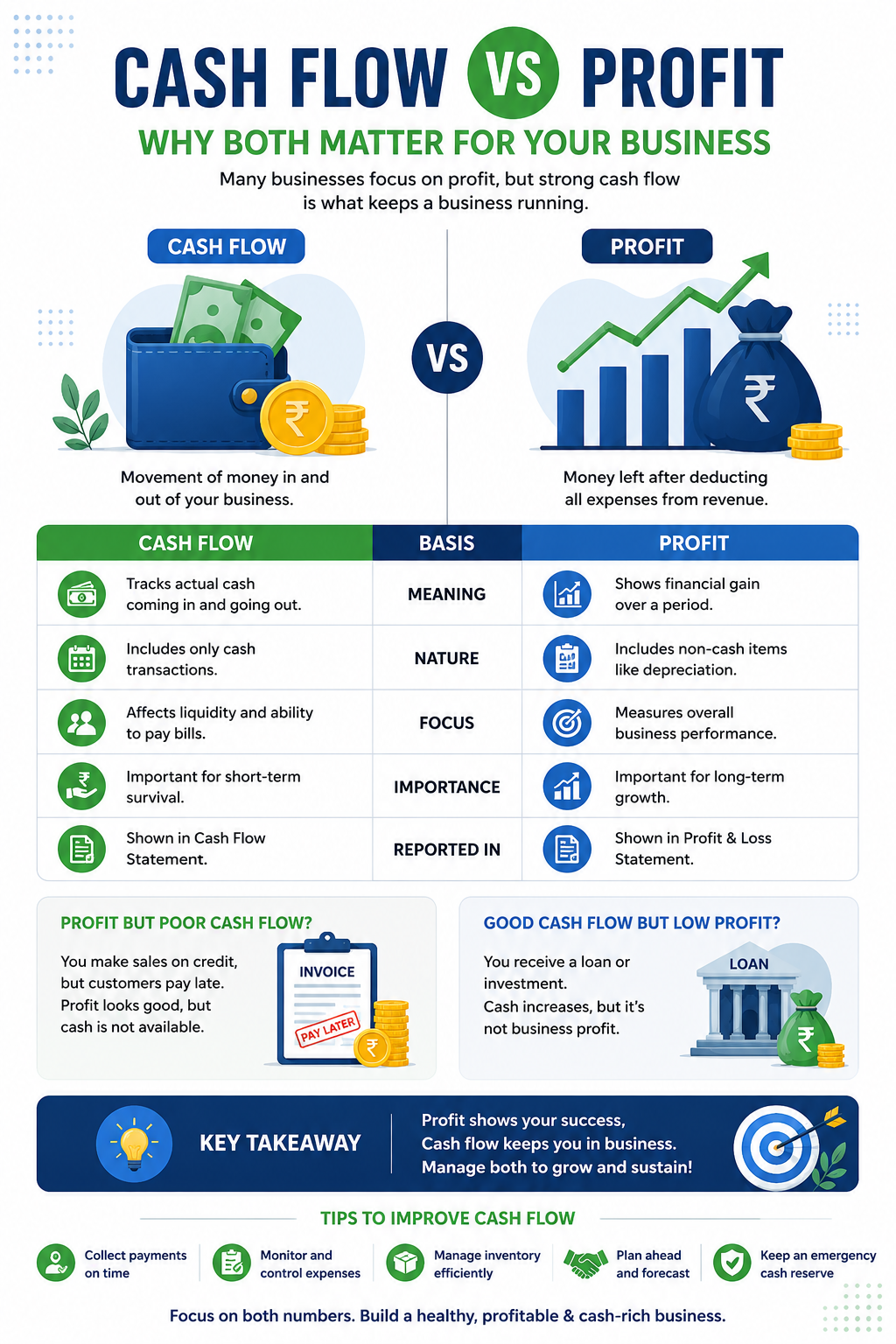
Cash Flow vs Profit: Key Difference
| Basis | Profit | Cash Flow |
|---|---|---|
| Meaning | Revenue remaining after expenses | Movement of actual cash |
| Focus | Business profitability | Liquidity |
| Includes credit sales? | Yes | Not until cash is collected |
| Includes depreciation? | Generally yes | No direct cash movement |
| Useful for | Measuring profitability | Managing day-to-day liquidity |
| Main statement | Profit & Loss Statement | Cash Flow Statement |
The key point is simple:
Profit tells you whether your business is profitable. Cash flow tells you whether your business has enough cash available to meet its financial obligations.
How Can a Business Be Profitable but Have Poor Cash Flow?
This is one of the most important concepts for business owners.
Imagine a company makes a sale worth ₹5,00,000 on credit. The sale is recorded as revenue, but the customer will pay after 90 days.
The business may recognize profit from the transaction, but it does not yet have ₹5,00,000 in cash.
Meanwhile, the company may need to pay:
- Employees
- Suppliers
- Rent
- Taxes
- Utility bills
If customers delay their payments, the business could face a cash shortage despite reporting a profit.
This is why accounts receivable management and cash flow management are critical.
Can a Business Have Positive Cash Flow but Low Profit?
Yes.
For example, a business may receive:
- ₹10 lakh as a business loan
- ₹2 lakh from customers
The company now has significant cash available. However, the ₹10 lakh loan is not business profit—it is a financing inflow that creates a repayment obligation.
Therefore, positive cash flow does not automatically mean the business is profitable.
Why Profit Matters
Profit is important because it helps businesses understand their financial performance.
1. Measures Business Performance
Profit helps determine whether revenue is sufficient to cover business costs.
2. Supports Growth
Consistent profits can provide funds for expansion, hiring, marketing, and investment.
3. Helps Attract Investors
Investors often evaluate profitability and margins when assessing a business.
4. Supports Tax Planning
Business income and expenses form an important part of tax and accounting calculations.
5. Helps Measure Long-Term Sustainability
A business that continuously generates losses may struggle to remain sustainable over time.
Why Cash Flow Matters
Even a profitable business needs sufficient cash to operate.
1. Pay Employees on Time
Regular cash flow helps businesses meet salary obligations.
2. Pay Suppliers
Healthy cash availability allows businesses to maintain relationships with vendors.
3. Manage Taxes and Compliance
Businesses need cash to meet tax and regulatory payment obligations.
4. Handle Unexpected Expenses
Strong cash reserves can help businesses manage emergencies or sudden expenses.
5. Avoid Excessive Borrowing
Effective cash flow management can reduce the need for short-term borrowing.
Which Is More Important: Profit or Cash Flow?
The answer is both.
Profit without cash flow can create liquidity problems.
Cash flow without profitability may not be sustainable in the long run.
Think of it this way: Profit measures financial success, while cash flow supports financial survival.
A healthy business should therefore monitor both metrics regularly.
How Businesses Can Improve Cash Flow
Businesses can take several practical steps to strengthen cash management.
1. Collect Receivables Faster
Set clear payment terms and follow up on overdue invoices.
2. Monitor Expenses
Review recurring and unnecessary expenses regularly.
3. Maintain a Cash Flow Forecast
Estimate expected cash inflows and outflows for the coming weeks or months.
4. Manage Inventory Carefully
Excess inventory can tie up valuable business capital.
5. Negotiate Supplier Terms
Where appropriate, negotiate payment terms that align with your business's cash cycle.
6. Maintain an Emergency Cash Reserve
Keeping an appropriate reserve can help manage unexpected financial requirements.
7. Review Financial Reports Regularly
Regular accounting reports can help identify cash shortages, rising expenses, delayed collections, and declining profitability early.
How Accounting Helps Track Profit and Cash Flow
Proper accounting allows business owners to monitor both profitability and liquidity.
Important financial reports include:
- Profit & Loss Statement
- Balance Sheet
- Cash Flow Statement
- Accounts Receivable Report
- Accounts Payable Report
- Expense Reports
Reviewing these reports regularly gives business owners a clearer picture of where their money is coming from and where it is going.
Common Mistakes Businesses Make
Mistake 1: Assuming Profit Means Cash
A profitable business can still experience a cash shortage.
Mistake 2: Ignoring Outstanding Receivables
Uncollected invoices can significantly affect available cash.
Mistake 3: Not Forecasting Future Cash Requirements
Businesses may struggle when large payments become due unexpectedly.
Mistake 4: Mixing Personal and Business Finances
This can make it difficult to understand the company's actual financial position.
Mistake 5: Looking at Financial Statements Only Once a Year
Regular monitoring can help identify problems before they become serious.
Frequently Asked Questions
Is cash flow the same as profit?
No. Profit measures revenue minus expenses, while cash flow tracks actual money entering and leaving the business.
Can a profitable business have negative cash flow?
Yes. Delayed customer payments, large purchases, loan repayments, or other cash outflows can result in negative cash flow even when the business reports a profit.
Can a business have positive cash flow but make a loss?
Yes. Borrowings, investments, or asset sales can increase cash without increasing operating profit.
Which report shows profit?
Profit is primarily reported through the Profit & Loss Statement, also known as the Income Statement.
Which report shows cash movement?
The Cash Flow Statement shows cash inflows and outflows during a particular period.
Final Thoughts
Understanding cash flow vs profit is essential for every business owner.
Profit helps you determine whether your business model is financially successful, while cash flow helps you determine whether your business can meet its immediate financial obligations.
A successful business should not focus only on increasing sales or reporting profits. It should also ensure that cash is collected efficiently, expenses are controlled, and sufficient liquidity is maintained. Monitor profit. Manage cash flow. Make better financial decisions.If you're struggling to understand your business's financial position, maintaining accurate books of accounts and reviewing financial reports regularly can make a significant difference.