

The Goods and Services Tax Network (GSTN) continues to expand its digitised compliance framework across India. E-invoicing under GST is no longer just a requirement for corporate giants; it is an everyday reality for lakhs of small and medium-sized businesses. If your business crosses the government-mandated turnover line, generating a standard invoice is no longer legally sufficient. Missing or delaying an e-invoice can lead to extreme financial penalties, halted supply chains, and furious corporate clients who cannot claim their tax credits. This complete guide breaks down exactly who must comply, how to generate an e-invoice step-by-step, and the penalties for missing your window.
1. Who Must Comply with E-Invoicing?
The Indian government introduced electronic invoicing in a phased manner to minimize disruption. Today, the threshold is the lowest it has ever been.
The Turnover Threshold
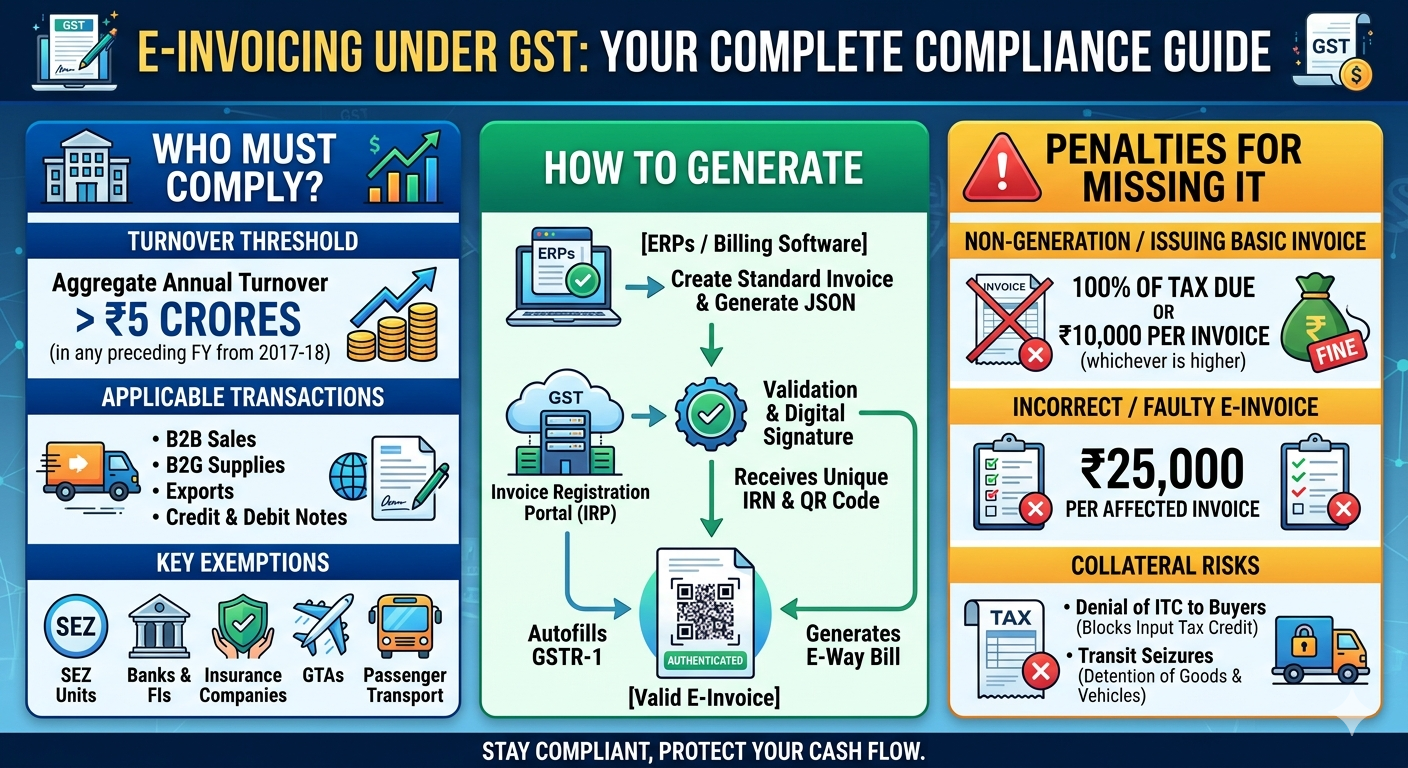
- The ₹5 Crore Baseline: Any registered business whose Aggregate Annual Turnover (AATO) exceeds ₹5 Crores in any preceding financial year (from 2017–18 onwards) must mandatorily implement e-invoicing.
- The 30-Day Reporting Window: If your business turnover is ₹10 Crores or more, strict regulations mandate that you must report your invoices to the government registration portal within 30 days of the invoice generation date. Invoices older than 30 days will be systematically blocked from processing.
Applicable Transactions
E-invoicing does not apply to retail sales made directly to standard end-consumers. It is explicitly required for:
- Business-to-Business (B2B) sales
- Business-to-Government (B2G) transactions
- Supplies for Export
- Credit Notes and Debit Notes related to these supplies
Core Exemptions
Even if their turnover exceeds ₹5 Crores, specific entities remain entirely exempt from generating e-invoices:
- Special Economic Zone (SEZ) Units
- Insurance Companies, Banks, and Financial Institutions
- Goods Transport Agencies (GTAs)
- Passenger Transport Services
- Movie Theaters / Multiplex Admissions
2. How to Generate an E-Invoice Step-by-Step
A common misconception is that you must log onto a government portal and manually type up an entire invoice. In reality, e-invoicing is a backend verification process. [1]
[Create standard invoice in ERP/Billing software]
                     ⬇️
[Export standard format file (JSON)]
                     ⬇️
[Upload JSON file to Invoice Registration Portal (IRP)]
                     ⬇️
[IRP verifies and stamps data with unique IRN and QR Code]
                     ⬇️
[Print/Issue final authenticated e-invoice to your buyer]
Step 1: Invoicing via your ERP
You create a standard tax invoice on your local billing or accounting software (such as Tally, Zoho Books, or specialised Saniiro GST software). Your system must capture mandatory details such as Supplier GSTIN, Recipient GSTIN, HSN Codes, and precise tax calculations.
Step 2: Payload Generation
Your software automatically converts this commercial invoice data into a standardised electronic file type known as a JSON schema file.
Step 3: Portal Submission & Authentication
The JSON file is sent to the official government Invoice Registration Portal (IRP) (either through direct GSP/API integration or manual portal upload).
Step 4: The Digital Stamp
The IRP verifies the structural fields of your file. Once validated, the system performs two essential tasks:
- It builds a 64-character alphanumeric Invoice Reference Number (IRN) unique to that document.
- It signs the payload with a secure government QR Code.
Step 5: Distribution
The portal automatically transmits this authenticated data directly into your GSTR-1 return portal and copies the details over to the E-Way Bill portal for shipping needs. You can now safely print the invoice with its new QR code and hand it over to your customer.
3. High-Cost Penalties for Non-Compliance
Operating a business over the ₹5 Crore threshold without validating your data via the IRP carries immediate, steep statutory fines under Section 122 of the CGST Act.
| Type of Violation | Financial Penalty Incurred |
|---|---|
| Failure to generate an E-Invoice (Issuing a traditional invoice instead) | 100% of the tax due on that supply OR ₹10,000 per invoice (whichever amount is higher). |
| Incorrect or Faulty E-Invoicing (Filing wrong values, mismatching calculations) | ₹25,000 per affected invoice. |
The Collateral Risks of Missing Your E-Invoices
Beyond basic flat-rate government fines, failing to compute an IRN creates severe operational blockades for your day-to-day trading:
- Your Invoice is Legally Invalid: Under Rule 48(4), any invoice issued by an applicable business that lacks a registered IRN is legally treated as if no invoice was ever issued.
- Denial of Input Tax Credit (ITC): Your corporate B2B clients cannot use an invalid invoice to claim their Input Tax Credits. If your buyers discover they are losing out on their tax offsets because your systems are non-compliant, they may completely stop payments or terminate your business relationship.
- Transit Seizures: Transporting heavy commercial freight with a basic invoice that has no matching IRP documentation can result in the immediate detention of your delivery vehicle and physical goods by on-road tax authorities.