

Every regular GST taxpayer has one big task at year-end: the annual return. For most businesses, GSTR-9 for a financial year is due by 31 December of the following year. GSTR-9 is not just a formality. It is a summary of everything you reported in your monthly or quarterly returns during the year. Mistakes here can lead to notices, demands and late fees. This guide explains who must file GSTR-9 and GSTR-9C, what you need ready, and how to file it step by step, in simple language.
What are GSTR-9 and GSTR-9C?
GSTR-9 is the annual return filed by regular taxpayers registered under GST. It combines the details of outward supplies, inward supplies, input tax credit (ITC), tax paid, refunds and demands for the whole financial year. It is filed under Section 44 of the CGST Act.
GSTR-9C is a reconciliation statement. It matches the figures in your GSTR-9 with your audited financial statements (books of accounts). Since 1 August 2021, GSTR-9C is self-certified by the taxpayer. A CA or CMA certification is no longer mandatory.
In simple words: GSTR-9 says what you reported to GST during the year. GSTR-9C checks whether that matches your books.
Who must file GSTR-9 and GSTR-9C?
The rule depends on your registration type and your aggregate annual turnover (AATO) for the year.
|
Taxpayer type / turnover |
GSTR-9 |
GSTR-9C |
|---|---|---|
|
Regular taxpayer, turnover up to ₹2 crore |
Optional (exemption notified for recent years; check the notification for your year) |
Not required |
|
Regular taxpayer, turnover above ₹2 crore and up to ₹5 crore |
Mandatory |
Not required |
|
Regular taxpayer, turnover above ₹5 crore |
Mandatory |
Mandatory |
|
Composition taxpayer |
Not required (files GSTR-4 instead) |
Not required |
|
Casual taxable person, non-resident taxable person, ISD, TDS/TCS deductor, OIDAR provider |
Not required |
Not required |
If you switched between composition and regular scheme during the year, you may need to file both GSTR-4 and GSTR-9 for the respective periods.
Even when GSTR-9 is optional, many businesses still file it voluntarily. It gives a clean year-end record and helps when the department asks questions later.
Due date and late fee
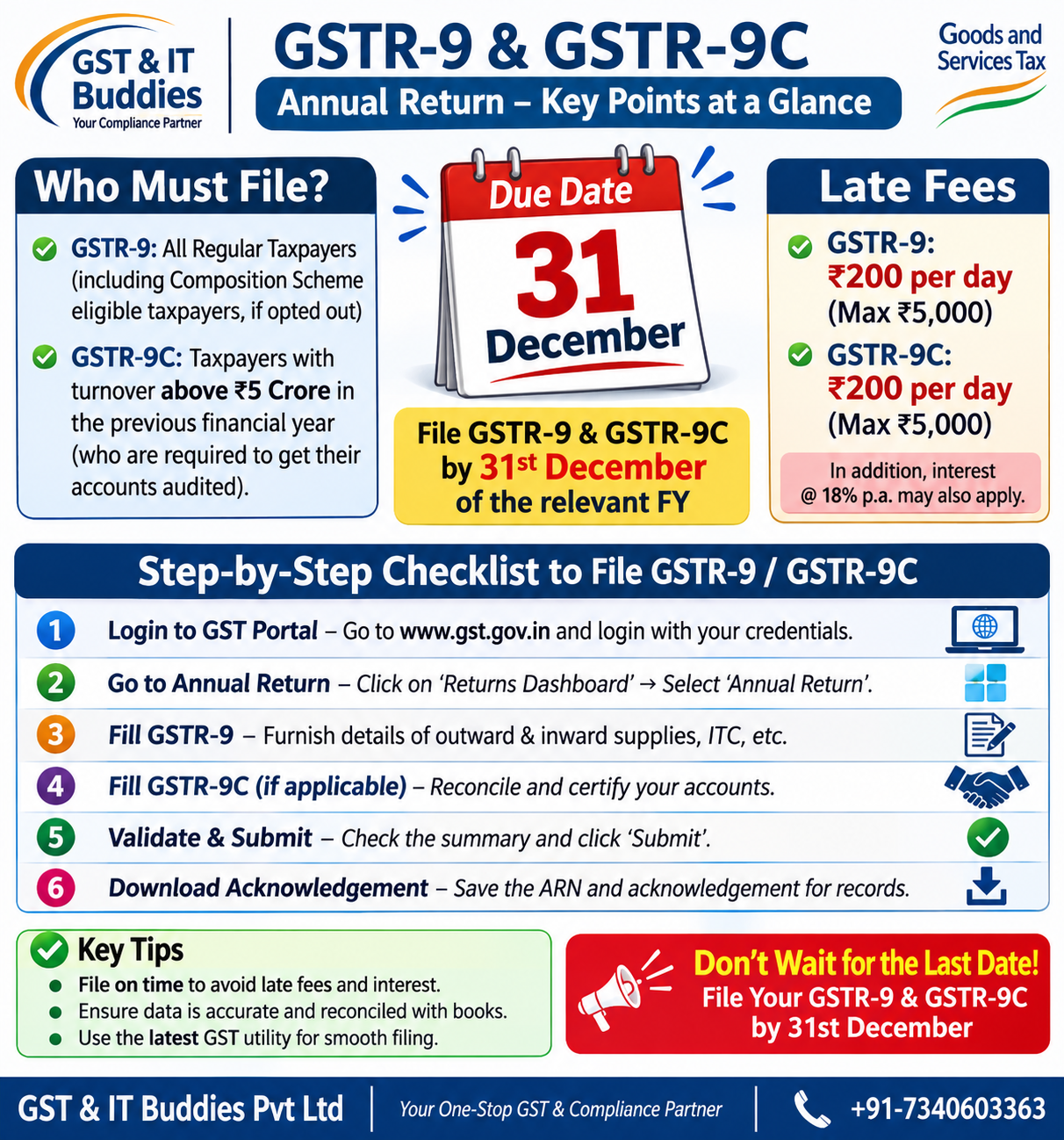
The due date for GSTR-9 and GSTR-9C is 31 December following the end of the financial year. So for FY 2025-26, the deadline is 31 December 2026, unless the government extends it.
If you miss the deadline, late fees apply per day of delay. For FY 2022-23 onwards, the late fee for GSTR-9 is:
- Turnover up to ₹5 crore: ₹50 per day (₹25 CGST + ₹25 SGST), capped at 0.04% of turnover in the state or UT.
- Turnover above ₹5 crore up to ₹20 crore: ₹100 per day (₹50 CGST + ₹50 SGST), capped at 0.04% of turnover in the state or UT.
- Turnover above ₹20 crore: ₹200 per day (₹100 CGST + ₹100 SGST), capped at 0.5% of turnover in the state or UT.
Also note: under the time limit introduced by the Finance Act 2023, a GST return generally cannot be filed after three years from its due date. So old pending annual returns should not be delayed further.
Checklist before you file
Keep these ready before you log in to the GST portal:
- All GSTR-1 and GSTR-3B filed for the full year. The portal will not let you file GSTR-9 if any return is pending.
- Sales reconciliation: match your sales register with GSTR-1 and GSTR-3B, month by month.
- ITC reconciliation: match ITC claimed in GSTR-3B with your purchase register and GSTR-2B.
- Amendments and credit/debit notes: list all changes made in later months, including those reported up to the following year's deadline.
- ITC reversals: collect details of reversals under Rule 42, Rule 43, Section 17(5) and Rule 37 (non-payment within 180 days).
- HSN summary: prepare HSN-wise details of outward and inward supplies.
- Tax paid details: cash and ITC used, interest, late fee and penalty paid during the year.
- Audited financial statements: needed for GSTR-9C if your turnover is above ₹5 crore.
- Demands and refunds: note any refund claimed or demand raised for the year.
How to file GSTR-9 on the GST portal: step by step
- Log in at gst.gov.in with your username and password.
- Go to Services > Returns > Annual Return.
- Select the financial year and click Search.
- Answer the questionnaire (for example, whether you want to file a nil return).
- Download the system-computed GSTR-9 and the GSTR-1, GSTR-3B summaries to compare.
- Fill or edit each table online, or use the offline tool for large data.
- Click Compute Liabilities. Pay any additional tax through DRC-03 if your reconciliation shows short payment.
- Preview the draft GSTR-9 and check every figure carefully.
- File with DSC or EVC. Download the filed return for your records.
- If GSTR-9C applies, file it after GSTR-9 from the same Annual Return section.
Common mistakes to avoid
- Copying auto-filled figures blindly. The portal pre-fills data from GSTR-1 and GSTR-3B, but it may not match your books.
- Ignoring ITC mismatch. A gap between GSTR-3B and GSTR-2B is a common trigger for notices.
- Missing next-year amendments. Credit notes and corrections for the year made in the following months must be shown in the right tables.
- Wrong HSN codes. HSN-wise reporting must match your invoices.
- Not paying short tax before filing. Extra liability found during reconciliation should be paid through DRC-03, with interest.
- Waiting till the last week. The portal gets slow near 31 December. Start at least two to three weeks early.
Frequently asked questions
Q1. Can GSTR-9 be revised after filing? No. Once filed, GSTR-9 cannot be revised. Check every figure before you submit.
Q2. Is GSTR-9 required if I had no business during the year? If you are a regular taxpayer who had no supplies, you can file a nil GSTR-9, subject to the turnover-based exemption for your year.
Q3. Do I need a CA to file GSTR-9C? No. GSTR-9C is now self-certified. But professional help is useful because it involves matching GST data with audited books.
Q4. Can I claim missed ITC through GSTR-9? No. GSTR-9 is only a reporting return. You cannot claim new ITC in it.
Q5. What happens if I find extra tax liability while filing? Pay it through Form DRC-03 along with interest, and then file GSTR-9.
Q6. I have multiple GSTINs. Do I file one return? No. GSTR-9 is filed separately for each GSTIN (each state registration).
Need help with your GST annual return?
GSTR-9 and GSTR-9C need careful reconciliation, and one wrong figure can lead to a notice later. The team at GST & IT Buddies can reconcile your books, file your annual return and handle GSTR-9C before the 31 December deadline.
Contact GST & IT Buddies today and get your annual return filed on time, without stress.
Disclaimer: This article is for general information only and does not constitute legal or tax advice. GST rules, due dates, exemptions and late fees can change through government notifications and circulars. Please check the latest updates on the official GST portal (gst.gov.in) and CBIC website, or consult a qualified professional before making any decision.