


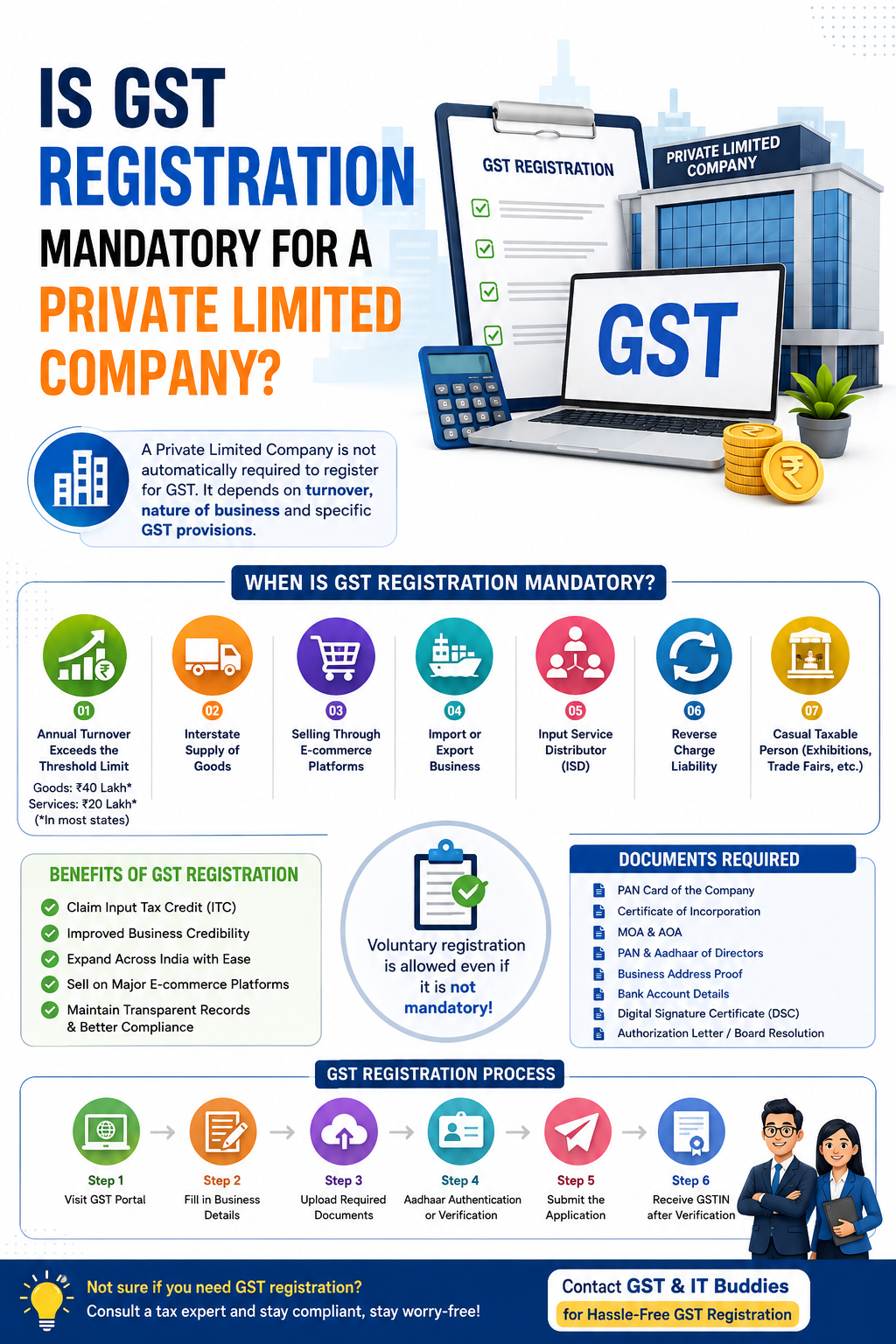
The answer is not always. While many private limited companies are required to obtain GST registration, it depends on the nature of the business, turnover, and specific GST provisions. In this guide, we'll explain everything you need to know in simple language.
What is GST Registration?
GST (Goods and Services Tax) registration is the process through which a business obtains a unique GST Identification Number (GSTIN). Once registered, the business can legally collect GST from customers, claim Input Tax Credit (ITC), and comply with GST laws.
Is GST Registration Compulsory for a Private Limited Company?
A Private Limited Company is not automatically required to register for GST simply because of its company structure.
GST registration becomes mandatory only when the company satisfies certain conditions under the GST Act.
When is GST Registration Mandatory?
A Private Limited Company must register for GST if it falls under any of the following situations:
1. Annual Turnover Exceeds the Threshold Limit
GST registration becomes compulsory when the aggregate annual turnover exceeds the prescribed limit.
Current general thresholds are:
- Goods: Up to ₹40 lakh (in eligible states)
- Services: Up to ₹20 lakh
- Special category states have lower limits.
2. Interstate Supply of Goods
If your company supplies taxable goods from one state to another, GST registration may become mandatory depending on applicable provisions.
3. Selling Through E-commerce Platforms
If your company sells products or services through marketplaces like:
- Amazon
- Flipkart
- Meesho
- Myntra
GST registration is generally required in many cases.
4. Import or Export Business
Companies involved in imports or exports generally require GST registration to comply with tax regulations and claim eligible benefits.
5. Input Service Distributor (ISD)
Companies functioning as an Input Service Distributor must obtain GST registration.
6. Reverse Charge Liability
Businesses liable to pay tax under the Reverse Charge Mechanism (RCM) may need GST registration depending on applicable provisions.
7. Casual Taxable Person
Businesses operating temporarily in another state or participating in exhibitions and trade fairs may require GST registration.
When is GST Registration Not Mandatory?
A Private Limited Company may not require GST registration if:
- Annual turnover is below the applicable threshold.
- The business deals exclusively in exempt goods or exempt services.
- None of the compulsory registration provisions apply.
However, many companies still choose voluntary registration.
Benefits of GST Registration for a Private Limited Company
1. Claim Input Tax Credit (ITC)
Registered businesses can claim credit for GST paid on purchases.
2. Improved Business Credibility
A GSTIN increases trust among customers, vendors, and financial institutions.
3. Expand Across India
GST registration enables businesses to operate more smoothly across multiple states while complying with tax requirements.
4. Sell on Major E-commerce Platforms
Many online marketplaces require sellers to have GST registration.
5. Better Compliance
GST registration helps maintain transparent tax records and supports smoother audits.
Documents Required for GST Registration
Typically, you'll need:
- PAN Card of the company
- Certificate of Incorporation
- Memorandum of Association (MOA)
- Articles of Association (AOA)
- PAN and Aadhaar of directors
- Business address proof
- Bank account details
- Digital Signature Certificate (DSC), where applicable
- Authorization letter or Board Resolution (if required)
GST Registration Process
Step 1
Visit the GST portal.
Step 2
Fill in business details.
Step 3
Upload the required documents.
Step 4
Complete Aadhaar authentication or verification.
Step 5
Submit the application.
Step 6
Receive your GSTIN after successful verification.
Consequences of Not Registering for GST
If GST registration is mandatory and the company fails to register, it may face:
- Monetary penalties
- Interest on unpaid tax
- Difficulty claiming Input Tax Credit
- Compliance notices from tax authorities
- Business disruptions
Frequently Asked Questions (FAQs)
Is GST registration compulsory immediately after company incorporation?
No. Incorporating a Private Limited Company does not automatically require GST registration. Registration becomes necessary only if applicable GST conditions are met.
Can a Private Limited Company voluntarily register for GST?
Yes. Even if registration is not mandatory, businesses can opt for voluntary GST registration to avail benefits like Input Tax Credit and enhanced credibility.
Can a company operate without GST?
Yes, if it does not fall under mandatory registration provisions and remains below the applicable threshold limits.
Is GST mandatory for software companies?
It depends on turnover, the nature of services provided, and whether compulsory registration provisions apply.
Is GST registration required before opening a business bank account?
No. Most banks allow companies to open a current account using incorporation documents. GST registration is generally not mandatory for opening the account.
Conclusion
A Private Limited Company does not need GST registration solely because it is incorporated. Registration becomes mandatory only when the business crosses the prescribed turnover limits or falls under compulsory registration provisions, such as interstate taxable supplies, e-commerce operations, or other specified cases.
Even if GST registration is optional, many companies voluntarily register to claim Input Tax Credit, improve business credibility, and support future growth.
If you're unsure whether your business requires GST registration, consulting a qualified tax professional can help ensure compliance and avoid unnecessary penalties.