

Goods and Services Tax (GST) compliance involves filing returns, reporting sales, paying tax liabilities, and maintaining accurate financial records. However, a common concern for businesses arises when a supplier files GSTR-1 but fails to pay the GST due to the government. This situation can create complications for both the supplier and the buyer, particularly when the buyer intends to claim Input Tax Credit (ITC) on the purchase. Goods and Services Tax (GST) compliance involves filing returns, reporting sales, paying tax liabilities, and maintaining accurate financial records. However, a common concern for businesses arises when a supplier files GSTR-1 but fails to pay the GST due to the government. This situation can create complications for both the supplier and the buyer, particularly when the buyer intends to claim Input Tax Credit (ITC) on the purchase.
What Is GSTR-1? GSTR-1 is a GST return used by registered taxpayers to report details of outward supplies, including sales invoices, debit notes, credit notes, and certain other transaction details.
When a supplier files GSTR-1, the reported invoice information may become available to the recipient through the GST system, subject to the applicable reporting and processing rules.
However, filing GSTR-1 does not itself mean that the supplier has paid the tax liability arising from those transactions. The supplier generally reports and discharges the relevant tax liability through GSTR-3B and the applicable payment mechanism.
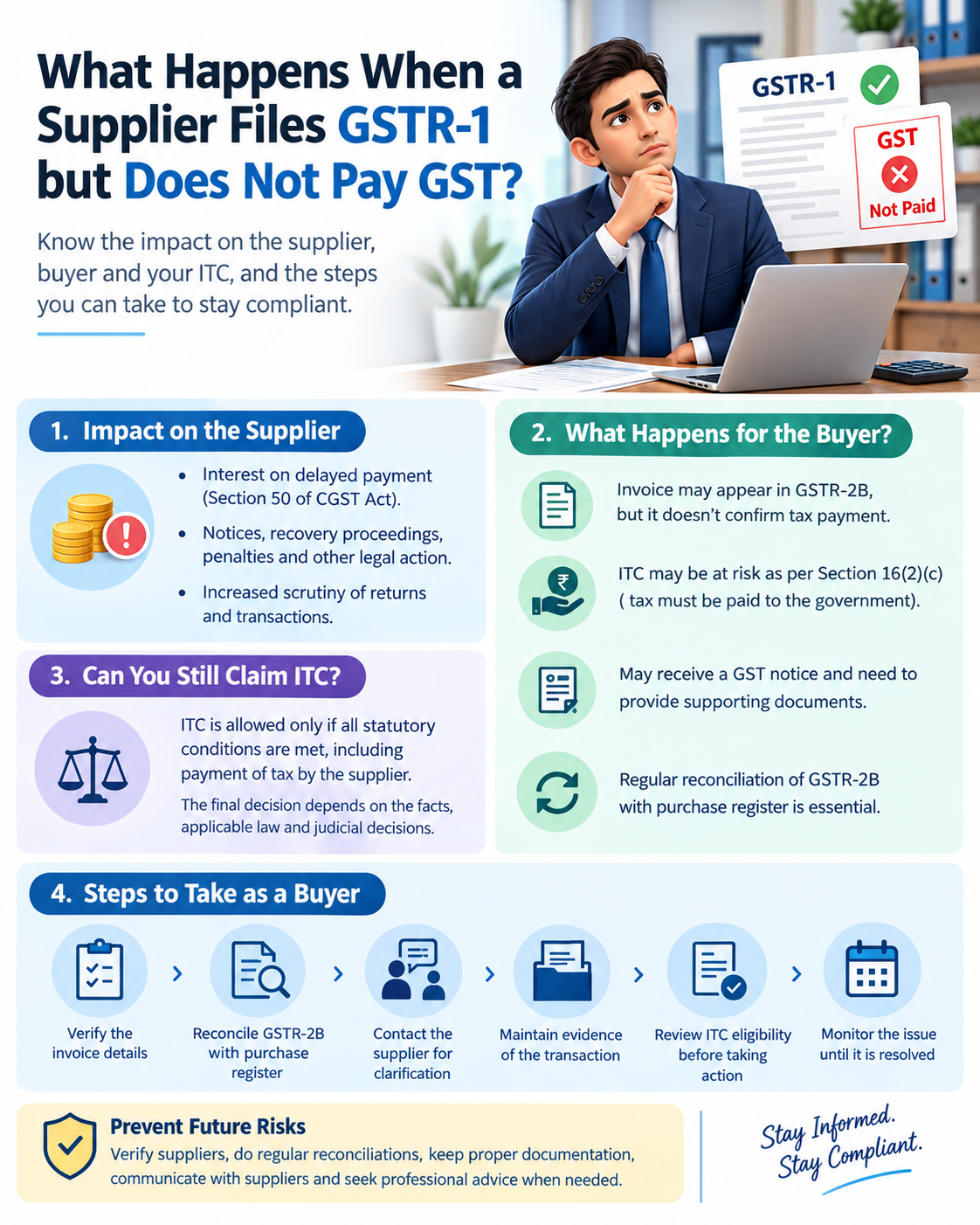
What Happens When a Supplier Files GSTR-1 but Does Not Pay GST? If a supplier reports sales in GSTR-1 but does not discharge the corresponding GST liability, several consequences may arise.
- The Supplier May Face Interest and Other Consequences A supplier who fails to pay GST by the applicable due date may be liable for interest on the delayed payment under Section 50 of the CGST Act, 2017, where applicable.
Depending on the circumstances, the supplier may also face notices, recovery proceedings, penalties, or other action under GST law.
The consequences depend on the nature of the default, the reason for non-payment, the amount involved, and the relevant statutory provisions.
- The Buyer May See the Invoice in GSTR-2B When the supplier reports an invoice correctly in GSTR-1 and the information is processed by the GST system, the invoice may appear in the buyer's GSTR-2B.
However, the appearance of an invoice in GSTR-2B does not automatically establish that every condition for claiming ITC has been satisfied.
The buyer must still meet the applicable requirements under Section 16 of the CGST Act, including possession of a valid tax invoice, receipt of goods or services, furnishing of the relevant return, and other applicable conditions.
- The Buyer May Face Input Tax Credit Risks One of the most important concerns is whether the buyer can claim or retain ITC when the supplier has reported an invoice but has not paid the corresponding GST.
Section 16(2)(c) of the CGST Act provides that the tax charged in respect of a supply must have been actually paid to the government, either in cash or through the utilisation of eligible ITC, subject to the statutory framework.
Therefore, if the supplier has not discharged the tax liability, the buyer may face ITC-related scrutiny or disputes.
The exact treatment depends on the applicable legal provisions, the facts of the transaction, and relevant judicial decisions. An invoice appearing in GSTR-2B should not be treated as conclusive proof that the supplier has paid the tax.
- The Buyer May Receive a GST Notice If the tax authorities identify a discrepancy between the supplier's reported transactions and tax payments, the buyer may be asked to explain the ITC claimed on the relevant invoices.
The buyer may need to provide supporting evidence, including:
Tax invoices issued by the supplier.
Purchase orders and contracts, where applicable.
Proof of receipt of goods or services.
Bank statements or payment records.
E-way bills, delivery challans, or transport documents, where relevant.
Purchase register and GST reconciliation records.
Correspondence with the supplier regarding the transaction.
Maintaining these records helps establish that the transaction was genuine and that the buyer fulfilled its statutory obligations.
- The Buyer May Need to Reconcile GST Returns A mismatch between the supplier's GSTR-1, GSTR-3B, and the buyer's GSTR-2B can create compliance issues.
Businesses should regularly compare their purchase register with GSTR-2B and investigate invoices involving missing information, incorrect reporting, or suspected non-payment.
However, a mismatch alone does not necessarily prove that the supplier has failed to pay tax. The buyer should verify the facts before making adjustments or taking corrective action.
Can a Buyer Claim ITC If the Supplier Has Not Paid GST? The answer requires careful consideration.
Under Section 16(2)(c) of the CGST Act, payment of the tax charged on the supply to the government is one of the statutory conditions for ITC eligibility.
At the same time, the practical treatment of ITC disputes involving supplier defaults has been the subject of litigation, and the outcome can depend on the facts and applicable legal developments.
A buyer should not assume either that ITC is automatically available because an invoice appears in GSTR-2B or that ITC must automatically be reversed solely because a supplier has a compliance issue.
The buyer should verify the transaction, preserve evidence of the purchase and payment, communicate with the supplier, and obtain professional advice where the amount or legal risk is significant.
What Should a Buyer Do If the Supplier Has Not Paid GST? Businesses can take the following steps to manage the situation.
Step 1: Verify the Invoice Check the supplier's GSTIN, invoice number, invoice date, taxable value, tax amount, and other relevant details.
Confirm that the goods or services were actually received and that the invoice relates to a genuine business transaction.
Step 2: Reconcile GSTR-2B With the Purchase Register Compare the invoice with the relevant GSTR-2B and purchase register.
Investigate differences in invoice values, tax amounts, reporting periods, and supplier details.
Step 3: Contact the Supplier Request clarification from the supplier and ask them to verify their GST liability and return filings.
Where a shortfall or reporting error exists, the supplier should take appropriate corrective steps under the applicable GST rules.
Keep written records of emails, messages, and other communications.
Step 4: Maintain Evidence of the Transaction Retain the invoice, proof of payment, delivery records, purchase order, and other supporting documents.
These records can help demonstrate the genuineness of the transaction and support the buyer's explanation during a compliance review.
Step 5: Review ITC Eligibility Before Taking Action Review the relevant statutory conditions and the facts of the case before claiming, retaining, reversing, or re-availing ITC.
If the supplier's failure to discharge tax creates a material risk, consult a GST professional before making adjustments in a return.
Step 6: Monitor the Issue Until It Is Resolved Maintain a record of disputed invoices and follow up with suppliers until the reporting or payment issue is resolved.
A regular reconciliation process can help identify recurring problems and reduce the risk of unresolved ITC differences.
What Are the Consequences for the Supplier? A supplier who files GSTR-1 but does not pay the applicable GST may face several consequences, depending on the circumstances:
Interest on delayed payment, where applicable.
GST notices seeking an explanation or payment.
Recovery proceedings for outstanding tax dues.
Penalties where the statutory conditions are satisfied.
Additional scrutiny of returns and transactions.
Potential litigation or other legal action in serious cases.
Filing the sales return does not replace the obligation to correctly report and discharge the applicable tax liability.
How Can Businesses Prevent GST-Related Risks? Businesses should establish a consistent GST compliance process rather than relying only on the appearance of invoices in GSTR-2B.
Useful preventive measures include:
Supplier verification: Check GST registration details and review suppliers' compliance practices.
Monthly reconciliation: Match purchase records with GSTR-2B and investigate discrepancies promptly.
Document retention: Keep invoices, delivery evidence, payment records, and purchase documentation.
Supplier communication: Follow up on missing invoices, incorrect reporting, and unresolved GST issues.
Professional review: Obtain expert advice for material ITC disputes or notices.
Compliance monitoring: Maintain a tracker of unresolved invoices and follow-up actions.
These practices help businesses improve transparency and identify potential GST risks early.
Frequently Asked Questions (FAQs)
-
Does filing GSTR-1 mean that the supplier has paid GST? No. GSTR-1 reports outward supplies. The supplier's tax liability is generally discharged through GSTR-3B and the applicable payment mechanism.
-
Will an invoice appear in GSTR-2B if the supplier has not paid GST? An invoice may appear in the buyer's GSTR-2B when it has been correctly reported and processed through the GST system. Its appearance does not, by itself, confirm payment of the tax or complete ITC eligibility.
-
Can the buyer be questioned for claiming ITC? Yes. The buyer may be asked to substantiate the claim and demonstrate compliance with the applicable statutory conditions. The outcome depends on the facts and relevant law.
-
What should a buyer do if the supplier refuses to pay GST? The buyer should contact the supplier in writing, retain transaction evidence, reconcile the relevant GST records, and seek professional advice about the appropriate treatment of ITC.
-
Is the supplier liable for interest if GST is paid late? Interest may be payable under Section 50 of the CGST Act, depending on the circumstances and applicable provisions.
-
Is GSTR-2B sufficient proof for claiming ITC? No. GSTR-2B is an important reconciliation statement, but the taxpayer must satisfy all applicable statutory conditions for ITC eligibility.
Conclusion When a supplier files GSTR-1 but does not pay GST, the issue can affect the supplier's compliance position and create potential ITC risks for the buyer.
Businesses should remember that an invoice appearing in GSTR-2B does not automatically confirm that the supplier has discharged the tax or that every condition for claiming ITC has been met.
Regular GST reconciliation, supplier follow-ups, proper documentation, and timely professional advice can help businesses manage these risks effectively.
Need help with GST reconciliation, ITC verification, or GST notice assistance? Professional support can help your business review discrepancies and follow the appropriate compliance process.
Disclaimer: This article is for general educational purposes and does not constitute legal or tax advice. GST provisions and their interpretation may change. Verify the applicable law, notifications, circulars, and judicial decisions before taking action in a specific case.