

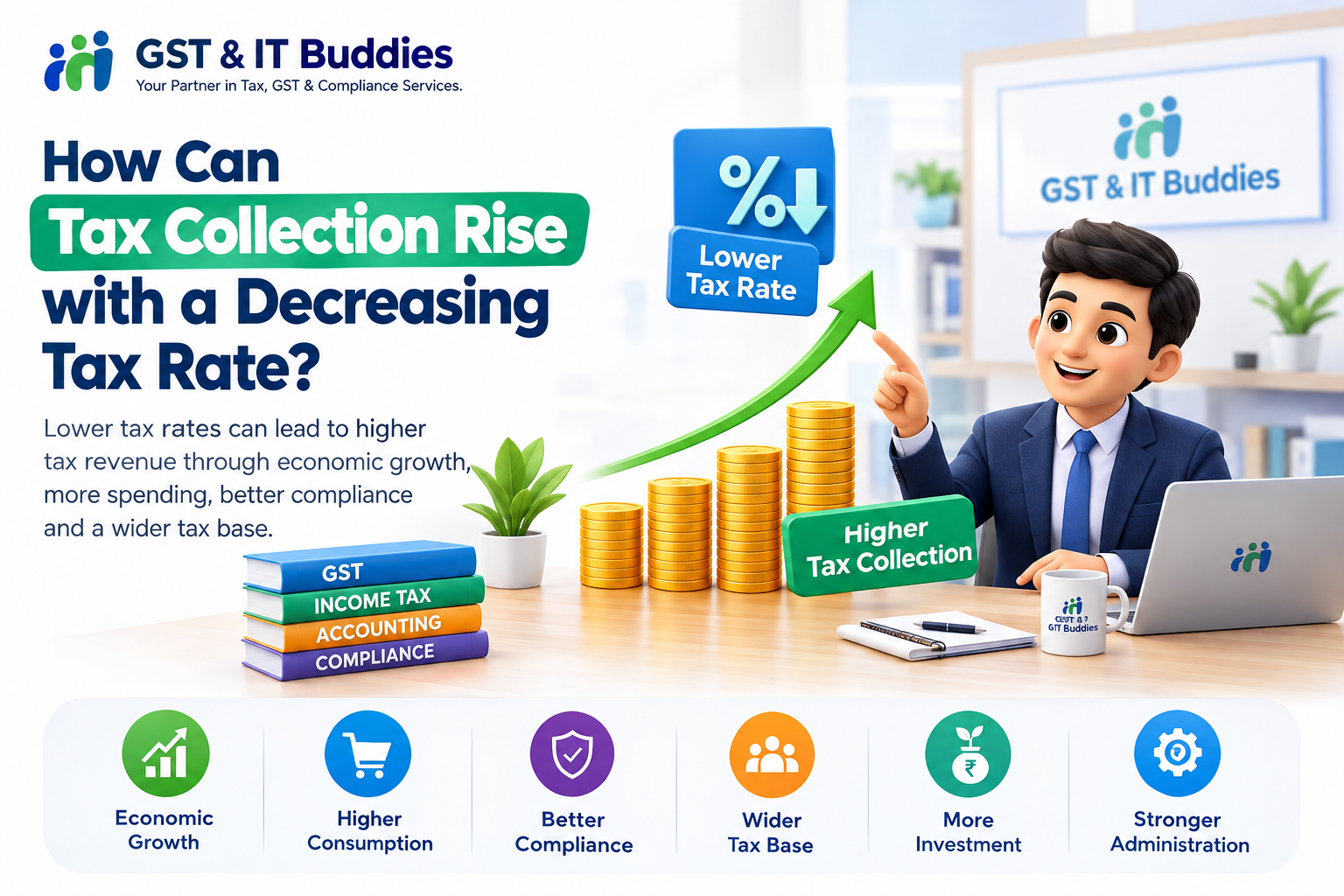
Can the government collect more tax revenue even when tax rates are reduced? Yes, it is possible. Although lower tax rates may reduce the amount of tax paid on each transaction or unit of income, they can also encourage economic activity, improve tax compliance, increase consumption, and bring more individuals and businesses into the tax system. Understanding how tax collection can rise despite decreasing tax rates helps explain the relationship between taxation, economic growth, and government revenue.
What Is the Relationship Between Tax Rates and Tax Collection?
A tax rate is the percentage of income, profit, sales, or another taxable amount that the government collects as tax. Tax collection, also called tax revenue, is the total amount of money the government receives from taxes.
For example, suppose a business earns a taxable profit of ₹10 lakh and the applicable tax rate is 30%. Its tax liability would be ₹3 lakh.
If the tax rate falls to 25% but the business's taxable profit increases to ₹15 lakh, its tax liability becomes ₹3.75 lakh.
| Particulars | Before Reduction | After Reduction |
|---|---|---|
| Taxable profit | ₹10,00,000 | ₹15,00,000 |
| Tax rate | 30% | 25% |
| Tax payable | ₹3,00,000 | ₹3,75,000 |
In this example, the tax rate decreases by 5 percentage points, but the tax collected from the business increases by ₹75,000 because its taxable profit grows significantly.
This illustrates an important principle: tax revenue depends on both the tax rate and the amount of income or economic activity being taxed.
7 Reasons Why Tax Collection Can Increase When Tax Rates Decrease
1. Higher Economic Growth
Lower tax rates can leave individuals and businesses with more money to spend, save, or invest. Businesses may use the extra funds to expand operations, buy machinery, hire employees, or enter new markets.
As economic activity grows, taxable income, corporate profits, and consumption may also increase. This can generate higher tax revenue even when certain tax rates are lower.
However, the outcome depends on economic conditions and how taxpayers use the additional funds.
2. Improved Tax Compliance
High tax rates may create stronger incentives for some taxpayers to underreport income or avoid entering the formal tax system.
A reasonable reduction in tax rates, combined with effective enforcement and simpler filing procedures, may encourage more taxpayers to report income accurately and pay their taxes on time.
When compliance improves, the government may collect more revenue from a broader base of taxpayers.
3. Expansion of the Tax Base
The tax base refers to the income, profits, transactions, or other economic activity subject to taxation.
When tax rates decrease, more businesses may become profitable, more transactions may take place through formal channels, and more individuals may participate in the recorded economy.
If the taxable base expands sufficiently, the increase in taxable activity can offset the lower tax rate.
For example, a lower indirect tax rate may encourage consumers to purchase more goods and services, potentially increasing the total taxable value of sales.
4. Reduction in Tax Evasion and Informal Transactions
Very high tax burdens can encourage some businesses to conduct transactions outside formal reporting systems. Lower rates, when supported by transparent rules and stronger enforcement, may make formal compliance more attractive.
Businesses that previously underreported sales may begin issuing invoices and maintaining proper accounts.
This can improve the government's ability to identify taxable transactions and collect the taxes legally due.
Important: Lower rates do not automatically eliminate tax evasion. Effective administration, digital records, audits, and taxpayer awareness also matter.
5. Higher Consumer Spending
When indirect tax rates decrease, the prices of affected goods and services may fall if businesses pass on the tax reduction to consumers.
Lower prices can encourage additional purchases, increasing sales volumes and the total value of taxable transactions.
For example, if a product's GST rate is reduced, demand may increase because the final price becomes more affordable. Depending on the price reduction, demand response, and other factors, the government may collect more total GST from increased sales.
The outcome is not guaranteed: the rise in taxable sales must be large enough to compensate for the lower tax rate.
6. More Investment and Business Activity
Lower taxes on business profits or investment returns can improve the expected returns from certain projects.
This may encourage businesses to invest in new facilities, technology, equipment, and employment. Over time, successful investments can increase production, profits, wages, and taxable economic activity.
The additional revenue may come from several sources, including corporate taxes, personal income taxes, and indirect taxes on goods and services.
The effects may take time to materialise, and the result depends on the design of the tax reduction and the wider business environment.
7. Better Tax Administration and Digitalisation
Tax collection can also rise when the government improves tax administration while reducing selected rates.
Measures such as electronic invoicing, digital payments, data matching, automated return processing, and stronger information reporting can help identify unreported transactions and improve compliance.
For example, India's GST system uses digital returns and invoice-related information to help authorities monitor transactions and identify discrepancies.
If these measures increase the number of correctly reported taxable transactions, revenue may grow even when some tax rates decline.
Understanding the Laffer Curve
The Laffer Curve is an economic concept that illustrates how tax rates and total tax revenue may be related.
At a 0% tax rate, the government generally collects no revenue from that tax. At an extremely high tax rate, taxable activity or voluntary compliance may decline substantially, potentially reducing revenue.
Between these extremes, there may be a tax rate at which revenue is maximised.
The curve is often used to explain why a tax-rate reduction could sometimes increase tax revenue. If the original rate is above the revenue-maximising level, reducing it may encourage enough additional taxable activity or compliance to raise total collections.
However, the revenue-maximising rate is difficult to determine in practice. It differs across taxes, countries, time periods, and economic circumstances. The Laffer Curve does not mean that every tax cut will increase revenue.
How Can This Concept Apply to GST in India?
India's Goods and Services Tax (GST) is an indirect tax imposed on eligible supplies of goods and services. Changes in GST rates can affect prices, demand, business decisions, and tax compliance.
A GST rate reduction may contribute to higher collections if it leads to a sufficiently large increase in taxable sales, improved reporting, or a shift from informal to formal transactions.
Consider a simplified example:
| Particulars | Scenario A | Scenario B |
|---|---|---|
| GST rate | 18% | 12% |
| Total taxable sales | ₹1 crore | ₹1.6 crore |
| GST before input tax credit and adjustments | ₹18 lakh | ₹19.2 lakh |
In Scenario A, GST at 18% on ₹1 crore of taxable sales equals ₹18 lakh.
In Scenario B, GST at 12% on ₹1.6 crore of taxable sales equals ₹19.2 lakh.
Despite the lower GST rate, the calculated GST on sales increases by ₹1.2 lakh because taxable sales rise by 60%.
This is a simplified illustration, not an actual government revenue forecast. It assumes the stated sales are taxable at the relevant rates and ignores input tax credit, refunds, exemptions, compliance differences, and other adjustments that affect net GST collections.
Does Reducing Tax Rates Always Increase Tax Revenue?
No. Tax-rate reductions can increase, decrease, or have a limited effect on government revenue.
Revenue is more likely to increase when the expansion in taxable income or transactions, along with any improvement in compliance, is sufficient to offset the lower rate.
Revenue may decrease when the tax base does not expand enough, demand remains unchanged, or the reduction mainly lowers the tax paid on existing activity.
For this reason, governments assess tax-rate changes alongside economic growth, taxpayer behaviour, compliance levels, distributional effects, and the overall fiscal position.
Conclusion
Tax collection can rise even when tax rates decrease because total revenue depends on more than the rate alone. Economic growth, higher consumption, improved compliance, a broader tax base, increased investment, and better tax administration can all contribute to higher collections.
Nevertheless, the relationship is not automatic. A tax reduction raises revenue only when the resulting increase in taxable activity and compliance is sufficient to offset the lower rate.
For businesses and taxpayers, understanding this relationship provides useful insight into tax policy, GST changes, and the broader connection between taxation and economic growth.
Frequently Asked Questions (FAQs)
1. Can the government collect more tax after reducing tax rates?
Yes. Tax revenue can increase if taxable income, business activity, consumption, or compliance grows enough to compensate for the lower rate.
2. What is the Laffer Curve in taxation?
The Laffer Curve is a theoretical model showing that tax revenue may rise or fall as tax rates change. It suggests that reducing a rate that is above the revenue-maximising level may increase collections under certain conditions.
3. How can lower GST rates increase GST collection?
Lower GST rates may reduce prices, stimulate demand, encourage formal transactions, or improve compliance. If the resulting increase in taxable sales is sufficiently large, total GST collected can rise.
4. Does a lower tax rate always benefit the economy?
Not necessarily. The effects depend on the type of tax, how the reduction is funded, taxpayer behaviour, economic conditions, and the government's spending and revenue requirements.
5. What is the difference between a tax rate and tax revenue?
A tax rate is the percentage applied to a taxable amount. Tax revenue is the total amount of tax collected across all relevant taxpayers and transactions.
6. Why is tax compliance important when tax rates decrease?
Better compliance helps ensure that more taxable income and transactions are accurately reported. This can increase collections and reduce the revenue lost through evasion or underreporting.
About GST & IT Buddies
GST & IT Buddies helps businesses and professionals understand GST, income tax, accounting, and statutory compliance through practical educational content.
Your Partner in Tax, GST & Compliance Services.