



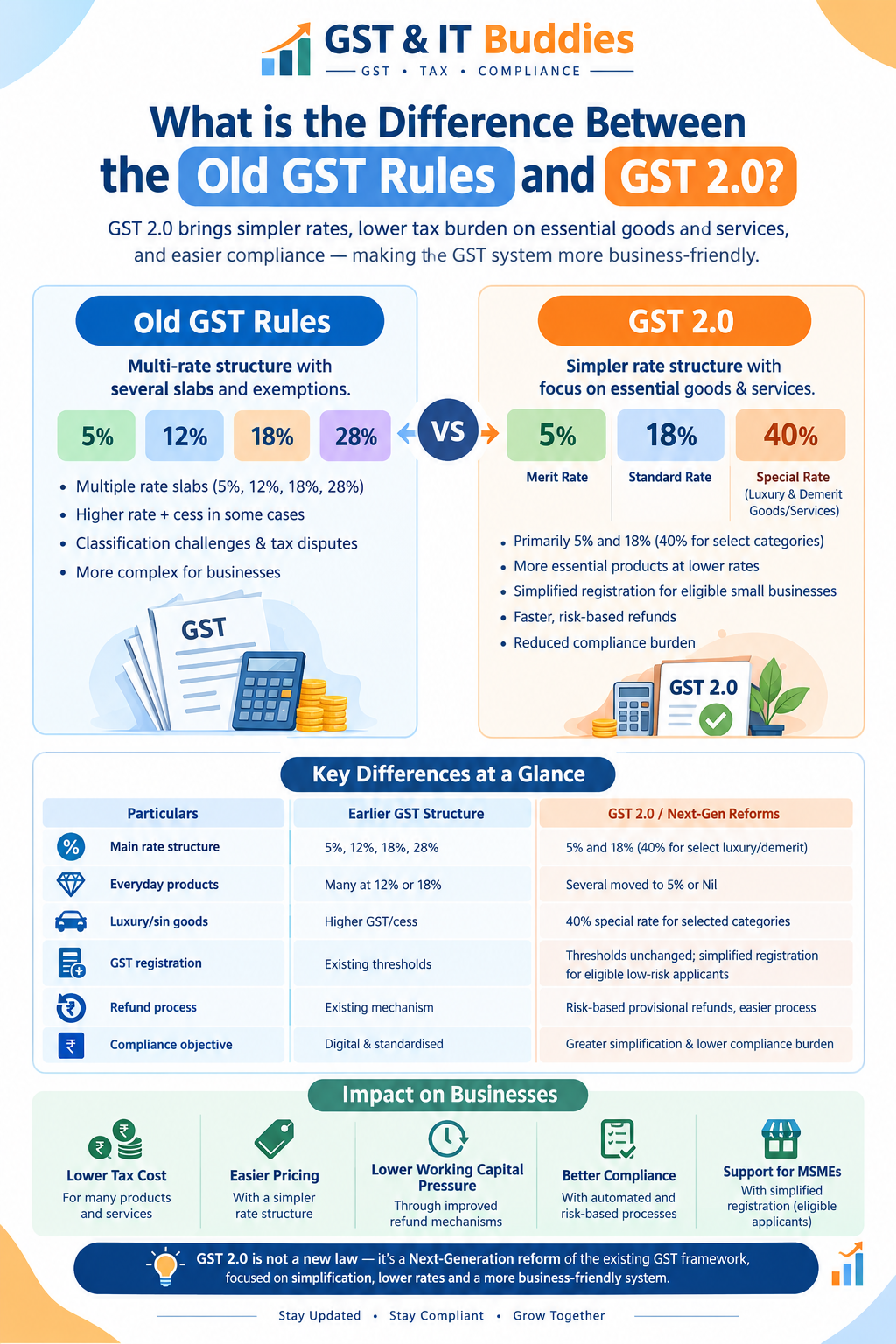
India’s Goods and Services Tax (GST) system has undergone a major transformation since its introduction in 2017. The latest phase of reforms, commonly referred to as GST 2.0, was introduced following the recommendations of the 56th GST Council meeting in September 2025. GST 2.0 focuses on simplifying tax rates, reducing the tax burden on several goods and services, improving compliance, and making GST processes easier for businesses. The revised rates for most goods and services became effective from 22 September 2025.
What Was the Old GST Structure?
Under the earlier GST framework, India broadly followed a multi-rate structure with major slabs of:
- 5%
- 12%
- 18%
- 28%
Certain goods and services also attracted exemptions, compensation cess or other special treatment.
While this structure helped replace multiple indirect taxes and created a common national tax system, the presence of several rate slabs sometimes resulted in classification challenges, tax disputes and complexity for businesses.
Over time, the GST Council introduced several changes to address these issues.
What Is GST 2.0?
GST 2.0 refers to the Next-Generation GST reforms introduced in 2025. The reforms aim to make GST simpler, more business-friendly and more focused on reducing tax incidence on commonly used goods and services.
One of the biggest changes is the move toward a simpler rate structure primarily centred around:
- 5% — Merit Rate
- 18% — Standard Rate
- 40% — Special Rate for selected luxury and demerit goods and services
The earlier 12% and 28% rates were substantially rationalised, although the GST system still contains specific exemptions and special treatments for certain categories.
Old GST vs GST 2.0: Key Differences
| Particulars | Earlier GST Structure | GST 2.0 / Next-Gen Reforms |
|---|---|---|
| Main rate structure | Multiple major slabs: 5%, 12%, 18%, 28% | Primarily 5% and 18% |
| Special high rate | 28% plus applicable cess in certain cases | 40% special rate for selected luxury/demerit categories |
| Rate rationalisation | Several rate slabs | Greater focus on fewer principal slabs |
| Everyday products | Many products taxed at 12% or 18% | Several products moved to 5% or Nil |
| Luxury/sin goods | Generally higher GST/cess structure | 40% special rate for specified categories |
| GST registration | Existing thresholds | Thresholds for goods registration were not changed by the September 2025 rate reforms |
| Small-business registration | Conventional registration process | Optional simplified registration scheme introduced for eligible low-risk applicants |
| Refund process | Existing refund mechanism | Greater use of risk-based provisional refunds |
| Compliance objective | Digital and standardised compliance | Greater emphasis on simplification and lower compliance burden |
The GST Council specifically clarified that the GST registration threshold for goods was not changed merely because of the September 2025 rate reforms.
1. GST Rates Have Been Simplified
The most visible GST 2.0 change is rate rationalisation.
Earlier, businesses had to deal with several major GST slabs, including 12% and 28%. GST 2.0 moves the principal structure toward 5% and 18%, while a 40% rate applies to selected luxury and demerit goods and services.
This can make GST classification and pricing easier in many sectors.
For example, several products that previously attracted 12% or 18% GST were moved to the 5% category.
2. More Essential and Common-Use Products Get Lower Tax Rates
GST 2.0 reduced the tax rate on a number of household and commonly used products.
Examples include:
- Hair oil
- Toilet soap bars
- Shampoos
- Toothbrushes
- Toothpaste
- Bicycles
- Tableware and kitchenware
Several of these categories were moved to 5% GST.
Certain food products also received rate reductions, while some essential products were moved to Nil GST.
The objective is to reduce the tax burden on consumers while supporting demand and simplifying the tax structure.
3. Certain Luxury and Demerit Goods Face a 40% Rate
GST 2.0 did not simply reduce every tax rate.
A 40% special rate was introduced for selected luxury and demerit goods and services.
The categories include specified products such as:
- Tobacco-related products
- Aerated drinks
- Certain high-end cars
- Yachts
- Private aircraft
- Other specified luxury or demerit categories
This approach allows the government to reduce tax rates on many ordinary goods while maintaining a higher rate on selected luxury and demerit categories.
4. GST Registration Becomes Easier for Certain Small Businesses
GST 2.0 also introduced a simplified registration scheme for eligible small and low-risk businesses.
Under the recommended scheme, eligible applicants can receive automated registration within three working days, subject to the prescribed conditions.
The scheme is intended for low-risk applicants and applicants who determine that their output tax liability on supplies to registered persons will not exceed ₹2.5 lakh per month, subject to the applicable rules and conditions. It was scheduled for operationalisation from 1 November 2025.
This is particularly relevant for small businesses and startups looking for a simpler GST registration process.
5. Faster and More Risk-Based Refunds
Another important GST 2.0 reform relates to refunds.
The GST Council recommended a system of risk-based provisional refunds, including provisional sanction of 90% of eligible refund claims arising from inverted duty structures, subject to the prescribed conditions and system-based risk evaluation.
The reforms also proposed removing the threshold limit for refunds relating to certain low-value export consignments made with payment of tax, which can particularly benefit smaller exporters.
This can help reduce working-capital blockage for eligible businesses.
6. Impact on MSMEs and Businesses
For MSMEs, GST 2.0 can have several practical implications.
Lower Tax Cost
Where a product or service moves to a lower GST slab, businesses may experience lower tax incidence and potentially improved demand.
Easier Pricing
A simpler rate structure can make pricing and tax calculation easier for businesses dealing with products that have undergone rate rationalisation.
Lower Working-Capital Pressure
Improved refund mechanisms can help eligible exporters and businesses facing inverted duty structures reduce the time their funds remain blocked.
Better Compliance Processes
The reforms place greater emphasis on automated, risk-based and simplified compliance mechanisms, particularly for smaller businesses.
However, businesses must still correctly identify the applicable HSN/SAC, GST rate, exemption, place of supply and time-of-supply provisions before issuing invoices or filing returns.
7. GST 2.0 Does Not Mean Every GST Rule Has Changed
This is an important point.
GST 2.0 should not be understood as the complete replacement of the GST Act or as a completely new tax system.
The GST framework continues to operate under the CGST, SGST/UTGST and IGST laws. The 2025 reforms primarily represent a significant phase of rate rationalisation, exemptions and procedural reforms within the existing GST framework.
Therefore, businesses should not assume that all previous GST provisions have disappeared.
What Should Businesses Do After GST 2.0?
Businesses should review their GST processes carefully after the rate changes.
1. Review HSN and SAC Codes
Check whether the GST rate applicable to your products or services has changed.
2. Update Accounting Software
Update GST rates in accounting, billing and ERP systems to avoid incorrect invoices.
3. Review Product Pricing
Where GST rates have changed, review selling prices, quotations and customer contracts.
4. Check Existing Inventory
Businesses holding stock purchased or sold around the rate-change period should carefully review the applicable rate and relevant transition/time-of-supply provisions.
5. Review Input Tax Credit
A reduction in the output GST rate does not automatically mean that every input tax credit treatment remains unchanged. Businesses should review ITC eligibility and related provisions carefully.
6. Update GST Invoices
Ensure invoices reflect the correct GST rate, HSN/SAC and tax amounts.
7. Review Refund Eligibility
Exporters and businesses affected by inverted duty structures should review the updated refund mechanisms and applicable conditions.
Example: Understanding the Difference
Suppose a product was previously taxed at 12% GST and has now been moved to 5% GST under the revised rate structure.
If the taxable value of the product is ₹1,00,000:
Earlier GST @ 12% = ₹12,000
GST at 5% = ₹5,000
The tax amount reduces by ₹7,000, subject to the applicable classification, effective date and other GST provisions.
This illustrates why businesses need to update their billing systems and pricing after a GST rate change.
Is GST 2.0 Better Than the Old GST Structure?
GST 2.0 is intended to make the system simpler, more predictable and business-friendly, particularly by reducing the number of major rate slabs and lowering GST on several commonly used products.
For consumers, lower rates on selected goods can reduce the tax component of purchases.
For businesses, rate rationalisation and simplified procedures can reduce some compliance and working-capital pressures.
However, the actual benefit depends on the specific goods or services supplied by a business. Not every product or service receives a lower rate, and some categories are subject to special rates.
Conclusion
The biggest difference between the earlier GST structure and GST 2.0 is the shift toward a simpler rate framework, lower taxation for several commonly used goods and services, a special 40% rate for selected luxury and demerit categories, and more streamlined compliance measures.
The reforms that took effect from 22 September 2025 represent an important new phase in India’s GST journey.
For businesses, the key takeaway is simple: GST 2.0 is not just about new tax rates. It also requires businesses to review their invoicing, accounting software, product classification, pricing, ITC and compliance processes.
Staying updated with GST notifications and rate changes can help businesses avoid incorrect invoicing, tax shortfalls and unnecessary compliance issues.
Frequently Asked Questions
Q1. What is GST 2.0?
GST 2.0 is a commonly used term for the Next-Generation GST reforms introduced in 2025. The reforms include GST rate rationalisation, exemptions and measures aimed at simplifying compliance.
Q2. When did GST 2.0 come into effect?
Most revised GST rates for goods and services covered by the 2025 reforms became effective from 22 September 2025. Certain specified tobacco-related products were treated separately.
Q3. What are the main GST 2.0 rates?
The principal structure is centred around 5% and 18%, with a 40% special rate for specified luxury and demerit goods and services.
Q4. Did GST 2.0 change GST registration thresholds?
The September 2025 GST rate reforms did not change the registration threshold for goods. However, a simplified registration scheme was introduced for eligible low-risk applicants subject to specified conditions.
Q5. Does GST 2.0 affect businesses?
Yes. Businesses may need to review GST rates, HSN/SAC classification, invoices, pricing, accounting software, ITC and refund processes based on the specific goods or services they supply.
Q6. Should businesses update their accounting software for GST 2.0?
Yes. Businesses affected by GST rate changes should ensure that their billing and accounting systems reflect the applicable revised rates and classifications.
Disclaimer: GST provisions, notifications and rates can change. Businesses should verify the applicable notification and classification for their specific goods or services before taking tax positions.