


Running a business involves more than generating sales and earning profits. Business owners also need to understand what the business owns and what it owes. This is where the concepts of assets and liabilities become important. Assets and liabilities are two fundamental components of accounting and appear prominently on a company’s balance sheet. Understanding the difference between them can help business owners evaluate financial stability, manage cash flow, make better investment decisions, and plan for future growth.
What Are Assets?
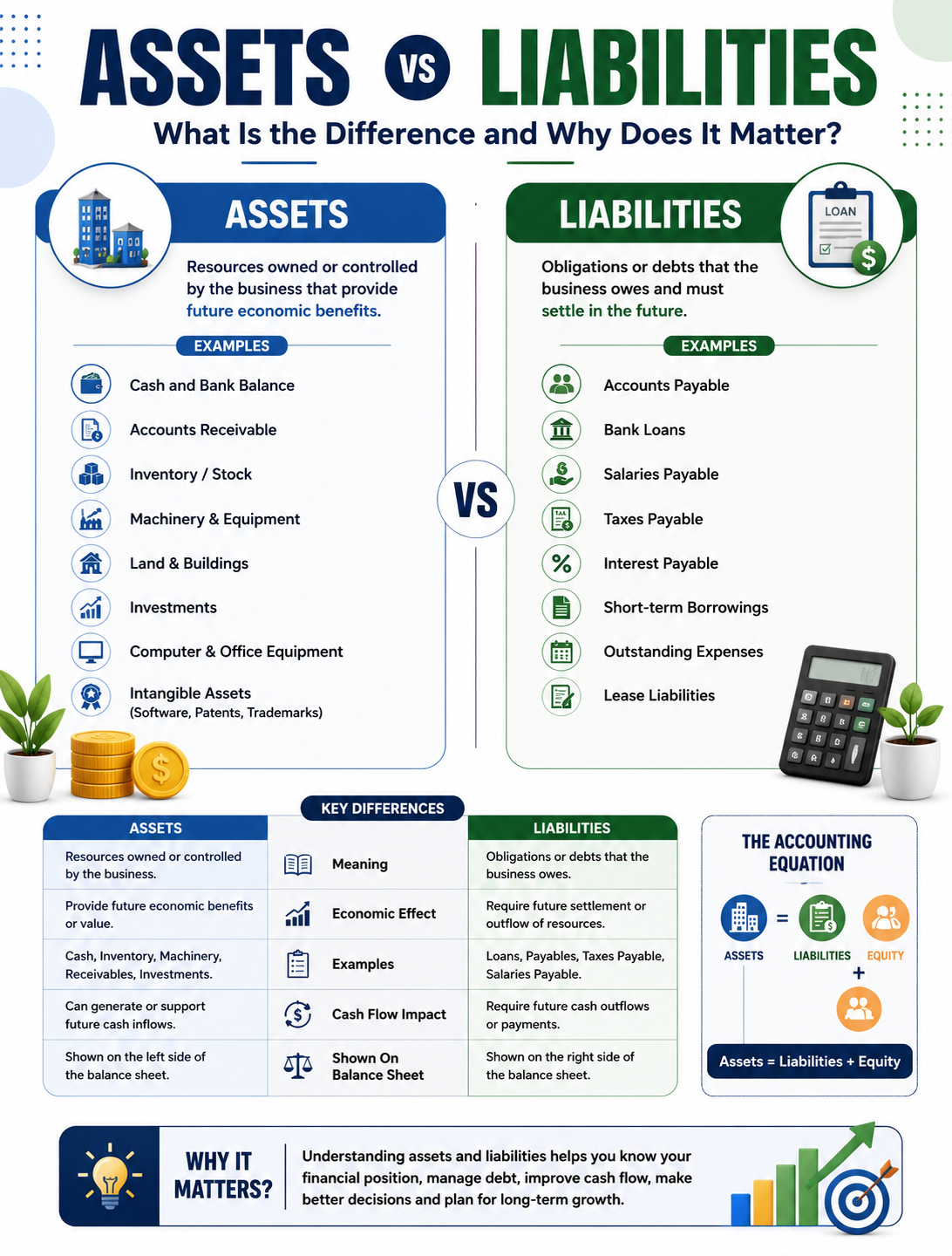
An asset is a resource controlled by a business that is expected to provide future economic benefits.
Assets can be physical items such as machinery and inventory, or financial and intangible resources such as receivables and software rights.
Common Examples of Assets
- Cash and bank balances
- Accounts receivable
- Inventory or stock
- Land and buildings
- Machinery and equipment
- Vehicles
- Investments
- Computer equipment
- Prepaid expenses
- Intangible assets such as software or trademarks
For example, if a company owns machinery worth ₹10 lakh that is used to manufacture products, the machinery is an asset because it helps the business generate future economic benefits.
Types of Assets
Assets are generally classified according to their nature and expected period of use.
1. Current Assets
Current assets are expected to be converted into cash, sold, consumed, or realized within the normal operating cycle or generally within one year.
Examples include:
- Cash
- Bank balance
- Trade receivables
- Inventory
- Short-term investments
- Prepaid expenses
2. Non-Current Assets
Non-current assets are resources held for longer-term use in the business.
Examples include:
- Land
- Buildings
- Plant and machinery
- Furniture
- Vehicles
- Long-term investments
- Certain intangible assets
3. Tangible Assets
Tangible assets have a physical form.
Examples:
- Machinery
- Office furniture
- Buildings
- Vehicles
- Computers
4. Intangible Assets
Intangible assets do not have a physical form but can provide economic benefits.
Examples:
- Software
- Patents
- Copyrights
- Trademarks
- Goodwill, where applicable
What Are Liabilities?
A liability represents a present obligation of a business arising from past events that is expected to result in an outflow of economic resources.
In simpler language, liabilities are amounts that the business owes to others.
Common Examples of Liabilities
- Accounts payable
- Bank loans
- Business borrowings
- Salaries payable
- Taxes payable
- Interest payable
- Outstanding expenses
- Lease-related obligations, where applicable
For example, if a company takes a bank loan of ₹20 lakh to purchase machinery, the outstanding loan is recorded as a liability because the business has an obligation to repay the bank.
Types of Liabilities
1. Current Liabilities
Current liabilities are obligations generally expected to be settled within the normal operating cycle or within one year.
Examples include:
- Trade payables
- Short-term borrowings
- Salaries payable
- Taxes payable
- Outstanding expenses
- Interest payable
2. Non-Current Liabilities
These are obligations that are generally payable after more than one year.
Examples include:
- Long-term bank loans
- Long-term borrowings
- Certain lease liabilities
- Other long-term financial obligations
Assets vs Liabilities: Key Difference
The easiest way to remember the distinction is:
| Basis | Assets | Liabilities |
|---|---|---|
| Meaning | Resources owned or controlled by the business | Obligations owed by the business |
| Economic effect | Expected to provide future benefits | Expected to require future settlement |
| Examples | Cash, inventory, machinery, receivables | Loans, payables, taxes payable |
| Balance Sheet | Shown as assets | Shown as liabilities |
| Cash flow impact | Can generate or support future cash inflows | Can require future cash outflows |
| Business perspective | What the business has | What the business owes |
Simple Example
Suppose a business has:
- Cash: ₹5 lakh
- Inventory: ₹8 lakh
- Machinery: ₹12 lakh
- Bank loan: ₹10 lakh
- Trade payables: ₹3 lakh
Total Assets = ₹25 lakh
Total Liabilities = ₹13 lakh
The difference represents the owners’ equity:
Equity = Assets − Liabilities
₹25 lakh − ₹13 lakh = ₹12 lakh
This relationship forms the foundation of the accounting equation.
Understanding the Accounting Equation
The basic accounting equation is:
Assets = Liabilities + Equity
This equation must remain balanced.
For example:
Assets = ₹25 lakh
Liabilities = ₹13 lakh
Equity = ₹12 lakh
Therefore:
₹25 lakh = ₹13 lakh + ₹12 lakh
This balance provides the basic framework for double-entry accounting and financial reporting.
Why Is the Difference Between Assets and Liabilities Important?
Understanding assets and liabilities isn't just an accounting exercise. It helps business owners assess the overall financial position of their business.
1. Helps Measure Financial Strength
A business with substantial assets compared with its liabilities may have a stronger financial position, although the quality and liquidity of those assets also matter.
2. Helps Manage Debt
By tracking loans, payables, and other obligations, businesses can monitor their debt levels and repayment commitments.
3. Supports Cash Flow Management
A company may have significant assets but still experience cash-flow problems if most of those assets are tied up in inventory or receivables.
4. Helps in Business Decision-Making
Before purchasing machinery, taking a loan, expanding operations, or making a major investment, management should understand how the decision will affect assets and liabilities.
5. Important for Financial Reporting
Assets and liabilities form key sections of the balance sheet and help stakeholders understand the financial position of a business.
6. Helps Banks and Investors Evaluate a Business
Lenders and investors may examine a company's assets, liabilities, debt levels, liquidity, and equity before making financial decisions.
Assets Do Not Always Mean Cash
One common misconception is that having more assets always means having more cash.
That is not necessarily true.
Consider a business with:
- ₹2 lakh cash
- ₹15 lakh inventory
- ₹20 lakh accounts receivable
- ₹30 lakh machinery
The company has substantial assets, but only ₹2 lakh is immediately available as cash.
This is why businesses should monitor liquidity, not just total assets.
Liabilities Are Not Always Bad
Another common misconception is that liabilities are automatically negative.
Borrowing can help a business expand.
For example, a company may borrow ₹50 lakh to purchase modern machinery. The loan creates a liability, but the machinery becomes an asset that may increase production capacity and future revenue.
The key issue is whether the business can manage the obligation effectively and whether the funds are being used productively.
Assets, Liabilities and Working Capital
Assets and liabilities are also important for understanding working capital.
A simplified formula is:
Working Capital = Current Assets − Current Liabilities
For example:
Current Assets = ₹30 lakh
Current Liabilities = ₹18 lakh
Working Capital = ₹12 lakh
Positive working capital can provide the business with resources to manage its short-term operating requirements. However, the ideal level varies by industry and business model.
How Assets and Liabilities Appear on a Balance Sheet
A simplified balance sheet may look like this:
Assets
- Cash & Bank: ₹5 lakh
- Receivables: ₹8 lakh
- Inventory: ₹7 lakh
- Machinery: ₹15 lakh
Total Assets: ₹35 lakh
Liabilities & Equity
- Trade Payables: ₹6 lakh
- Bank Loan: ₹12 lakh
- Owner's Equity: ₹17 lakh
Total Liabilities & Equity: ₹35 lakh
The two sides remain equal because of the accounting equation:
Assets = Liabilities + Equity
Common Mistakes Businesses Make
Businesses can face accounting problems when assets and liabilities are not properly recorded or reconciled.
Some common mistakes include:
- Failing to record business loans correctly
- Not reconciling accounts receivable
- Ignoring outstanding expenses
- Incorrectly classifying current and non-current items
- Not maintaining accurate inventory records
- Recording personal expenses as business assets
- Failing to account for depreciation appropriately
- Not reconciling bank balances regularly
Accurate bookkeeping and regular reconciliation can help reduce these errors.
How Professional Bookkeeping Helps
Maintaining accurate records of assets and liabilities is essential for reliable financial reporting.
A professional accounting or bookkeeping process can help businesses:
- Maintain accurate ledgers
- Reconcile bank accounts
- Track receivables and payables
- Monitor loans and outstanding obligations
- Maintain fixed asset records
- Prepare financial statements
- Support GST and income-tax compliance
- Identify accounting discrepancies
- Improve financial decision-making
Frequently Asked Questions
What is an asset in accounting?
An asset is a resource controlled by a business that is expected to provide future economic benefits. Examples include cash, inventory, receivables, machinery, and property.
What is a liability in accounting?
A liability is an obligation that a business is expected to settle in the future. Examples include loans, trade payables, taxes payable, and outstanding expenses.
Is a bank loan an asset or liability?
For the borrower, a bank loan is generally a liability because it represents an obligation to repay the lender.
Is cash an asset?
Yes. Cash and bank balances are generally classified as current assets.
Is inventory an asset or liability?
Inventory is generally a current asset because it is held for sale or consumption in the normal course of business.
What is the relationship between assets and liabilities?
Assets represent resources controlled by the business, while liabilities represent obligations. Together with equity, they form the accounting equation:
Assets = Liabilities + Equity
Can a business have more liabilities than assets?
Yes, it is possible. If total liabilities exceed total assets, the business may have negative equity, which can indicate financial stress depending on the circumstances.
Conclusion
Understanding assets vs liabilities is fundamental to understanding business accounting.
Assets represent what a business owns or controls, while liabilities represent what it owes. Monitoring both helps businesses understand their financial position, manage debt, control working capital, and make informed financial decisions.
The most important relationship to remember is:
Assets = Liabilities + Equity
Whether you operate a small business, startup, trading company, or established enterprise, maintaining accurate records of assets and liabilities is an essential part of sound financial management.
Need help with bookkeeping, accounting, GST compliance, or business financial records? Professional accounting support can help you maintain accurate books and make better financial decisions