


Private equity (PE) is one of the most influential sectors in modern finance. It helps businesses grow, improve operations, expand into new markets, and create long-term value. Whether you're an entrepreneur seeking investment or an investor exploring alternative assets, understanding what business private equity is can help you make informed financial decisions.In this guide, we'll explain how private equity works, its business model, benefits, risks, and why it has become an important part of the global economy.
What Is Private Equity?
Private equity is a type of investment where funds invest in privately owned companies or purchase publicly traded companies to make them private. The objective is to improve the company's performance and eventually sell it at a profit.
Unlike stock market investments, private equity focuses on businesses that are not freely traded on public exchanges. These investments are usually held for several years before being sold.
How Does the Private Equity Business Work?
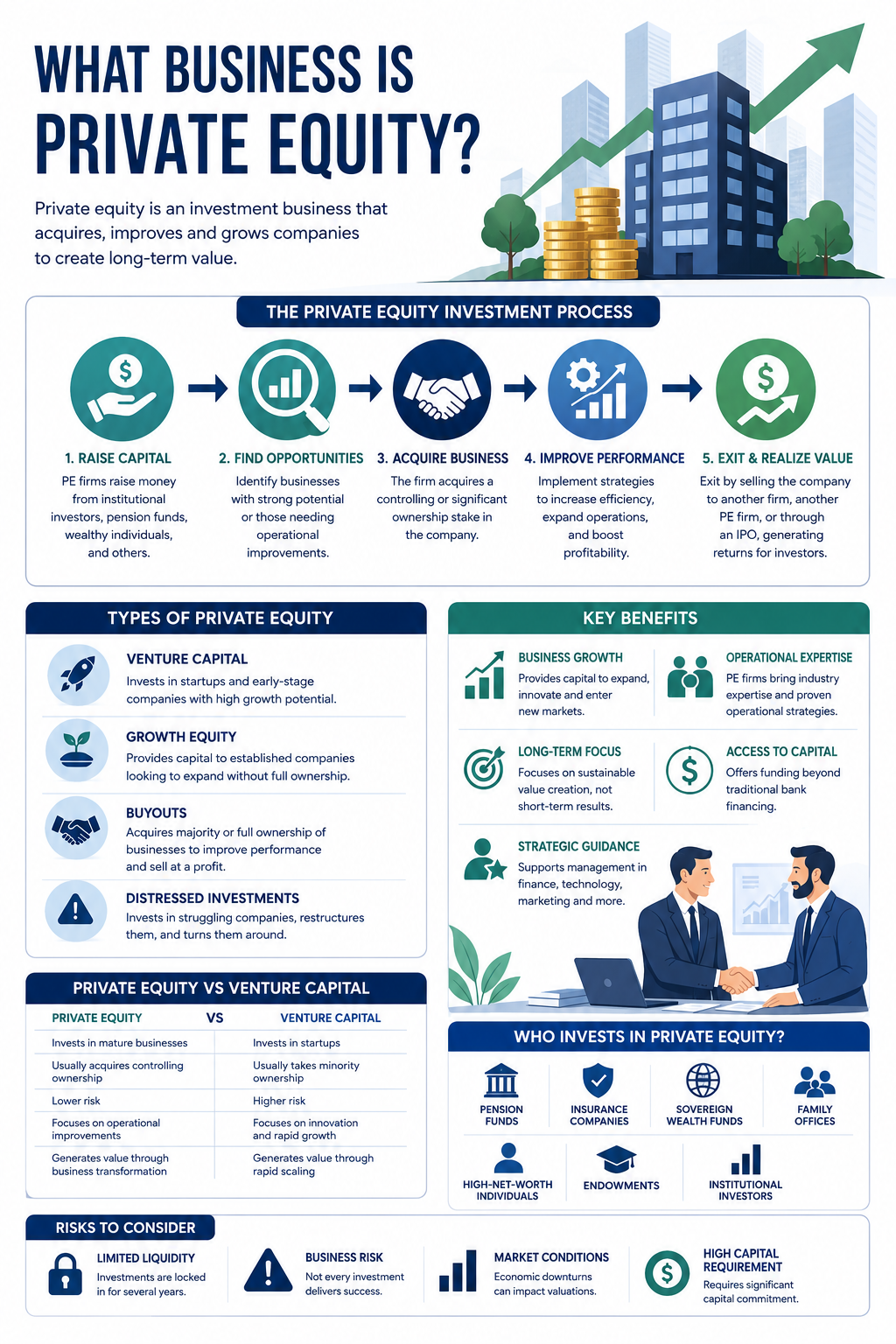
The private equity business follows a structured investment cycle:
1. Raising Capital
Private equity firms collect money from institutional investors, high-net-worth individuals, pension funds, insurance companies, and family offices.
2. Finding Investment Opportunities
The firm identifies businesses with strong growth potential, operational challenges, or expansion opportunities.
3. Acquiring the Business
The PE firm purchases a controlling or significant ownership stake in the company.
4. Improving Business Performance
After acquisition, the firm works on:
- Increasing operational efficiency
- Improving financial management
- Expanding into new markets
- Introducing better leadership
- Reducing unnecessary costs
- Investing in technology
5. Exit Strategy
Once the company has grown in value, the private equity firm exits by:
- Selling to another company
- Selling to another private equity firm
- Launching an Initial Public Offering (IPO)
The difference between the purchase price and selling price generates returns for investors.
Types of Private Equity Investments
Private equity firms invest in different stages of business growth.
Venture Capital
Invests in startups and early-stage businesses with high growth potential.
Suitable for:
- Technology startups
- Healthcare innovations
- Fintech companies
Growth Equity
Provides funding to established businesses looking to expand without giving up complete control.
Common uses include:
- Market expansion
- Product development
- International growth
Buyouts
The most common form of private equity.
A PE firm acquires a majority or complete ownership of a business to improve its profitability before selling it.
Distressed Investments
Private equity firms invest in financially struggling companies that have recovery potential.
They restructure operations and finances before selling the business.
Who Invests in Private Equity?
Private equity funds generally attract:
- Pension funds
- Insurance companies
- Sovereign wealth funds
- Family offices
- High-net-worth individuals
- Endowments
- Institutional investors
These investors seek higher long-term returns than traditional investments.
Benefits of Private Equity
Private equity offers several advantages.
Business Growth
Companies receive capital to expand operations, hire talent, launch new products, and enter new markets.
Operational Expertise
Private equity firms bring experienced professionals who improve efficiency and profitability.
Long-Term Focus
Unlike public markets that emphasize quarterly results, private equity focuses on creating sustainable long-term value.
Access to Capital
Businesses gain funding without relying entirely on bank loans.
Strategic Guidance
Management teams receive support in finance, marketing, technology, acquisitions, and governance.
Risks of Private Equity
Although attractive, private equity also carries risks.
Limited Liquidity
Investments are usually locked in for several years.
Business Risk
Not every acquired company succeeds.
Market Conditions
Economic downturns can reduce company valuations.
High Capital Requirement
Private equity investments often require significant amounts of capital.
Private Equity vs Venture Capital
| Private Equity | Venture Capital |
|---|---|
| Invests in mature businesses | Invests in startups |
| Usually acquires controlling ownership | Usually acquires minority ownership |
| Lower risk | Higher risk |
| Focuses on operational improvements | Focuses on innovation and growth |
| Generates value through business transformation | Generates value through rapid scaling |
Why Is Private Equity Growing?
Several factors have contributed to the rapid growth of private equity:
- Increasing institutional investment
- Growing demand for alternative investments
- Rising number of privately owned businesses
- Strong focus on operational improvements
- Global expansion opportunities
- Digital transformation across industries
Private equity has become an important funding source for businesses worldwide.
Is Private Equity Right for Your Business?
Private equity may be suitable if your business:
- Has a proven business model
- Generates consistent revenue
- Needs expansion capital
- Wants strategic guidance
- Plans acquisitions or market expansion
- Has long-term growth potential
However, business owners should understand that private equity investors often seek active involvement in decision-making.
Final Thoughts
Private equity is more than just investing—it is a business of acquiring, improving, and growing companies to create long-term value. By combining capital, strategic expertise, and operational improvements, private equity firms help businesses reach their full potential while generating returns for investors.
For entrepreneurs, private equity can provide the resources needed to accelerate growth. For investors, it offers exposure to businesses with the potential for substantial long-term returns, though it also comes with higher risk and lower liquidity than traditional investments.