
Goods and Services Tax (GST) compliance has become one of the most important responsibilities for businesses in India. While filing GST returns on time is essential, businesses must also ensure that their records, invoices, and tax payments are accurate because the GST department has the authority to conduct audits. For many business owners, receiving a GST audit notice can feel stressful and confusing. However, understanding how a GST audit works and preparing properly can make the process much smoother and help avoid penalties or legal complications.
Under GST law, audits may happen in different situations. The GST department may select businesses based on risk assessment, mismatches in returns, excessive input tax credit claims, abnormal refund claims, or inconsistent turnover reporting. Businesses with high transaction volumes or repeated compliance errors may also attract scrutiny. In some cases, special audits may be ordered if authorities believe the value declared or tax paid is not correct.
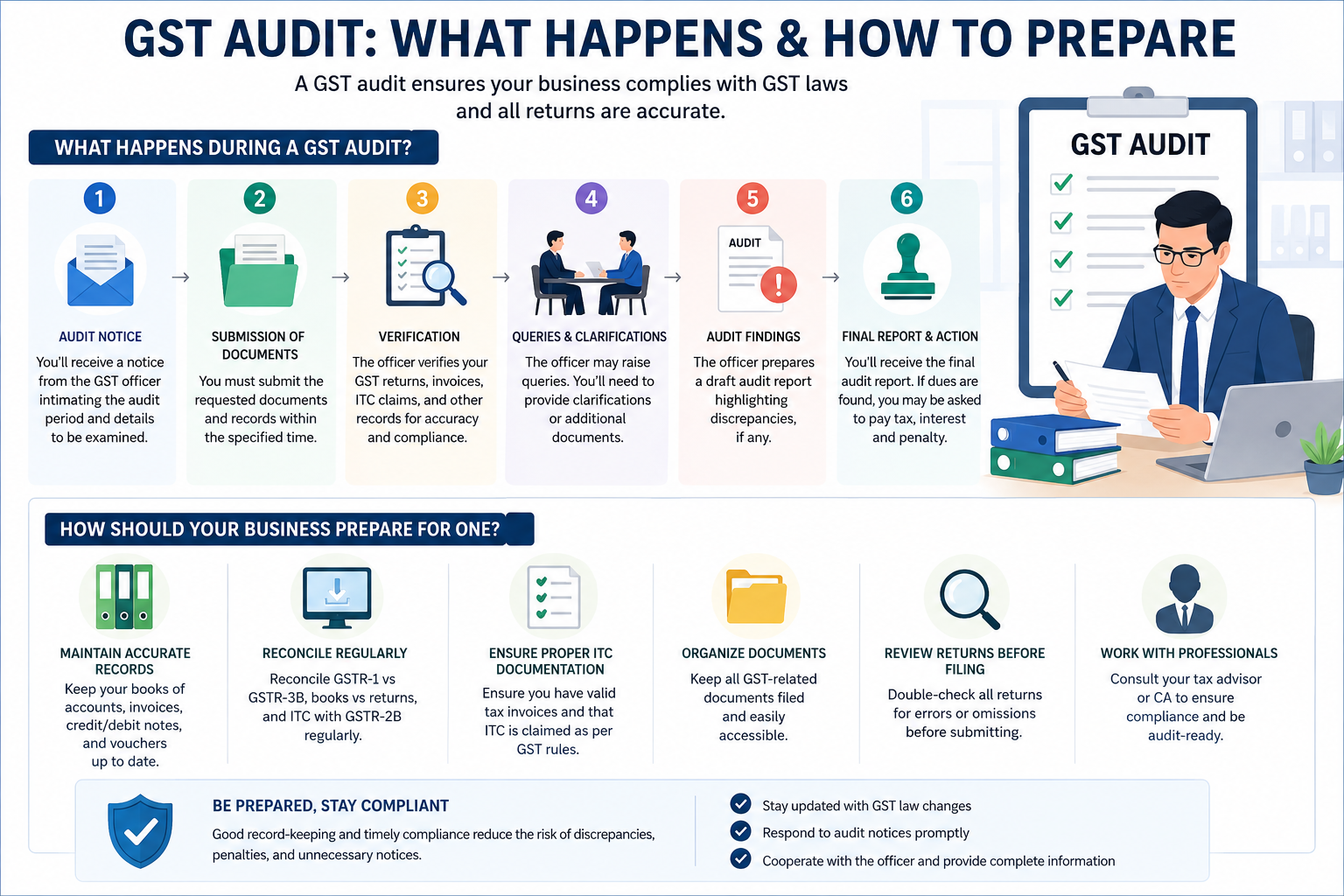
During a GST audit, officers usually review several important documents related to the business. These include GST returns such as GSTR-1 and GSTR-3B, purchase and sales registers, invoices, e-way bills, bank statements, balance sheets, Profit & Loss statements, input tax credit records, tax payment challans, and reconciliation statements. Authorities compare the information filed in GST returns with accounting records and financial statements to identify mismatches or possible tax evasion.
One of the first things auditors verify is whether the turnover reported in GST returns matches the turnover recorded in the books of accounts and income tax returns. If there is any mismatch, the business may be asked to explain the difference. Auditors also check whether the input tax credit claimed by the business is valid and supported by proper invoices. Incorrect or excess input tax credit claims are among the most common reasons businesses receive GST notices.
The GST department also reviews whether tax invoices comply with GST rules. Missing invoice details, incorrect GSTIN numbers, wrong tax rates, or fake invoices can lead to penalties. In addition, auditors may examine whether the correct GST rate has been applied on goods or services sold by the business. Businesses sometimes classify products incorrectly and pay lower GST rates unintentionally, which can create disputes during audits.
Another important area checked during a GST audit is reconciliation. Authorities compare data from:
- GSTR-1
- GSTR-3B
- E-way bills
- Books of accounts
- Annual GST returns
If the figures do not match, businesses may have to provide explanations or pay additional tax, along with interest and penalties. In some cases, businesses may also receive notices for delayed GST payments or incorrect refund claims.
Preparing for a GST audit should begin long before receiving an audit notice. Businesses should maintain proper bookkeeping and regularly reconcile GST returns with financial records. Every invoice, purchase bill, debit note, credit note, and payment proof should be properly stored and organized. Maintaining digital records can make document retrieval easier during audits.
One of the best ways to prepare for a GST audit is to perform periodic internal reviews. Businesses should regularly verify whether:
- GST returns are filed correctly
- Input tax credit claims are accurate
- Vendor GST compliance is proper
- Sales and purchase records match GST filings
- Tax payments are made on time
Monthly or quarterly reconciliation helps identify errors early before they become major compliance issues.
Businesses should also ensure that invoices contain all mandatory GST details, including GSTIN, invoice number, HSN/SAC code, tax amount, and customer details where required. Incorrect or incomplete invoices can create unnecessary complications during audits.
Another important preparation step is reconciling GSTR-2B with purchase records before claiming input tax credit. Claiming ITC on invoices not reflected in GSTR-2B may attract notices or disallowance during audit proceedings. Businesses should also review vendor compliance because non-compliant vendors may affect the buyer’s input tax credit eligibility.
If a business receives a GST audit notice, it is important not to panic or ignore it. The notice should be read carefully to understand:
- The period under audit
- Documents requested
- Deadline for submission
- Specific issues raised by authorities
Responding professionally and within the given timeline is extremely important. Delayed or incomplete responses can increase scrutiny and penalties.
In many cases, businesses benefit from taking assistance from a Chartered Accountant or GST consultant during audits. A professional can help organize documents, prepare reconciliations, draft responses, and communicate with tax authorities properly. Expert guidance becomes especially important in cases involving high tax demands, classification disputes, refund issues, or allegations of excess input tax credit claims.
Failure to comply during a GST audit can lead to several consequences. Businesses may face:
- Additional tax demands
- Interest on unpaid taxes
- Penalties
- Cancellation of GST registration
- Departmental investigations
- Legal proceedings in serious cases
Therefore, proper compliance and preparation are essential for avoiding unnecessary financial and legal risks.
In conclusion, a GST audit is not something businesses should fear if records are maintained correctly and compliance is handled properly. The audit process primarily focuses on verifying that taxes have been paid accurately and that proper records are maintained. Businesses that maintain organized accounts, reconcile returns regularly, preserve invoices, and follow GST rules carefully can handle audits smoothly and confidently. Instead of waiting for notices, proactive compliance and regular financial review are the best ways to stay audit-ready and protect the business from penalties and disputes.
If your business needs help with GST compliance, audit preparation, reconciliation, or notice handling, consulting a GST expert or Chartered Accountant can help ensure smooth and stress-free compliance.