



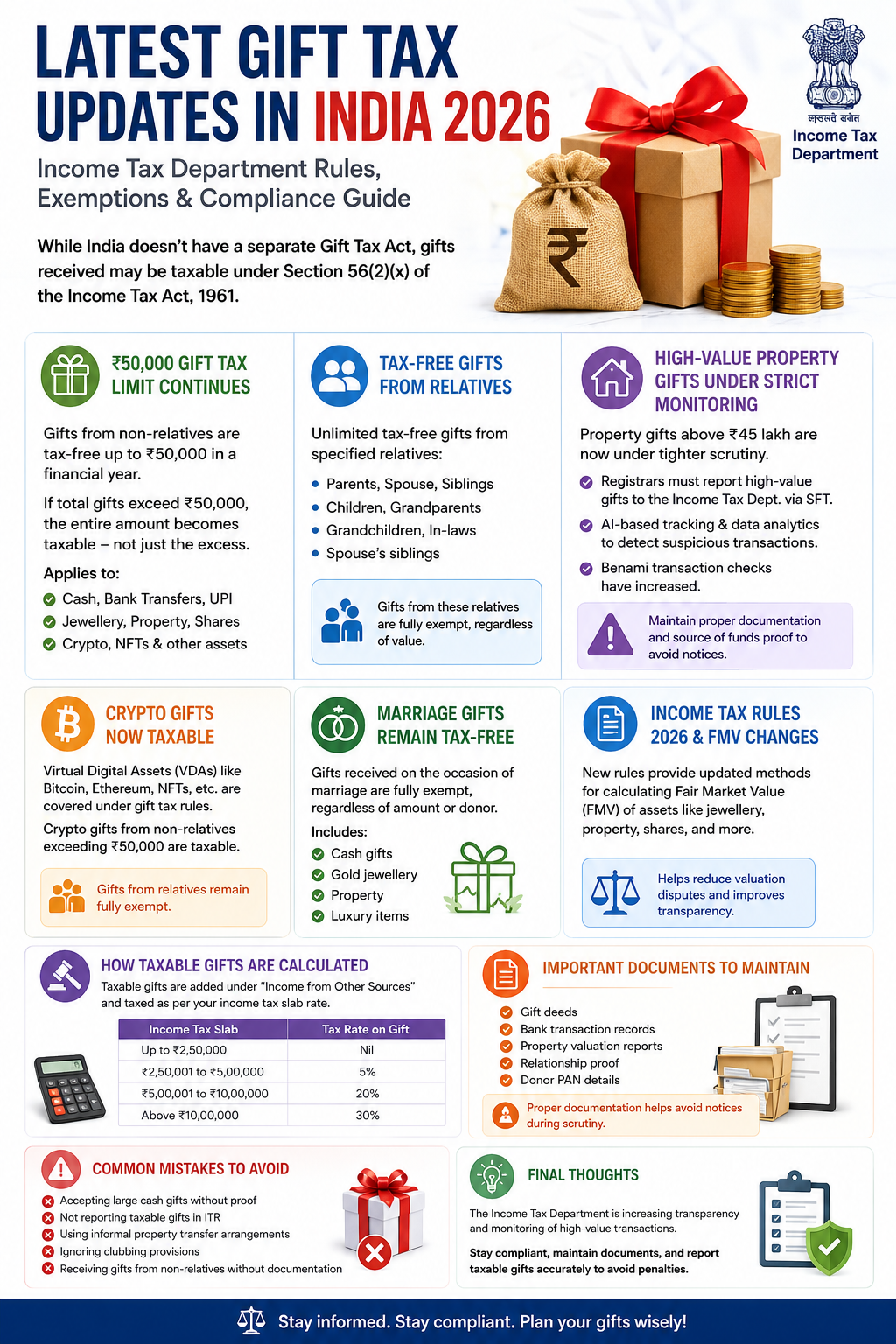
Gift taxation in India has become a major focus area for the Income Tax Department in 2026. With stricter reporting rules, new Income Tax Rules 2026, and increased scrutiny on high-value transactions, taxpayers must understand how gift tax provisions work under Section 56(2)(x) of the Income Tax Act. Although India does not have a separate “Gift Tax Act” anymore, gifts received in cash, property, jewellery, shares, crypto, or other assets can still be taxable under “Income from Other Sources.” The latest amendments and compliance measures are aimed at preventing tax evasion and improving financial transparency. What Is Gift Tax in India? The Gift Tax Act was abolished in 1998. However, gift taxation now falls under Section 56(2)(x) of the Income Tax Act, 1961. Under this provision, gifts received without consideration or at a lower-than-market value may become taxable if they exceed prescribed limits.
Latest Gift Tax Updates by the Income Tax Department in 2026
1. ₹50,000 Gift Tax Limit Continues
The Income Tax Department has retained the ₹50,000 exemption threshold for gifts received from non-relatives.
Important Rule:
If the total value of gifts exceeds ₹50,000 in a financial year, the entire amount becomes taxable — not just the excess amount.
Example:
- Gifts received from friends: ₹48,000 → No tax
- Gifts received from friends: ₹55,000 → Entire ₹55,000 taxable
This rule applies to:
- Cash gifts
- UPI transfers
- Bank transfers
- Jewellery
- Shares
- Immovable property
- Cryptocurrency & NFTs
Who Can Give Tax-Free Gifts?
The Income Tax Department continues to allow unlimited tax-free gifts from specified relatives.
Tax-Free Relatives Include:
- Parents
- Spouse
- Siblings
- Children
- Grandparents
- Grandchildren
- In-laws
- Spouse’s siblings
Gifts from these relatives remain fully exempt regardless of value.
2026 Update: High-Value Property Gifts Under Strict Monitoring
One of the biggest updates in 2026 is the stricter monitoring of property gifts above ₹45 lakh.
Under the new Income-tax Rules 2026:
- Property registrars must report high-value gifted properties to the Income Tax Department through the Statement of Financial Transactions (SFT).
- Data analytics and AI-based tracking systems are being used to identify suspicious transactions.
- Benami transaction checks have increased significantly.
What This Means for Taxpayers
If you receive gifted property:
- Proper documentation is essential
- The source of funds must be explainable
- Non-reporting can trigger notices, penalties, and scrutiny
Crypto Gifts Now Taxable in India
The Income Tax Department has clarified that Virtual Digital Assets (VDAs) such as:
- Bitcoin
- Ethereum
- NFTs
- Other cryptocurrencies
are covered under gift taxation rules.
If crypto gifts from non-relatives exceed ₹50,000, they become taxable. Relative exemptions still apply.
Marriage Gifts Remain Fully Tax-Free
A major relief for taxpayers is that gifts received on the occasion of marriage remain fully exempt from tax, regardless of amount or donor relationship.
This includes:
- Cash gifts
- Gold jewellery
- Property
- Expensive luxury items
However, birthday gifts and anniversary gifts are not covered under this exemption.
The Income Tax Rules 2026 & Fair Market Value (FMV) Changes
The draft Income Tax Rules 2026 introduced updated methods for calculating Fair Market Value (FMV) of:
- Jewellery
- Property
- Shares
- Other movable assets
This is important because taxable gifts are often calculated based on FMV.
The Income Tax Department aims to:
- Reduce valuation disputes
- Improve transparency
- Standardize reporting practices
New Income Tax Act 2025 Impact on Gift Taxation
From April 1, 2026, the new Income Tax Act 2025 is being implemented to simplify taxation and compliance.
While gift tax principles largely remain unchanged, the new framework:
- Simplifies tax language
- Introduces updated reporting systems
- Enhances digital scrutiny mechanisms
- Improves taxpayer compliance tracking
How Taxable Gifts Are Calculated
Taxable gifts are added under:
“Income from Other Sources”
The tax payable depends on your income tax slab rate.
Example:
If your taxable income falls under:
- 5% slab → Gift taxed at 5%
- 20% slab → Gift taxed at 20%
- 30% slab → Gift taxed at 30%
Important Documents Required for Gift Tax Compliance
The Income Tax Department is encouraging taxpayers to maintain:
- Gift deeds
- Bank transaction records
- Property valuation reports
- Relationship proof
- Donor PAN details
These documents help avoid notices during scrutiny.
Common Gift Tax Mistakes to Avoid in 2026
Avoid These Errors:
- Accepting large cash gifts without proof
- Not reporting taxable gifts in ITR
- Using informal property transfer arrangements
- Ignoring clubbing provisions
- Receiving gifts from non-relatives without documentation
Final Thoughts
The latest gift tax updates in India clearly show that the Income Tax Department is increasing transparency and digital monitoring of financial transactions. While genuine family gifts continue to enjoy major exemptions, high-value gifts, property transfers, and crypto transactions are now under tighter scrutiny.
Taxpayers should:
- Maintain proper documentation
- Report taxable gifts accurately
- Understand Section 56(2)(x)
- Stay compliant with Income Tax Rules 2026
Proper planning can help individuals avoid penalties, notices, and unnecessary litigation while legally benefiting from available gift tax exemptions.