

Running a business and filing GST returns on time may seem enough to stay compliant. However, many taxpayers still receive GST notices from the department. This often creates confusion and anxiety among business owners, especially small and medium enterprises. The truth is that filing regular GST returns alone does not guarantee complete GST compliance. Even minor mismatches, incorrect reporting, or procedural mistakes can trigger automated scrutiny by the GST system. In this blog, we will explain the primary reasons businesses receive GST notices despite filing returns regularly and provide guidance on how to avoid them.
What Is a GST Notice?
A GST notice is an official communication sent by the GST department when they identify discrepancies, mismatches, delayed compliance, or suspicious transactions in your GST records.
The notice may ask for:
- Clarification
- Additional documents
- Tax payment
- Interest or penalty
- Correction in GST returns
Receiving a GST notice does not always mean fraud or tax evasion. In many cases, notices are generated automatically due to data mismatches.
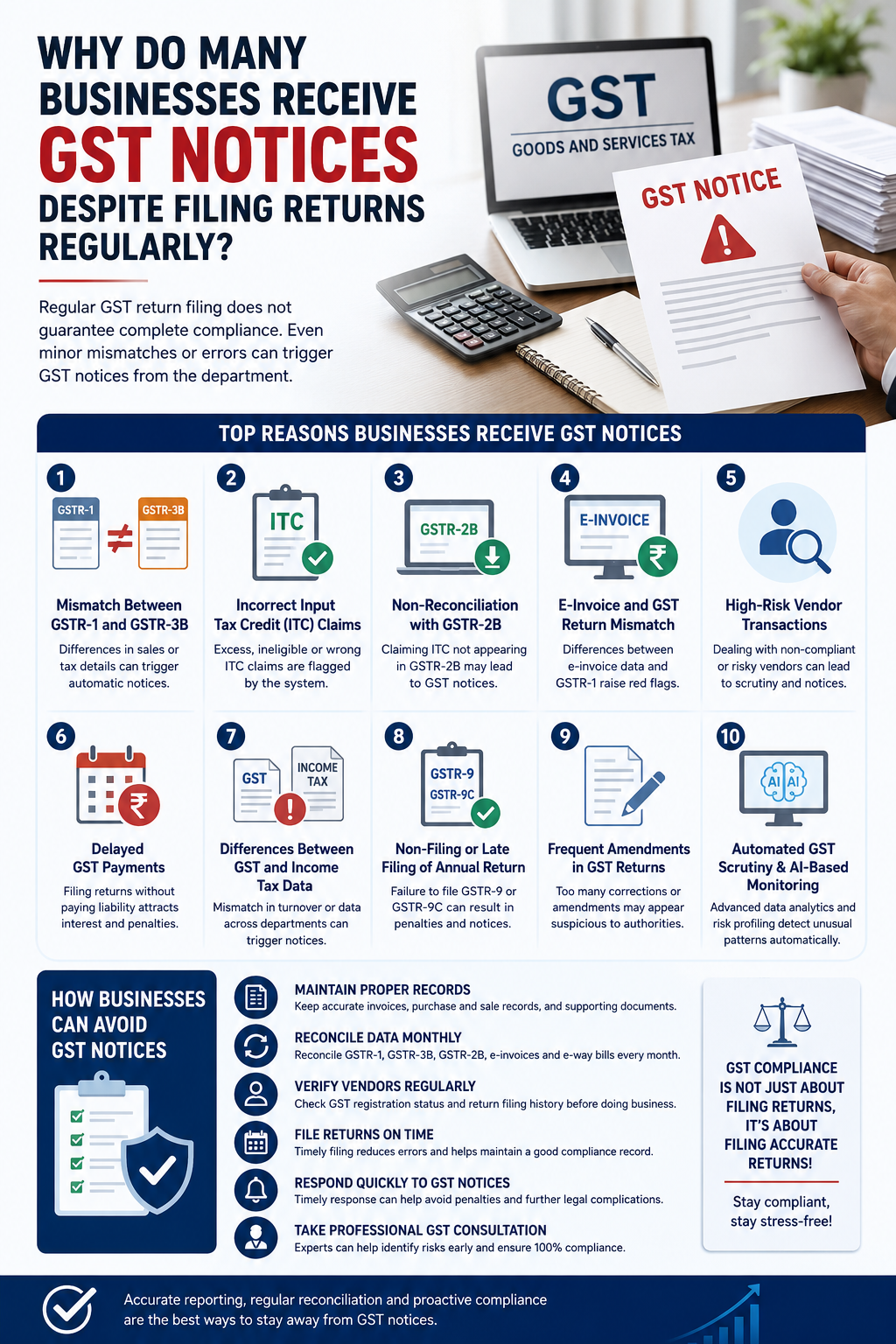
Top Reasons Businesses Receive GST Notices
1. Mismatch Between GSTR-1 and GSTR-3B
One of the most common reasons for receiving a GST mismatch notice is inconsistency between:
- GSTR-1 → Sales details
- GSTR-3B → Summary tax payment return
If the sales reported in GSTR-1 are higher than those declared in GSTR-3B, the GST portal may generate a notice automatically.
Example:
- Sales in GSTR-1: ₹15 lakh
- Sales in GSTR-3B: ₹12 lakh
The department may ask why GST was not paid on the remaining ₹3 lakh turnover.
How to Avoid It:
- Reconcile sales data monthly
- Cross-check invoices before filing
- Use GST reconciliation software
2. Incorrect Input Tax Credit (ITC) Claims
Claiming excess or ineligible ITC is another major reason businesses receive GST scrutiny notices.
Common ITC mistakes include:
- Claiming ITC on personal expenses
- Claiming ITC without supplier filing returns
- Duplicate ITC claims
- Wrong GSTIN entries
The GST department now uses advanced analytics to detect incorrect ITC claims quickly.
Best Practice:
Always reconcile:
- Purchase register
- GSTR-2B
- Vendor invoices
before claiming ITC.
3. Non-Reconciliation With GSTR-2B
Many businesses claim ITC directly from purchase invoices without checking GSTR-2B.
If the supplier:
- does not file returns,
- files incorrect data, or
- delays filing,
your ITC may not appear in GSTR-2B, resulting in a GST notice.
Important Tip:
Only claim ITC appearing in GSTR-2B unless legally justified.
4. E-Invoice and GST Return Mismatch
Businesses covered under e-invoicing often receive notices when:
- e-invoice data differs from GSTR-1,
- invoice values mismatch, or
- invoices are missing.
Since e-invoice data directly flows into GST systems, inconsistencies are detected instantly.
Solution:
Regularly reconcile:
- E-invoice portal data
- GSTR-1
- Accounting software
5. High-Risk Vendor Transactions
If your business deals with suspicious or non-compliant vendors, the GST department may flag your transactions.
Even if you filed returns properly, purchasing from fake invoice dealers can lead to:
- ITC reversal
- GST audit
- Penalty notices
How to Stay Safe:
Before dealing with vendors:
- Verify GST registration
- Check return filing status
- Review compliance history
6. Delayed GST Payments
Some businesses file GST returns on time but delay tax payments due to cash flow issues.
This can attract:
- Interest notices
- Late fee notices
- Demand notices
Important:
Filing returns without paying GST liability completely still creates compliance risk.
7. Differences Between GST and Income Tax Data
The government now cross-verifies:
- GST returns
- Income tax returns
- TDS data
- E-way bills
- Banking transactions
If turnover reported in GST differs significantly from income tax records, businesses may receive a compliance notice.
Example:
- GST turnover: ₹80 lakh
- Income tax turnover: ₹1.2 crore
Such discrepancies often trigger scrutiny.
8. Non-Filing or Late Filing of Annual Return
Many taxpayers regularly file monthly GST returns but forget:
- GSTR-9
- GSTR-9C
Failure to file annual returns can lead to GST notices and penalties.
Tip:
Maintain a GST compliance calendar to avoid missing deadlines.
9. Frequent Amendments in GST Returns
Too many corrections or amendments in:
- invoices,
- tax liability,
- ITC claims,
can trigger system alerts.
Frequent revisions may appear suspicious to tax authorities.
Recommendation:
Ensure accurate bookkeeping from the beginning instead of repeated corrections later.
10. Automated GST Scrutiny and AI-Based Monitoring
The GST department now uses:
- AI-based analytics,
- data matching systems,
- risk profiling tools,
to identify unusual activities automatically.
Even genuine businesses can receive notices due to:
- unusual transaction patterns,
- sudden turnover increase,
- high refund claims,
- sector-based risk assessment.
This is why modern GST compliance requires more than simple return filing.
How Businesses Can Avoid GST Notices
Here are some practical GST compliance tips:
Maintain Proper Accounting Records
Accurate bookkeeping reduces mismatches and errors.
Reconcile Data Monthly
Compare:
- GSTR-1
- GSTR-3B
- GSTR-2B
- E-way bills
- E-invoices
every month.
Verify Vendors Regularly
Work only with compliant suppliers.
File Returns Before Deadline
Avoid last-minute filing mistakes.
Respond Quickly to GST Notices
Ignoring notices can increase penalties and legal complications.
Take Professional GST Consultation
Expert review helps identify compliance risks early.
Final Thoughts
Many businesses believe that simply filing GST returns regularly is enough. However, the GST system today is highly data-driven and automated. Even small mismatches or compliance gaps can trigger notices.
The key to avoiding GST notices is:
- accurate reporting,
- regular reconciliation,
- proper ITC management,
- vendor verification,
- and proactive GST compliance.
Businesses that maintain transparent accounting and timely reconciliations significantly reduce the risk of departmental scrutiny.
If your business has received a GST notice recently, it is advisable to consult a GST professional immediately to avoid penalties and future complications.