

Filing your income tax return may sound complicated, but with the right process, it becomes simple and stress-free. Whether you are a salaried employee, freelancer, business owner, or professional, filing your tax return on time helps you stay compliant, claim refunds, and avoid penalties. In this guide, we’ll explain how to file your tax return in India step by step using easy language. What Is an Income Tax Return (ITR)? An Income Tax Return (ITR) is a form submitted to the Income Tax Department where you report: Your total income Tax paid during the year Deductions and exemptions claimed Refunds or taxes due Filing an ITR is mandatory if your income exceeds the basic exemption limit or if you meet certain financial criteria.
Why Filing Your Tax Return Is Important
1. Avoid Penalties
Late filing may result in penalties and interest under the Income Tax Act.
2. Claim Tax Refunds
If excess TDS has been deducted, you can claim your income tax refund through ITR filing.
3. Easy Loan & Visa Approval
Banks and embassies often ask for ITR acknowledgements as proof of income.
4. Carry Forward Losses
Business or capital losses can only be carried forward if returns are filed on time.
5. Maintain Financial Compliance
Regular tax filing improves your financial credibility and compliance record.
Step-by-Step Process to File Your Tax Return
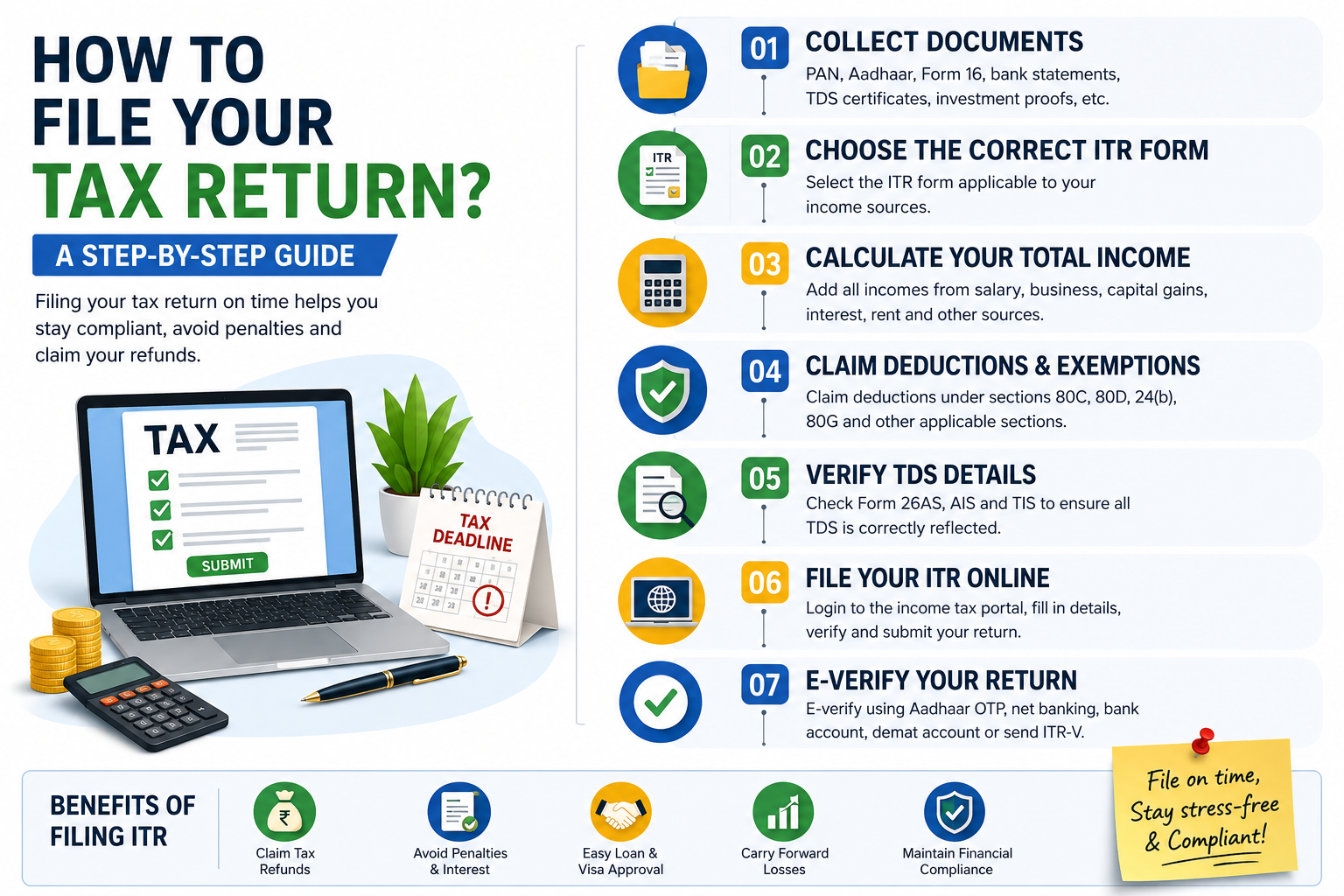
Step 1: Collect Required Documents
Before starting your income tax filing, keep these documents ready:
- PAN Card
- Aadhaar Card
- Form 16 (for salaried employees)
- Bank statements
- Investment proofs
- TDS certificates
- Rent receipts (if applicable)
- Home loan statements
- Capital gain statements
- Business income details (if applicable)
Step 2: Choose the Correct ITR Form
Different taxpayers use different ITR forms.
Common ITR Forms:
| Taxpayer Type | Applicable ITR Form |
|---|---|
| Salaried Individuals | ITR-1 |
| Freelancers & Professionals | ITR-3 or ITR-4 |
| Businesses | ITR-3 |
| Capital Gains Income | ITR-2 |
Choosing the correct ITR form is important for accurate income tax return filing.
Step 3: Calculate Your Total Income
Add income from all sources:
- Salary income
- Business/professional income
- Freelance income
- Rental income
- Interest income
- Capital gains
- Other sources
Step 4: Claim Deductions & Exemptions
You can reduce your taxable income by claiming deductions under various sections.
Popular Tax Saving Deductions:
- Section 80C – ELSS, LIC, PPF, Tuition Fees
- Section 80D – Health Insurance
- Section 24(b) – Home Loan Interest
- Section 80G – Donations
- HRA Exemption
Proper tax planning can significantly reduce your income tax liability.
Step 5: Verify TDS Details
Check your:
- Form 26AS
- AIS (Annual Information Statement)
- TIS (Taxpayer Information Summary)
Ensure all TDS deductions are correctly reflected before filing your tax return online.
Step 6: File Your ITR Online
You can file your tax return through the official income tax portal.
Basic Filing Process:
- Login using PAN and password
- Select the assessment year
- Choose the correct ITR form
- Fill income details
- Claim deductions
- Verify tax computation
- Submit the return
Step 7: E-Verify Your Return
Your ITR filing is incomplete without verification.
Methods for E-Verification:
- Aadhaar OTP
- Net Banking
- Bank Account Validation
- Demat Account
- Physical ITR-V
E-verification should be completed within the prescribed timeline.
Common Mistakes to Avoid While Filing Tax Returns
Incorrect PAN or Bank Details
Small errors can delay refunds.
Choosing Wrong Tax Regime
Compare old vs new tax regime before filing.
Missing Income Sources
Always disclose all bank interest, freelance income, or capital gains.
Not Verifying ITR
Unverified returns are treated as invalid.
Filing After Due Date
Late filing may attract penalties and loss of benefits.
Who Should File an Income Tax Return?
You should file ITR if:
- Your income exceeds the exemption limit
- TDS has been deducted
- You want to claim refunds
- You own foreign assets
- You are applying for loans or visas
- You are a freelancer or business owner
Even if your income is below taxable limits, voluntary income tax return filing is often beneficial.
Benefits of Online Tax Filing
- Fast processing
- Easy refund tracking
- Paperless compliance
- Secure documentation
- Convenient from anywhere
Digital tax filing has made the process easier than ever for individuals and businesses