
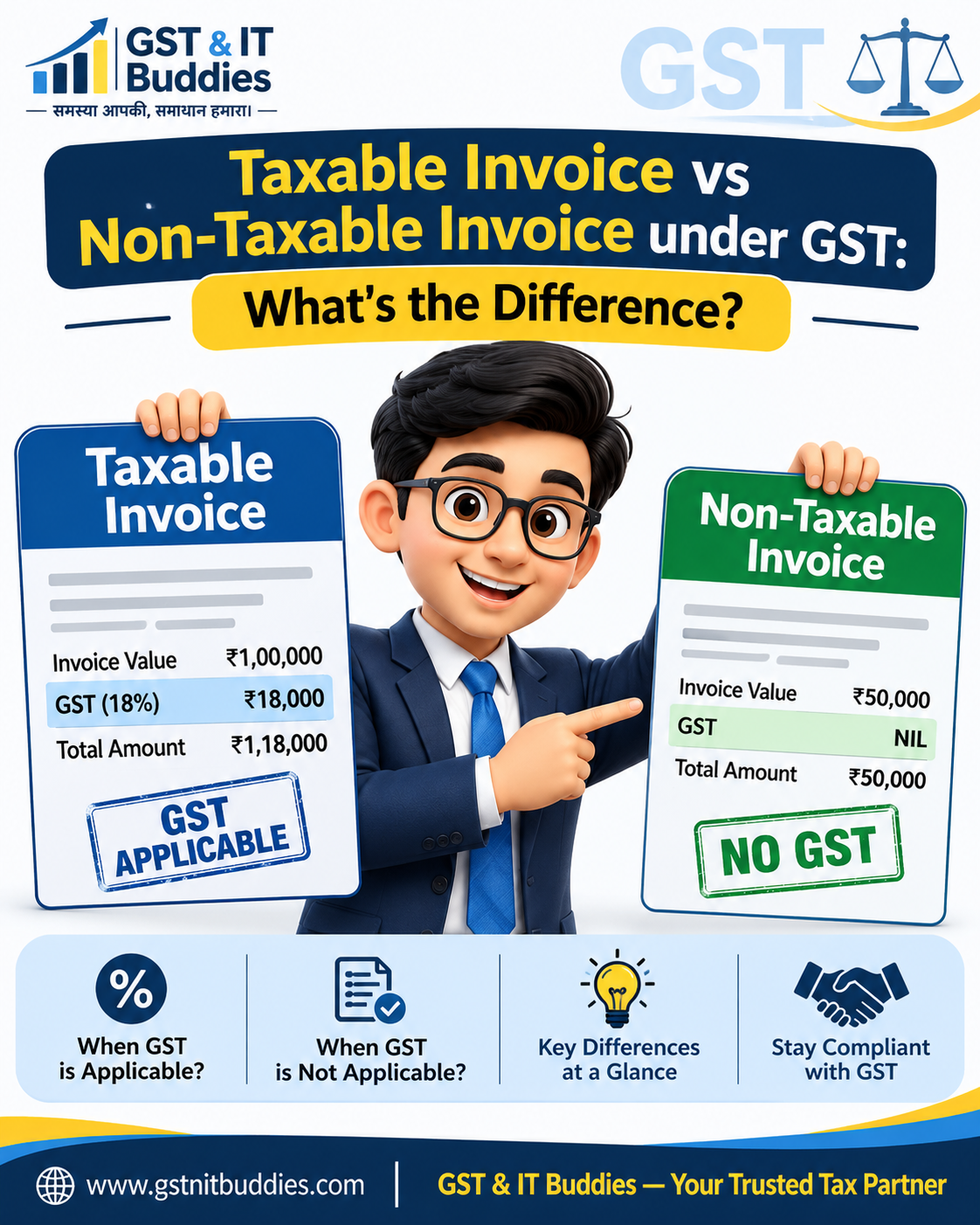
All enterprises registered under the Goods and Services Tax (GST) regime are mandated to generate an invoice upon the sale of goods or services; however, these invoices are not uniform in their composition or function. Certain invoices explicitly itemize the applicable GST, while others omit this tax component entirely.Furthermore, there exists a distinct dichotomy regarding fiscal benefits: specific invoices empower the recipient purchaser to avail of Input Tax Credit (ITC), whereas others do not..
What is a Taxable Invoice (Tax Invoice)?
A tax invoice is the bill a regular GST-registered business issues when it sells taxable goods or services. It clearly shows the GST charged — CGST + SGST for sales within the state, or IGST for sales to another state.
A tax invoice does three jobs:
- It is proof that the sale happened.
- It shows how much GST was collected from the buyer.
- It is the document the buyer needs to claim Input Tax Credit (ITC).
Example: A computer shop in Jaipur sells a laptop to a business for ₹50,000. GST at 18% = ₹9,000 (CGST ₹4,500 + SGST ₹4,500). The shop issues a tax invoice for ₹59,000, and the buying business can claim ₹9,000 as ITC.
Main details on a tax invoice (Rule 46)
- Supplier's name, address and GSTIN
- Unique invoice number (up to 16 characters, in one series per financial year) and date
- Buyer's name, address and GSTIN (if registered)
- HSN code for goods / SAC code for services
- Description, quantity and value of goods or services
- Taxable value after discount
- GST rate and tax amount — CGST, SGST/UTGST or IGST, and cess if any
- Place of supply (with state name) for inter-state sales
- Whether tax is payable under reverse charge
- Signature or digital signature of the supplier
HSN digits: Businesses with turnover up to ₹5 crore must mention at least a 4-digit HSN code (on B2B invoices). Above ₹5 crore, a 6-digit HSN code is required.
What is a Non-Taxable Invoice (Bill of Supply)?
A bill of supply is issued when no GST can be charged on the sale. It looks like a normal bill but does not show any tax amount. In fact, Rule 49 says a bill of supply must not contain any tax charged.
A bill of supply is issued in two main cases:
- Exempt or non-taxable supplies — for example, fresh vegetables, fresh milk, unbranded grains, or certain educational and healthcare services.
- Composition scheme dealers — businesses that pay GST at a flat rate on turnover under the composition scheme. They cannot collect GST from customers, so they always issue a bill of supply.
Example: A vegetable wholesaler sells fresh tomatoes worth ₹12,000. Fresh vegetables are exempt from GST, so the wholesaler issues a bill of supply for ₹12,000 — no GST line, and no ITC for the buyer.
Main details on a bill of supply (Rule 49)
- Supplier's name, address and GSTIN
- Consecutive serial number (separate series) and date
- Buyer's name, address and GSTIN (if registered)
- HSN / SAC code
- Description of goods or services
- Value of supply (after discount)
- Signature or digital signature of the supplier
Note for composition dealers: The bill must clearly say "composition taxable person, not eligible to collect tax on supplies" at the top.
Taxable Invoice vs Non-Taxable Invoice: Quick Comparison
|
Point |
Tax Invoice (Taxable) |
Bill of Supply (Non-Taxable) |
|---|---|---|
|
Legal basis |
Section 31, Rule 46 |
Section 31(3)(c), Rule 49 |
|
Who issues it |
Regular GST-registered business |
Composition dealers, or anyone selling exempt / non-GST items |
|
Type of supply |
Taxable goods or services |
Exempt, nil-rated or non-GST supplies |
|
GST shown on bill |
Yes — CGST/SGST or IGST |
No tax shown at all |
|
ITC for buyer |
Yes, buyer can claim ITC |
No ITC available |
|
E-invoicing |
Required for B2B if turnover is above ₹5 crore |
Not applicable |
|
Reported in |
GSTR-1 (taxable supplies) |
GSTR-1 (exempt/nil) or CMP-08 for composition dealers |
|
Wrong use risk |
Charging GST on exempt items |
Buyer loses ITC if used for a taxable sale |
Common Mistakes to Avoid
1. Treating exports as exempt sales is a fundamental error; even when exports qualify for zero-rating under the LUT regime without the payment of IGST, they remain zero-rated transactions rather than exempt ones. Consequently, the issuance of a tax invoice is mandatory for all export dealings, rendering the generation of a bill of supply inappropriate and incorrect.
2. Issuing a tax invoice for exempt items. If a regular dealer issues a tax invoice for an exempt supply, it is treated as a bill of supply anyway. Charging GST on exempt items only creates confusion and refund issues.
3. Composition dealers charging GST. A composition dealer can never show or collect GST on a bill.Doing so can lead to penalties and recovery of the tax collected.
4. Mixing number series. Keep separate number series for tax invoices and bills of supply.It makes GSTR-1 filing and audits much easier.
5. Should your aggregate turnover equal or exceed ₹10 crore, you are mandated to submit e-invoices via the Invoice Registration Portal (IRP) within a thirty-day window from the date of issuance. Failure to adhere to this strict timeline will result in the portal's refusal to process subsequent submissions, thereby jeopardizing the buyer's eligibility to claim Input Tax Credit (ITC).
What if I Sell Both Taxable and Exempt Items?
Many businesses do—for example, a grocery store selling both packaged branded items (taxable) and fresh vegetables (exempt).
If you sell both types of items to an unregistered customer in one sale, you can issue a single "Invoice-cum-Bill of Supply" (Rule 46A). For registered buyers, issue a tax invoice for the taxable items and a separate bill of supply for the exempt ones.
Is a Bill Needed for Small Sales?
For sales below ₹200 to an unregistered customer who doesn't ask for a bill, you don't need to issue an individual tax invoice or bill of supply. Instead, you can issue one consolidated bill at the end of the day covering all such small sales.
When Should You Issue the Invoice?
- Goods: On or before removal / delivery of the goods.
- Services: Within 30 days from the date the service is provided (45 days for banks and financial institutions).
These timelines apply to both tax invoices and bills of supply.
Frequently Asked Questions (FAQs)
Q1. Is a bill of supply the same as a non-taxable invoice? Yes. "Non-taxable invoice" is the common name. Under GST law, the correct name is Bill of Supply.
Q2. Can a buyer claim ITC on a bill of supply? No. A bill of supply shows no GST, so there is no tax credit to claim.
Q3. Can a composition dealer issue a tax invoice? No. Composition dealers must always issue a bill of supply and cannot collect GST from customers.
Q4. Do I need to issue a tax invoice for exports? Yes. Exports are zero-rated supplies, not exempt supplies, so a tax invoice is required — even if you export under LUT without paying IGST.
Q5. Is e-invoicing required for a bill of supply? No. E-invoicing applies only to tax invoices (and related credit/debit notes) for B2B supplies and exports by businesses with turnover above ₹5 crore.
Q6. Can an unregistered business issue a tax invoice? No. Only a GST-registered person can issue a tax invoice and collect GST.
Conclusion
The rule is simple: if GST is charged, issue a tax invoice; if no GST can be charged, issue a bill of supply. Regular dealers selling taxable items use tax invoices. Composition dealers and sellers of exempt items use bills of supply.
Getting this right keeps your GST returns clean, protects your customers' ITC, and saves you from notices and penalties.
Need help with GST invoicing, registration, or return filing? The team at GST & IT Buddies handles GST registration, monthly and quarterly returns, composition scheme filings, and more—quickly and affordably. Contact us today and stay 100% GST compliant.
Disclaimer: This article is for general information only. GST rules change from time to time—please check the latest notifications or consult a tax professional before acting.