



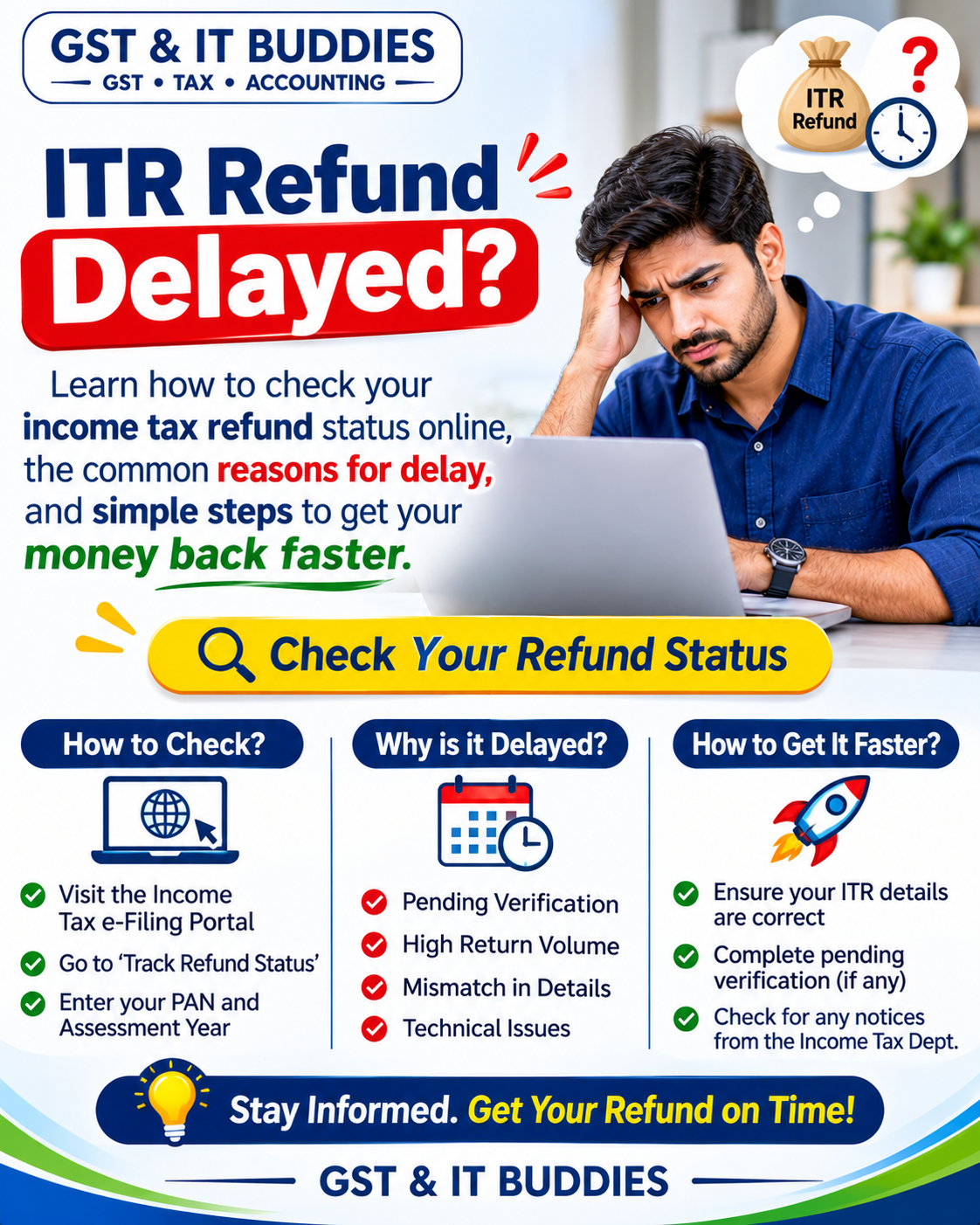
You filed your ITR on time, but the refund still has not reached your bank account. You are not alone. Lakhs of taxpayers face refund delays every year, and most of them are caused by small, fixable issues. In most cases, the problem is an unverified return, an unvalidated bank account, or a mismatch with Form 26AS or AIS. The good news is that you can check the exact status online in a few minutes. This guide explains how long a refund normally takes, how to check your refund status, the most common reasons for delay, and how to fix each one.
How Long Does an ITR Refund Usually Take?
The Income Tax Department generally credits refunds within 4 to 5 weeks after you e-verify your return. Many taxpayers with simple returns now get their refund within a few days.
The clock starts only after e-verification, not after filing. If your return is selected for further checks or has a mismatch, it can take longer.
If more than 5 weeks have passed since e-verification and you have not received any refund or intimation, it is time to check your status.
How to Check Your ITR Refund Status
You can check your refund status in two ways: on the Income Tax e-filing portal, or on the refund banker's (NSDL/Protean) website.
Method 1: Income Tax e-Filing Portal
- Go to incometax.gov.in and log in with your PAN and password.
- Click e-File, then Income Tax Returns, then View Filed Returns.
- Select the relevant Assessment Year (for example, AY 2026-27 for FY 2025-26).
- Check the status timeline. It will show stages like "Return Filed", "Return Verified", "Return Processed,", and "Refund Issued".
- If the refund has failed, the reason will usually be shown here.
Method 2: NSDL (Protean) Refund Status Page
- Visit the TIN-NSDL (Protean) refund status page.
- Enter your PAN and select the Assessment Year.
- Fill in the captcha and click Proceed.
- You will see whether the refund has been sent, its mode of payment, and the date.
Also check your registered email and SMS. The department sends an intimation under Section 143(1) once your return is processed, which shows the refund amount or any demand.
Common Reasons for ITR Refund Delay (and Quick Fixes)
Most refund delays come from one of the reasons below. Match your status message with the table to find the fix.
|
Reason for Delay |
What It Means |
Quick Fix |
|---|---|---|
|
Return not e-verified |
Return is not processed until verified |
E-verify via Aadhaar OTP or net banking within 30 days of filing |
|
Bank account not pre-validated |
Refund cannot be credited to an unvalidated account |
Pre-validate the account under My Profile, then request reissue |
|
Name or PAN mismatch with bank |
Bank rejects the credit |
Update bank KYC so the name matches PAN, then request reissue |
|
PAN not linked with Aadhaar |
PAN becomes inoperative; no refund is issued |
Link PAN and Aadhaar (late fee applies) and wait for PAN to become operative |
|
TDS mismatch with Form 26AS/AIS |
Claimed TDS is not reflected in department records |
Ask the deductor to correct the TDS return, or file a revised ITR |
|
Outstanding tax demand |
Refund adjusted against an old demand |
Check the demand under Pending Actions; agree or disagree with the reasons |
|
Defective return notice |
Return has errors or missing details |
Respond to the defective return notice within the given time |
|
Return under scrutiny |
Additional checks before refund |
Respond to notices on time; refund follows after assessment |
Step-by-Step Fixes for a Delayed or Failed Refund
1. Pre-Validate Your Bank Account
- Log in to the e-filing portal and go to My Profile.
- Click My Bank Account, then Add Bank Account.
- Enter the account number, IFSC, and account type, then submit.
- Wait for the status to show "Validated" (usually a few days).
- Make sure this account is marked as nominated for refund.
2. Raise a Refund Reissue Request
Use this when the status shows "Refund Failed".
- Go to Services, then Refund Reissue.
- Click Create Refund Reissue Request and select the Assessment Year.
- Choose a validated bank account.
- E-verify the request with Aadhaar OTP or another method.
3. Respond to Notices and Demands
- Open Pending Actions, then Worklist and Response to Outstanding Demand.
- If the demand is correct, agree and pay it. If not, disagree and give reasons with documents.
- For a defective return notice, file the corrected return within the time allowed.
4. File a Grievance on e-Nivaran
If nothing works, raise a complaint.
- Go to Grievances, then submit a grievance on the e-filing portal.
- Select CPC-ITR as the category and choose the refund-related issue.
- Describe the problem briefly and attach proof if needed.
- Note the grievance number and track it under Grievance Status.
Do You Get Interest on a Delayed Refund?
Yes. Under Section 244A of the Income Tax Act, 1961, you get interest at 0.5% per month (6% a year) on the refund amount. For returns filed on time, interest is generally counted from 1 April of the Assessment Year until the refund date.
Example: if your refund is ₹20,000 and it is delayed by 6 months, the interest would be about ₹600 (₹20,000 × 0.5% × 6).
Note that if the delay is caused by you, such as a late return or late verification, interest for that period may not be paid. Interest on refund is taxable and must be shown under "Income from Other Sources" in the next ITR. The 1961 Act still governs returns for FY 2025-26; for later years, check the matching provision under the new Income Tax Act, 2025.
Frequently Asked Questions
1. Why is my ITR processed but the refund not received? The most common reasons are a failed bank credit (account not pre-validated or name mismatch) or adjustment against an old demand. Check the status on the e-filing portal and raise a refund reissue request if it shows "Refund Failed".
2. How do I know if my refund has failed? The status under View Filed Returns will show "Refund Failed" along with the reason. You may also get an email from the department.
3. Can I change the bank account for my refund after filing? Yes. Add and pre-validate the new account in My Profile, then use the Refund Reissue option to select it.
4. What happens if my PAN is inoperative? No refund is issued, and no interest is paid for the period the PAN stays inoperative. Link PAN with Aadhaar to make it operative again.
5. Is there a helpline for refund issues? Yes. You can call the CPC or e-filing helpline numbers listed on the Contact Us page of incometax.gov.in, or file a grievance through e-Nivaran.
6. Is interest on income tax refund taxable? Yes. It is taxed as "Income from Other Sources" in the year you receive it.
Conclusion
A delayed ITR refund is frustrating, but it is usually easy to fix. Check your status first, match the reason with the table above, and take the right step: e-verify, pre-validate your bank account, raise a reissue request, or respond to a notice.
Still stuck? The team at GST & IT Buddies can review your return, find the reason for the delay, and handle the follow-up with the department for you. Visit giblog. to get in touch.
Disclaimer: This article is for general information only and does not constitute legal or tax advice. Rules, portal steps, and timelines may change. Please verify details on the official Income Tax portal or consult a qualified tax professional before acting.