


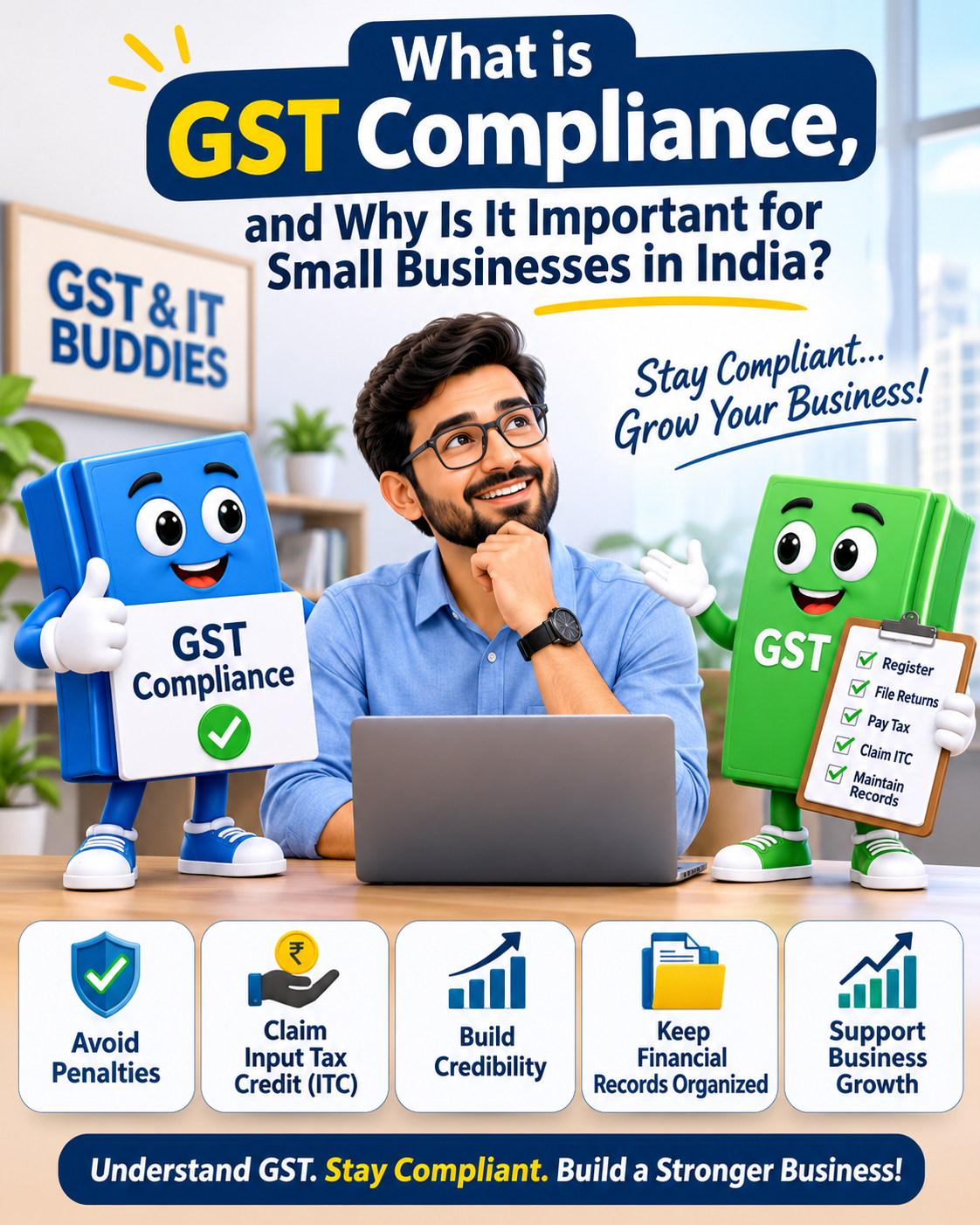
Goods and Services Tax (GST) has transformed India's indirect taxation system by bringing multiple indirect taxes under one unified tax structure. For small businesses, GST has made taxation more organised, but it has also introduced certain responsibilities that business owners must follow regularly. GST compliance refers to following all the rules and regulations prescribed under the GST Act, including GST registration, filing returns, paying taxes, maintaining records, issuing tax invoices, and claiming Input Tax Credit (ITC) correctly.
What Is GST Compliance?
GST compliance means fulfilling all legal obligations under India's Goods and Services Tax framework.
Every business registered under GST must follow the applicable rules regarding tax collection, reporting, payment, and documentation.
The main objective of GST compliance is to ensure businesses accurately report transactions and pay the correct tax to the government.
Some important GST compliance activities include:
-
Obtaining GST registration when legally required.
-
Issuing GST-compliant tax invoices.
-
Filing GST returns within the prescribed deadlines.
-
Paying GST liabilities on time.
-
Maintaining proper sales and purchase records.
-
Claiming eligible Input Tax Credit (ITC).
-
Reconciling purchase records with GSTR-2B.
-
Complying with applicable e-invoicing and e-way bill requirements.
Important: GST compliance requirements depend on the nature, turnover, location, and type of business. Not every requirement applies to every small business.
Why Is GST Compliance Important for Small Businesses in India?
GST compliance is not just a legal responsibility; it also plays an important role in maintaining business stability and financial discipline.
Let's understand its major benefits.
1. Helps Avoid Penalties and Legal Notices
One of the biggest reasons to maintain GST compliance is to avoid unnecessary penalties and legal complications.
Late filing of GST returns, non-payment of tax, incorrect reporting, and other violations can result in interest, late fees, penalties, or notices, depending on the nature of the default.
By filing returns and paying taxes within the prescribed timelines, small businesses can reduce the risk of financial losses.
2. Helps Businesses Claim Input Tax Credit (ITC)
Input Tax Credit (ITC) allows eligible registered businesses to reduce their GST liability by claiming credit for GST paid on eligible business purchases.
For example:
Suppose a small business purchases goods worth ₹1,00,000 and pays 18% GST.
-
Purchase value: ₹1,00,000
-
GST paid: ₹18,000
-
Eligible Input Tax Credit: ₹18,000
If the business collects ₹30,000 as output GST, its net GST liability may be ₹12,000, subject to applicable ITC conditions and restrictions.
Proper GST compliance and reconciliation help businesses claim eligible ITC and avoid losing legitimate tax credits.
3. Improves Financial Transparency
Maintaining GST records helps small businesses track their sales, purchases, expenses, and tax liabilities.
Regular GST filing creates a systematic financial record that can help business owners understand their financial position and make better business decisions.
It also makes accounting, auditing, and financial reporting more organised.
4. Builds Business Credibility
GST compliance can improve a business's professional image and credibility.
Large companies, corporate clients, and established organisations often prefer dealing with vendors who maintain proper GST records and issue valid tax invoices.
A compliant business can also provide relevant GST documents when required during vendor registration, financial verification, or business transactions.
5. Makes Business Expansion Easier
When a small business plans to expand into new markets, work with corporate clients, or increase its sales volume, proper financial and tax records become increasingly important.
GST compliance helps businesses maintain organised documentation and meet applicable tax requirements as their operations grow.
6. Reduces Errors in Accounting and Tax Reporting
Regular reconciliation of sales, purchases, tax payments, and GST returns helps identify mistakes at an early stage.
It reduces the possibility of reporting incorrect figures, claiming ineligible ITC, or overlooking tax liabilities.
A proper GST compliance process also makes it easier for accountants and tax professionals to manage business records.
Key GST Compliance Requirements for Small Businesses
Small businesses registered under GST should understand the following important compliance requirements.
|
Compliance Requirement |
Purpose |
|---|---|
|
GST Registration |
Obtain registration when applicable |
|
GSTR-1 |
Report outward supplies |
|
GSTR-3B |
Declare tax liability and pay applicable tax |
|
GSTR-2B Reconciliation |
Verify eligible ITC |
|
GST Payment |
Pay tax within applicable deadlines |
|
Tax Invoice |
Issue invoices with prescribed details |
|
E-Way Bill |
Generate when applicable to goods movement |
|
E-Invoicing |
Follow applicable e-invoicing requirements |
|
Record Maintenance |
Maintain prescribed business and tax records |
Important GST Returns for Small Businesses
GSTR-1: Used to report details of outward supplies, including sales invoices, debit notes, and credit notes.
GSTR-3B: A summary return used to declare GST liabilities, eligible ITC, and discharge the applicable tax.
GSTR-2B: A statement that helps registered taxpayers review ITC details based on information furnished by suppliers.
QRMP Scheme: Eligible small taxpayers with aggregate annual turnover up to ₹5 crore may opt for the Quarterly Return Monthly Payment (QRMP) scheme, subject to prescribed conditions. This allows quarterly filing of GSTR-1 and GSTR-3B with monthly tax payments.
Common GST Compliance Mistakes Small Businesses Should Avoid
Many small businesses face GST-related difficulties because of common mistakes. Some of these include:
-
Missing GST Return Deadlines: Filing returns late can lead to late fees and other consequences.
-
Incorrect GST Rates: Applying the wrong GST rate can result in incorrect tax calculations.
-
Claiming Ineligible ITC: Claiming credit without fulfilling the prescribed conditions can create tax liabilities.
-
Ignoring GSTR-2B Reconciliation: Not checking purchase-related ITC information can lead to discrepancies.
-
Incorrect Invoice Details: Missing GSTIN, HSN/SAC codes, tax rates, or other mandatory details can cause compliance issues.
-
Not Maintaining Proper Records: Poor record-keeping makes GST reporting and verification difficult.
-
Ignoring GST Notices: Delayed responses to departmental notices can create additional complications.
Avoiding these mistakes can make GST compliance easier and help businesses maintain accurate tax records.
GST Compliance Checklist for Small Businesses
To maintain proper GST compliance, business owners should follow a regular checklist.
-
Verify GST registration details.
-
Prepare accurate sales and purchase invoices.
-
Reconcile purchase records with GSTR-2B.
-
Calculate GST liability correctly.
-
File applicable GST returns on time.
-
Pay outstanding GST liabilities within deadlines.
-
Maintain proper books of accounts.
-
Check GST portal notifications and notices.
-
Review e-invoicing and e-way bill applicability.
Following this checklist can help small businesses avoid common compliance issues and manage their tax responsibilities more efficiently.
How Can Small Businesses Simplify GST Compliance?
Managing GST compliance can become challenging for small businesses, especially when they have limited accounting resources.
Here are some practical ways to simplify the process:
1. Use Accounting Software: Choose reliable accounting software to manage invoices, purchases, sales, and GST calculations.
2. Maintain Monthly Records: Keep sales, purchase, expense, and payment records updated regularly instead of waiting until the return filing deadline.
3. Track GST Due Dates: Maintain a compliance calendar to avoid missing important return filing and payment deadlines.
4. Reconcile GST Data Regularly: Compare accounting records with GST portal data to identify discrepancies and verify eligible ITC.
5. Consult GST Professionals: Take assistance from experienced GST consultants or tax professionals to understand applicable rules and resolve compliance-related issues.
What Happens If a Business Does Not Follow GST Compliance?
Failure to comply with GST regulations can create financial and legal difficulties for businesses.
Depending on the nature of non-compliance, consequences may include:
-
Late fees for delayed return filing.
-
Interest on delayed tax payments.
-
Penalties for specific GST violations.
-
Restrictions or suspension of GST registration in applicable cases.
-
GST notices and departmental scrutiny.
-
Reversal of incorrectly claimed Input Tax Credit.
-
Additional financial and administrative burdens.
Therefore, businesses should take GST compliance seriously and complete their applicable obligations within the prescribed timelines.
Conclusion
GST compliance is an essential part of running a successful small business in India. From GST registration and return filing to tax payments and Input Tax Credit reconciliation, every compliance activity contributes to better financial management and legal security.
By maintaining accurate records, monitoring GST deadlines, and following the applicable regulations, small businesses can avoid unnecessary penalties, improve financial transparency, and focus more on business growth.
Remember, GST compliance is not just about paying taxes; it is about building a transparent, organised, and financially responsible business.
If you are a small business owner, staying updated with GST rules and taking professional assistance when required can make your compliance journey much easier.
Frequently Asked Questions (FAQs)
Q1. What is GST compliance in India?
GST compliance refers to fulfilling the legal requirements under the Goods and Services Tax Act, including registration, return filing, tax payments, invoice generation, and maintaining proper records.
Q2. Is GST compliance mandatory for small businesses?
GST compliance is mandatory for businesses that are registered or otherwise required to register under GST. The applicable obligations depend on turnover, business activities, location, and statutory conditions.
Q3. What are the main GST returns for small businesses?
The main GST returns and statements include GSTR-1, GSTR-3B, and GSTR-2B. Their applicability and filing frequency depend on the taxpayer's category and scheme.
Q4. What is the penalty for late GST return filing?
Late filing may attract applicable late fees. Delayed tax payments may also attract interest. The amount depends on the return, delay, applicable provisions, and government notifications.
Q5. Can small businesses claim Input Tax Credit under GST?
Yes. Eligible registered businesses can claim ITC on qualifying business purchases, provided they satisfy the conditions and restrictions prescribed under GST law.
Q6. How can small businesses manage GST compliance easily?
Businesses can simplify GST compliance by using accounting software, maintaining proper records, reconciling ITC, tracking due dates, and consulting GST professionals.
Q7. What is the QRMP scheme under GST?
The QRMP scheme allows eligible registered taxpayers with aggregate annual turnover up to ₹5 crore, subject to prescribed conditions, to file GSTR-1 and GSTR-3B quarterly while making tax payments monthly.