
A tax audit in India is an examination of certain financial records and tax-related information of a taxpayer by a qualified Chartered Accountant (CA). The purpose of a tax audit is to verify whether the taxpayer has maintained proper books of accounts and complied with the applicable provisions of the Income Tax Act.For businesses, professionals, and other eligible taxpayers, understanding who needs a tax audit, the applicable turnover limits, and the reporting requirements can help avoid compliance issues and penalties.
What Is a Tax Audit?
A tax audit is conducted under Section 44AB of the Income-tax Act, 1961. It requires eligible taxpayers to have their accounts audited by a Chartered Accountant and furnish the prescribed audit report electronically.
The audit generally examines areas such as:
- Turnover or gross receipts
- Business and professional expenses
- Income and expenditure records
- Books of accounts
- Tax deductions and allowances
- Depreciation
- Loans and liabilities
- Payments covered by specified tax provisions
- Other information required in the tax audit report
The objective is not simply to calculate tax. It also helps provide a structured verification of financial information reported in the income tax return.
Who Needs a Tax Audit in India?
Tax audit requirements primarily depend on the nature of the taxpayer's activity, turnover or gross receipts, and certain circumstances prescribed under the Income-tax Act.
1. Businesses
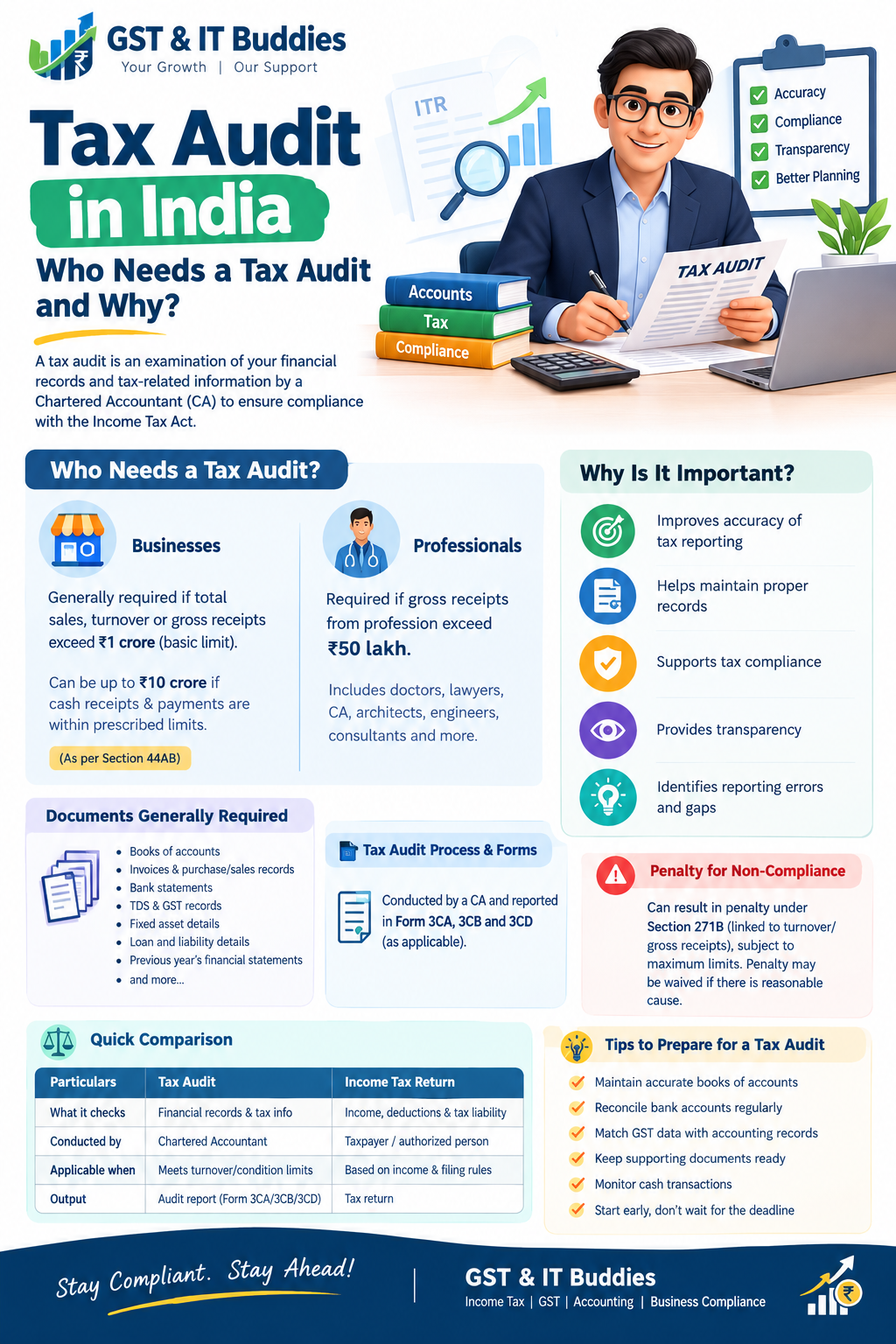
A person carrying on business may generally be required to get a tax audit if the total sales, turnover, or gross receipts exceed the applicable threshold under Section 44AB.
For eligible businesses, the basic threshold is generally ₹1 crore.
However, the threshold can be increased to ₹10 crore where the specified conditions relating to cash receipts and cash payments are satisfied. Broadly, this applies where cash receipts and cash payments do not exceed the prescribed percentage of total receipts and payments.
Therefore, businesses should not look at turnover alone. Their cash transaction pattern can also affect the applicable threshold.
2. Professionals
Professionals may be subject to tax audit when their gross receipts from profession exceed the applicable threshold.
The commonly applicable threshold for professionals is ₹50 lakh.
This can apply to professionals such as:
- Doctors
- Lawyers
- Chartered Accountants
- Architects
- Engineers
- Technical consultants
- Other specified professionals
The exact applicability should be checked based on the nature of the profession and the provisions applicable to the taxpayer.
Tax Audit Under Presumptive Taxation
Tax audit can also become relevant when a taxpayer opts for or exits from a presumptive taxation scheme.
For example, businesses may use Section 44AD and eligible professionals may use Section 44ADA, subject to their respective conditions and limits.
If the taxpayer does not follow the presumptive taxation provisions and the circumstances fall within the tax-audit requirements, an audit may become applicable.
Therefore, taxpayers using presumptive taxation should carefully evaluate their eligibility and the consequences of declaring income differently from the prescribed presumptive framework.
Why Is Tax Audit Important?
Tax audit serves several important purposes.
1. Improves Accuracy of Tax Reporting
An audit provides an additional level of verification of financial information before it is reported to the Income Tax Department.
2. Helps Maintain Proper Records
Businesses are encouraged to maintain organized books, invoices, expense records, and supporting documents.
3. Supports Tax Compliance
A tax audit can help identify discrepancies or compliance gaps that might otherwise be overlooked.
4. Provides Transparency
The audit report gives the tax authorities standardized information about the taxpayer's financial activities.
5. Helps Identify Reporting Errors
During the audit process, a CA may identify issues relating to expenses, depreciation, income recognition, deductions, or other reporting matters.
What Documents Are Generally Required for a Tax Audit?
The exact documents depend on the nature and size of the business or profession. Commonly required records may include:
- Books of accounts
- Sales and purchase records
- Invoices
- Bank statements
- Expense records
- Fixed asset details
- Loan and liability details
- GST records, where applicable
- TDS records
- Details of depreciation
- Details of specified payments
- Previous year's financial statements
- Other supporting documents required for audit
Maintaining these records throughout the financial year makes the audit process significantly easier.
What Is the Role of a Chartered Accountant?
A Chartered Accountant conducts the tax audit and examines the relevant books and information.
The CA may verify:
- Financial transactions
- Books of accounts
- Income and expenses
- Tax-related information
- Applicable deductions
- Compliance with relevant provisions
- Information required in the prescribed audit forms
After completing the examination, the CA prepares and submits the applicable tax audit report electronically in the prescribed manner.
Tax Audit Report Forms
Tax audit reporting is generally associated with forms such as Form 3CA, Form 3CB, and Form 3CD, depending on the circumstances of the taxpayer.
Broadly:
- Form 3CA is generally relevant where accounts are already required to be audited under another law.
- Form 3CB is generally used where the taxpayer's accounts are not required to be audited under another law but tax audit applies.
- Form 3CD contains detailed particulars required under the Income-tax Act.
The appropriate form depends on the taxpayer's circumstances.
What Happens If a Taxpayer Does Not Get a Required Tax Audit?
Failure to comply with the tax-audit requirement may result in a penalty under Section 271B, subject to the provisions and applicable exceptions.
The penalty is generally linked to the turnover or gross receipts and is subject to a statutory maximum.
However, a penalty may not necessarily be imposed where the taxpayer can establish that there was reasonable cause for the failure, subject to the applicable provisions.
This is why taxpayers should identify their tax-audit requirements well before the relevant filing deadlines.
Tax Audit vs Income Tax Return Filing
Tax audit and income tax return filing are related but different compliance requirements.
| Tax Audit | Income Tax Return |
|---|---|
| Examines financial records and specified tax information | Reports income, deductions, tax liability, etc. |
| Conducted by a Chartered Accountant where applicable | Filed by the taxpayer or authorized person |
| Required only for taxpayers meeting applicable conditions | Required based on applicable income and filing rules |
| Produces a prescribed audit report | Reports taxable income and tax-related information |
A taxpayer who is subject to tax audit generally needs to complete the audit-related compliance before filing the applicable income tax return.
How Can Businesses Prepare for a Tax Audit?
Businesses can make the process easier by following good accounting practices throughout the year.
Maintain Accurate Books
Record sales, purchases, expenses, assets, liabilities, and other transactions regularly.
Reconcile Bank Accounts
Regular bank reconciliation can help identify missing or incorrectly recorded transactions.
Reconcile GST Data
Where GST applies, businesses should periodically reconcile accounting records with GST returns and other relevant records.
Maintain Supporting Documents
Keep invoices, receipts, agreements, bank records, and other evidence supporting financial transactions.
Review Cash Transactions
Since cash receipts and payments can affect certain tax-audit thresholds and compliance requirements, businesses should monitor cash transactions carefully.
Start Early
Waiting until the tax filing deadline can create unnecessary pressure. Periodic review allows errors to be identified and corrected earlier.
Frequently Asked Questions
Is tax audit mandatory for every business?
No. Tax audit is not mandatory for every business. Applicability depends on the taxpayer's turnover or gross receipts, nature of activity, and other conditions prescribed under the Income-tax Act.
What is the general tax-audit turnover limit for businesses?
The general threshold is ₹1 crore, with a higher threshold of ₹10 crore available in specified circumstances involving cash receipts and payments.
What is the tax-audit limit for professionals?
The commonly applicable threshold for professionals is ₹50 lakh, subject to the applicable provisions.
Who conducts a tax audit?
A tax audit is conducted by a Chartered Accountant who is eligible to undertake the audit under the applicable rules.
Is GST registration the same as tax audit?
No. GST registration and income-tax tax audit are separate compliance requirements. A taxpayer may be subject to one, both, or neither depending on the applicable laws and circumstances.
Conclusion
Understanding tax audit in India is important for businesses and professionals because the requirement is not determined by turnover alone in every situation. The nature of the activity, cash transactions, presumptive taxation provisions, and other conditions can affect whether a tax audit is required.
Maintaining accurate books of accounts, keeping proper supporting documents, reconciling financial and GST records, and reviewing tax-audit applicability in advance can make compliance much easier.
If you are unsure whether your business or profession requires a tax audit, it is advisable to consult a qualified tax professional or Chartered Accountant and evaluate your specific circumstances.
GST & IT Buddies — Income Tax | GST | Accounting | Business Compliance