
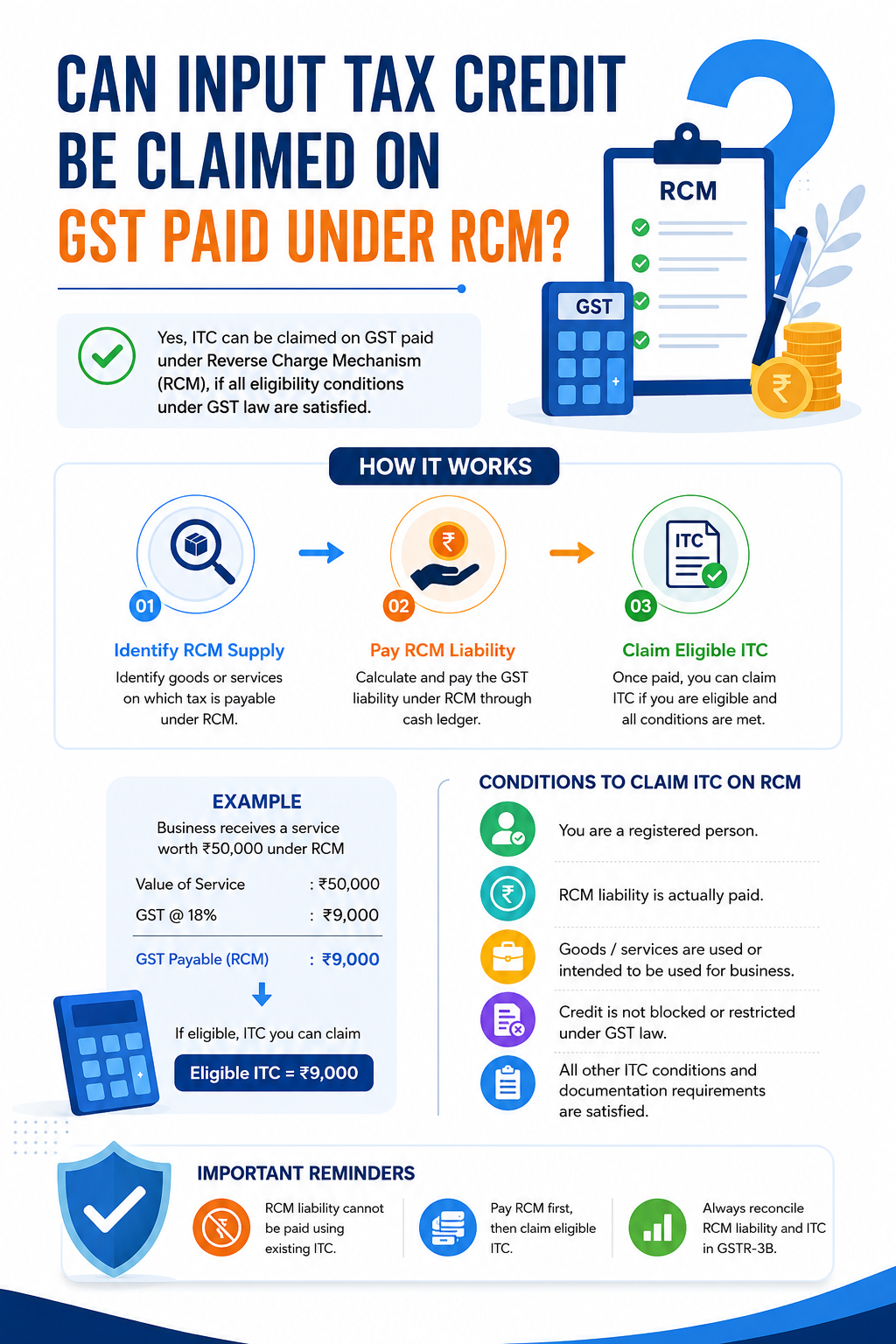
Yes, Input Tax Credit (ITC) can generally be claimed on GST paid under the Reverse Charge Mechanism (RCM), provided the recipient is otherwise eligible to claim the credit and all applicable conditions under GST law are satisfied.Under RCM, the recipient of certain goods or services becomes responsible for paying GST instead of the supplier. However, paying GST under RCM does not automatically mean that the tax becomes an eligible credit. The recipient must meet the applicable ITC conditions and ensure that the underlying expense is eligible for credit.
What Is Reverse Charge Mechanism (RCM)?
Normally, the supplier collects GST from the customer and pays it to the government. Under the Reverse Charge Mechanism, the responsibility for paying GST is shifted to the recipient for specified supplies.
For example, suppose a business receives a service on which GST is payable under RCM. Instead of the supplier charging and collecting GST, the recipient is required to discharge the applicable GST liability.
Importantly, RCM liability must be paid through the appropriate cash payment mechanism; it cannot simply be offset using existing ITC. After paying the RCM liability, the recipient may claim the corresponding ITC if the credit is otherwise eligible. CBIC specifically explains this principle in its RCM guidance.
Is GST Paid Under RCM Eligible for ITC?
Yes. GST paid under RCM is included within the concept of input tax under GST law.
CBIC's GST FAQ clarifies that input tax includes tax paid under reverse charge. Therefore, where the relevant conditions are fulfilled, a registered taxpayer can claim ITC of GST paid under RCM.
However, it is important to remember:
GST paid under RCM ≠ Automatic ITC
The credit must satisfy the applicable eligibility requirements.
How Does ITC on RCM Work?
The basic process can be understood in three steps:
Step 1: Identify the RCM Supply
First, determine whether the goods or services received are actually covered by the Reverse Charge Mechanism.
Step 2: Pay the RCM Liability
The recipient must calculate and discharge the applicable GST liability under RCM.
The GST Portal's GSTR-3B guidance confirms that reverse-charge liabilities are reported separately and that RCM-related liabilities are required to be paid through the cash ledger/appropriate cash mechanism rather than by using ITC.
Step 3: Claim Eligible ITC
Once the RCM tax has been paid, the recipient can claim the corresponding ITC, subject to the applicable provisions and restrictions.
The GST Portal specifically provides a category in Form GSTR-3B for inward supplies on which tax is payable on reverse charge basis under eligible ITC.
Example of ITC on RCM
Suppose a registered business receives an eligible service worth ₹50,000 that attracts GST under RCM at 18%.
GST payable under RCM:
₹50,000 × 18% = ₹9,000
The recipient would first discharge the ₹9,000 RCM liability as required.
If the underlying service is used for business purposes and the ITC is otherwise eligible, the business may claim:
Eligible ITC = ₹9,000
Therefore, the RCM payment can ultimately become available as ITC, subject to GST rules.
Conditions for Claiming ITC on RCM
Before claiming ITC, businesses should check whether the relevant requirements are satisfied.
1. The Recipient Should Be Registered
The ITC mechanism generally applies to a registered person who is eligible to claim credit under GST law.
2. The Tax Must Actually Be Paid
The recipient must discharge the GST liability arising under RCM before claiming the corresponding credit.
3. The Expense Should Be Used for Business
The goods or services should be used or intended to be used in the course or furtherance of business, subject to the applicable GST provisions.
4. The Credit Should Not Be Blocked
Certain categories of goods and services may be restricted or specifically blocked under GST provisions. Therefore, even if GST has been paid under RCM, ITC may not be available where the credit is specifically restricted.
5. Other ITC Conditions Must Be Satisfied
Businesses should also consider the applicable conditions, restrictions, documentation requirements and time limits for claiming ITC.
The GST Portal advises taxpayers to independently assess ITC eligibility because the appearance of information in GST statements does not by itself override other legal restrictions.
Where Is RCM ITC Reported in GSTR-3B?
Eligible ITC relating to inward supplies liable to reverse charge is reported in the Eligible ITC section of Form GSTR-3B.
The GST Portal's current GSTR-3B guidance identifies Table 4(A)(3) for inward supplies on which tax is payable under reverse charge.
Businesses should ensure that the RCM liability and corresponding ITC are correctly reported and reconciled.
Does RCM ITC Appear in GSTR-2B?
RCM transactions require special attention during reconciliation.
The GST Portal explains that Form GSTR-2B contains information relevant to ITC, but taxpayers must still independently determine whether a particular credit is actually eligible under GST law. Some ineligible credits may not necessarily be identified automatically by the system.
Therefore, businesses should not rely solely on GSTR-2B when determining whether RCM-related ITC can be claimed.
Common Mistakes Businesses Should Avoid
Mistake 1: Using ITC to Pay RCM Liability
RCM liability cannot simply be discharged using existing ITC. The taxpayer must follow the prescribed payment mechanism.
Mistake 2: Claiming ITC Without Paying RCM
The corresponding GST liability should first be properly discharged before claiming the eligible credit.
Mistake 3: Assuming Every RCM Payment Is Eligible for ITC
Payment of GST under RCM does not automatically make the credit eligible. Blocked credits and other restrictions continue to apply.
Mistake 4: Ignoring Documentation
Businesses should maintain appropriate records supporting the RCM transaction, tax calculation and payment.
Mistake 5: Failing to Reconcile Returns
The RCM liability and ITC should be reviewed against the books, GST returns and available GST statements to identify discrepancies.
RCM and ITC: Quick Comparison
| Particular | RCM |
|---|---|
| Who pays GST? | Recipient |
| Can existing ITC be used to discharge RCM liability? | No |
| Can GST paid under RCM become ITC? | Yes, if eligible |
| Is ITC automatic? | No |
| Is business use relevant? | Yes |
| Can blocked credit be claimed? | No |
| Where is eligible RCM ITC reported? | GSTR-3B, Table 4(A)(3) |
Final Takeaway
GST paid under RCM can generally be claimed as Input Tax Credit, but only when the taxpayer satisfies the applicable ITC conditions and the credit is not restricted or blocked.
The correct approach is:
Identify RCM Supply → Calculate GST → Pay RCM → Verify ITC Eligibility → Claim Eligible ITC → Reconcile
For businesses, maintaining accurate RCM records and regularly reconciling RCM liability with ITC can help reduce errors and improve GST compliance.
Frequently Asked Questions
Q1. Can ITC be claimed on GST paid under RCM?
Yes. GST paid under RCM can generally be claimed as ITC when the recipient is eligible and the applicable conditions are satisfied.
Q2. Can RCM liability be paid using ITC?
No. RCM liability is required to be discharged through the prescribed cash-payment mechanism.
Q3. Is ITC on RCM automatic?
No. The taxpayer must independently verify whether the credit is eligible under GST provisions.
Q4. Where is RCM ITC reported in GSTR-3B?
Eligible ITC on inward supplies liable to RCM is reported in Table 4(A)(3) of GSTR-3B.
Q5. Can blocked credit be claimed if GST was paid under RCM?
No. Payment under RCM does not override restrictions applicable to blocked or otherwise ineligible ITC.
Q6. Should businesses reconcile RCM transactions?
Yes. RCM liability, payment and eligible ITC should be reviewed against accounting records and GST returns as part of regular GST compliance.