

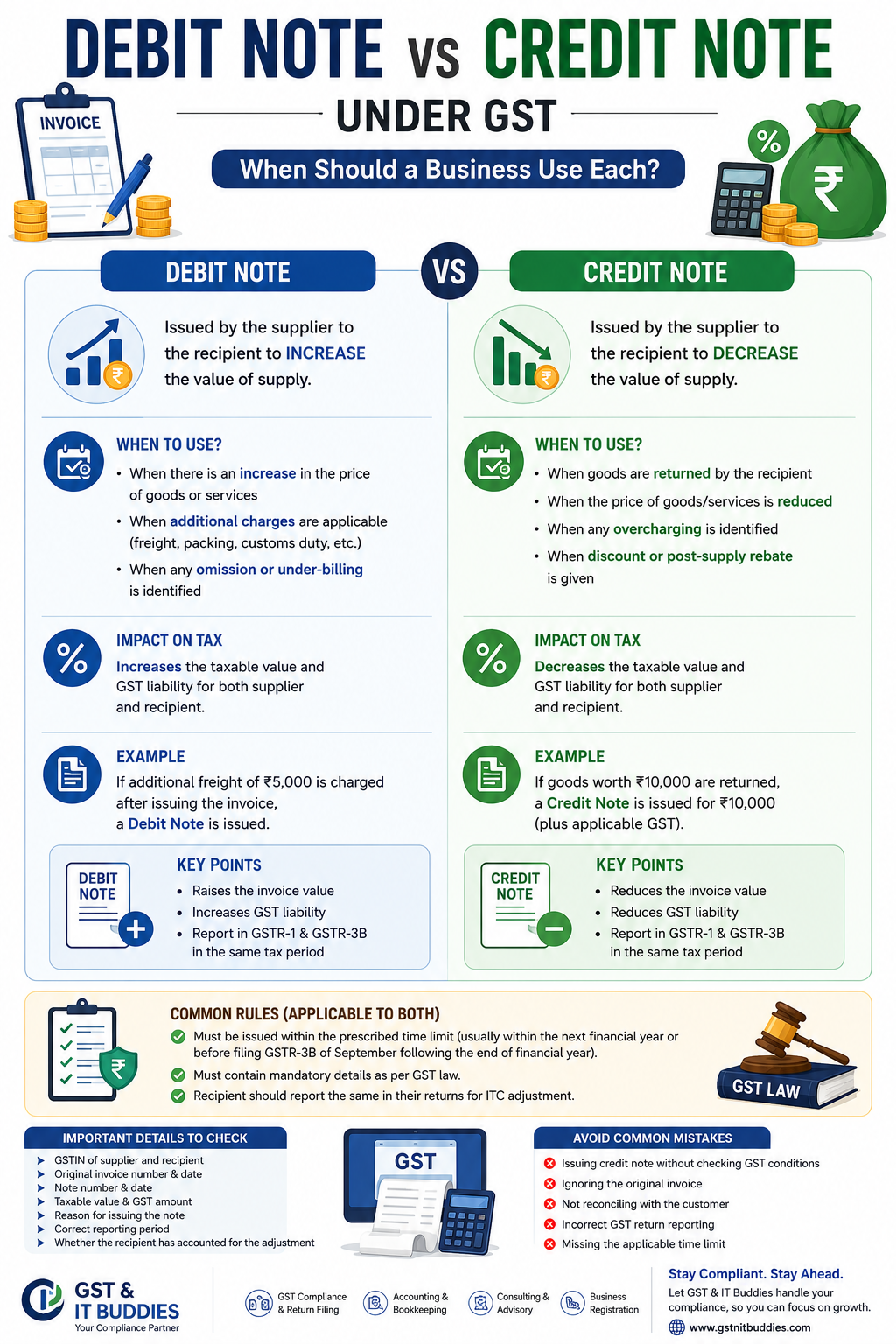
Understanding the difference between a Debit Note and a Credit Note under GST is important for maintaining accurate invoices, GST returns, and input tax credit records. Using the wrong document can lead to incorrect tax liability, reconciliation issues, and compliance problems. In this guide, we explain when a business should issue a debit note or credit note, how each affects GST, and what businesses should keep in mind while reporting them. What Is a Debit Note Under GST? A Debit Note is generally issued by a supplier when the value of a taxable supply or the GST charged in the original invoice needs to be increased. Under GST, a debit note can be issued when:The taxable value mentioned in the original invoice is lower than the actual taxable value. The GST charged in the original invoice is lower than the amount actually payable. Additional charges become applicable after the original invoice was issued. An omission or under-billing is subsequently identified.
Example of a Debit Note
Suppose a supplier originally invoices goods for ₹1,00,000 plus applicable GST. Later, an additional charge of ₹10,000 becomes payable under the terms of the transaction.
The supplier can issue a debit note for the additional taxable value and applicable GST.
The debit note increases the supplier's tax liability.
What Is a Credit Note Under GST?
A Credit Note is generally issued by a supplier when the taxable value or GST charged in the original invoice needs to be reduced, subject to the conditions prescribed under GST law.
A credit note may be issued in situations such as:
- Goods are returned by the customer.
- The original invoice contains excess taxable value.
- GST was charged in excess.
- The recipient receives a post-supply discount where the applicable GST conditions are satisfied.
- The quality or quantity of goods results in a reduction in the agreed consideration.
Example of a Credit Note
Suppose goods worth ₹1,00,000 were supplied, but the customer subsequently returns goods worth ₹20,000.
The supplier may issue a credit note for the eligible amount and corresponding GST adjustment.
The credit note reduces the supplier's taxable value and, where the statutory conditions are met, the corresponding GST liability.
Debit Note vs Credit Note: Key Difference
| Particular | Debit Note | Credit Note |
|---|---|---|
| Basic purpose | Increases the value of supply | Reduces the value of supply |
| Common reason | Under-billing or additional consideration | Sales return, excess billing or eligible discount |
| Taxable value | Generally increases | Generally decreases |
| Supplier's GST liability | Generally increases | May decrease subject to GST conditions |
| Accounting effect | Additional amount receivable | Reduction in amount receivable |
| GST reporting | Reported in applicable GST return | Reported in applicable GST return |
When Should a Business Issue a Debit Note?
A business should consider issuing a debit note when the original invoice does not reflect the actual consideration or GST payable.
For example, a business may discover that:
The invoice was issued for ₹5,00,000, but the final taxable value should have been ₹5,50,000.
If the additional ₹50,000 is taxable consideration, the supplier can issue the appropriate debit note and report it as required under GST.
When Should a Business Issue a Credit Note?
A credit note is relevant when the supplier needs to reduce the value of an earlier supply.
Common scenarios include:
1. Return of Goods
If a customer returns taxable goods, the supplier may issue a credit note for the eligible returned goods.
2. Excess Billing
If an invoice was issued for a higher taxable value than actually agreed, a credit note may be required.
3. Excess GST Charged
Where GST was charged in excess in the original invoice, the applicable correction can be made through a credit note, subject to the conditions of GST law.
4. Post-Supply Discounts
Certain post-supply discounts can result in a credit note, but businesses should carefully check the conditions applicable under GST, particularly where the recipient's ITC is involved.
How Do Debit and Credit Notes Affect GST Returns?
Debit and credit notes are not merely accounting documents. They can affect the supplier's GST liability and the recipient's input tax credit.
Businesses should ensure that the details reported in GST returns are consistent with:
- Original invoices
- Debit notes
- Credit notes
- Sales and purchase registers
- GSTR-1 data
- GSTR-3B
- GSTR-2B, wherever relevant for ITC reconciliation
A mismatch can create reconciliation problems between the supplier and recipient.
Impact on Input Tax Credit
Credit notes can have an important impact on the recipient's ITC.
If a supplier reduces the taxable value through a credit note and the recipient has already availed ITC on the original invoice, the recipient may need to make the corresponding ITC adjustment as applicable.
Therefore, businesses should not treat credit notes as only an accounts department issue. They should coordinate sales, purchase, accounts, and GST compliance teams.
Time Limit for Issuing Credit Notes
Businesses should pay particular attention to the statutory time limit applicable to GST credit notes and the related reporting requirements.
The applicable provisions can change through amendments and notifications, so businesses should verify the current GST provisions before making a tax adjustment.
Important Details to Check on Debit and Credit Notes
Before reporting a debit or credit note, verify:
- GSTIN of the supplier and recipient
- Original invoice number and date, where applicable
- Note number and date
- Taxable value
- Applicable GST rate
- CGST, SGST/UTGST or IGST amount
- Reason for issuing the note
- Place of supply, where relevant
- Correct reporting period
- Whether the recipient has accounted for the adjustment
Common Mistakes Businesses Should Avoid
Mistake 1: Issuing a Credit Note Without Checking GST Conditions
Not every commercial adjustment automatically results in a GST reduction.
Mistake 2: Ignoring the Original Invoice
Debit and credit notes should be properly linked with the underlying transaction and supporting documentation.
Mistake 3: Not Reconciling With the Customer
Differences between the supplier's records and customer's records can create GST reconciliation issues.
Mistake 4: Incorrect GST Return Reporting
Incorrect reporting can affect tax liability, ITC, and subsequent reconciliation.
Mistake 5: Missing the Applicable Time Limit
Businesses should monitor statutory timelines rather than waiting until year-end.
Simple Rule to Remember
Think of it this way:
Debit Note → Value goes UP → GST liability may go UP
Credit Note → Value goes DOWN → GST liability may go DOWN, subject to applicable conditions
However, businesses should always examine the underlying transaction and applicable GST provisions before making a tax adjustment.
Final Takeaway
Debit notes and credit notes play an important role in correcting commercial and tax adjustments after an invoice has been issued.
A properly managed process should connect invoice records, accounting entries, GST returns, ITC reconciliation, and supporting documents.
If your business frequently handles sales returns, discounts, price adjustments, or invoice corrections, maintaining a systematic debit-note and credit-note process can significantly reduce GST reconciliation issues.
Need help with GST compliance, return filing, reconciliation, or accounting? GST & IT Buddies can help your business manage its GST and accounting requirements efficiently.