
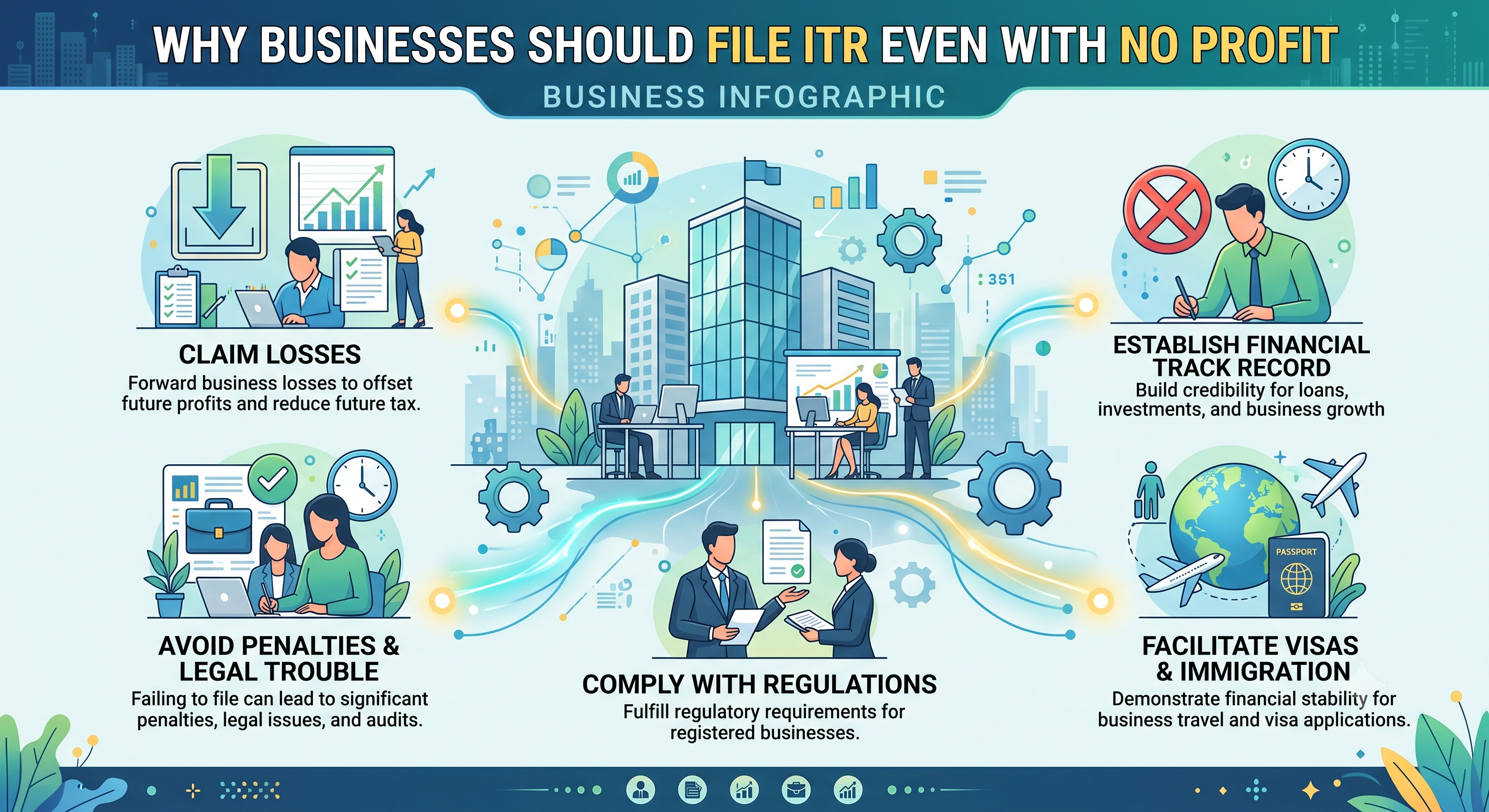
Why Businesses Should File ITR Even with No Profit Many business owners assume that if their business hasn't earned a profit during the financial year, there's no need to file an Income Tax Return (ITR). However, this is a common misconception that can lead to penalties, missed tax benefits, and future financial complications. Whether you operate as a sole proprietorship, partnership, LLP, or private limited company, filing your Income Tax Return is often a legal requirement—even if your business reports zero income or a loss. In this guide, we'll explain why filing your business ITR is essential, even when there's no profit.
Is Filing ITR Mandatory If There Is No Profit?
Yes, in many cases.
The requirement to file an Income Tax Return depends on your business structure, turnover, and legal obligations, not just your profitability.
For example:
- Private Limited Companies are generally required to file an ITR every financial year, even if there is no business activity.
- LLPs also have mandatory filing requirements.
- Proprietorships may be required to file depending on income, turnover, or other provisions under the Income Tax Act.
Ignoring these requirements can result in penalties and compliance issues.
Top Reasons to File Business ITR Even with No Profit
1. Stay Legally Compliant
Filing your Income Tax Return keeps your business compliant with Indian tax laws.
Non-compliance may lead to:
- Penalties
- Notices from the Income Tax Department
- Difficulty during future assessments
- Compliance issues with government authorities
Regular filing demonstrates that your business follows statutory requirements.
2. Carry Forward Business Losses
One of the biggest advantages of filing your ITR is the ability to carry forward eligible business losses.
These losses can often be adjusted against future profits, helping reduce taxable income in subsequent years.
If you fail to file your return within the prescribed timelines (where applicable), you may lose this valuable tax benefit.
3. Improve Loan Eligibility
Banks and financial institutions commonly ask for the last two or three years' Income Tax Returns when evaluating:
- Business loans
- Working capital finance
- Equipment financing
- Overdraft facilities
Even if your business isn't profitable yet, consistently filing ITRs helps establish financial credibility.
4. Build Business Credibility
Potential investors, lenders, suppliers, and corporate clients often request financial records before entering into business relationships.
Filed Income Tax Returns show that your business:
- Maintains proper records
- Follows tax regulations
- Operates transparently
This can strengthen your business reputation.
5. Simplify Future Tax Assessments
Regular tax filing creates a documented financial history.
If the Income Tax Department seeks clarification or conducts an assessment, accurate and timely ITR filings make the process smoother and reduce unnecessary complications.
6. Support Government Registrations and Tenders
Many government registrations, tenders, and vendor onboarding processes require businesses to submit previous Income Tax Returns.
Without filed returns, you may miss opportunities to work with:
- Government departments
- Public sector undertakings
- Large corporations
7. Required for Investment and Funding
Investors usually perform financial due diligence before investing in a business.
Your Income Tax Returns help demonstrate:
- Business continuity
- Financial discipline
- Historical financial performance
This becomes particularly important for startups seeking funding.
8. Maintain Financial Discipline
Preparing and filing your Income Tax Return encourages businesses to:
- Update books of accounts
- Reconcile financial records
- Identify operational inefficiencies
- Plan taxes effectively
This improves overall financial management.
What Happens If You Don't File Business ITR?
Failure to file your Income Tax Return may result in:
- Late filing consequences, where applicable
- Inability to claim certain tax benefits or carry forward eligible losses
- Notices from the Income Tax Department
- Challenges in obtaining loans and financial assistance
- Compliance issues affecting future business operations
Timely filing helps avoid unnecessary complications.
Businesses That Should Consider Filing ITR Every Year
Business entities that generally benefit from regular Income Tax Return filing include:
- Sole Proprietorships
- Partnership Firms
- LLPs
- Private Limited Companies
- One Person Companies (OPCs)
- Startups
- MSMEs
- Freelancers and Professionals with business income
Documents Required for Business ITR Filing
Before filing your Income Tax Return, keep the following documents ready:
- PAN Card
- Aadhaar (where applicable)
- GST returns (if registered)
- Profit & Loss Account
- Balance Sheet
- Bank Statements
- TDS Certificates
- Business expense records
- Investment details
- Previous year's ITR
Maintaining organized records can make the filing process faster and more accurate.
Best Practices for Business Tax Compliance
To ensure smooth Income Tax compliance:
- Maintain accurate books of accounts.
- Record all income and expenses.
- Preserve invoices and supporting documents.
- Reconcile bank statements regularly.
- File GST returns on time (if applicable).
- Consult a Chartered Accountant for complex tax matters.
- File your Income Tax Return before the due date.
These practices help reduce errors and support long-term compliance.
Frequently Asked Questions (FAQs)
Can I file ITR if my business has no income?
Yes. Depending on your business structure and legal obligations, filing may still be required or beneficial.
Can business losses be carried forward?
Eligible business losses can generally be carried forward subject to the provisions of the Income Tax Act and timely filing requirements.
Is ITR mandatory for a Private Limited Company with no business activity?
Private Limited Companies are generally required to file Income Tax Returns annually, even if there is no income or business activity.
Why do banks ask for Income Tax Returns?
Banks use ITRs to evaluate financial stability and repayment capacity while processing business loans.
Should startups file ITR even without profit?
Yes. Filing Income Tax Returns helps maintain compliance, build credibility with investors, and create a financial track record.
Conclusion
A business without profit today can still become a successful enterprise tomorrow. Filing your Income Tax Return every year is not just about paying taxes—it's about maintaining compliance, preserving tax benefits, building financial credibility, and preparing your business for future growth.
Whether you're a startup, MSME, LLP, or Private Limited Company, timely ITR filing can support financing opportunities, simplify compliance, and strengthen your business's reputation.
If you're unsure about your filing obligations, consult a qualified tax professional to ensure your business remains compliant with the latest regulations.