
Filing an Income Tax Return (ITR) is an important legal responsibility for many individuals and businesses in India. While many taxpayers believe that ITR filing is only necessary when tax is payable, the Income Tax Act, 1961 specifies several situations where filing an ITR is mandatory, even if no tax is due. Understanding whether you need to file an ITR can help you avoid penalties, remain compliant with tax laws, and enjoy financial benefits such as easier loan approvals, visa processing, and faster tax refunds. In this comprehensive guide, we'll explain who is required to file an Income Tax Return in India and why timely filing matters.
What Is an Income Tax Return (ITR)? An Income Tax Return (ITR) is a form through which taxpayers report their income, deductions, exemptions, taxes paid, and tax liability to the Income Tax Department.
ITR filing enables the government to verify income declarations and determine whether additional tax is payable or a refund is due.
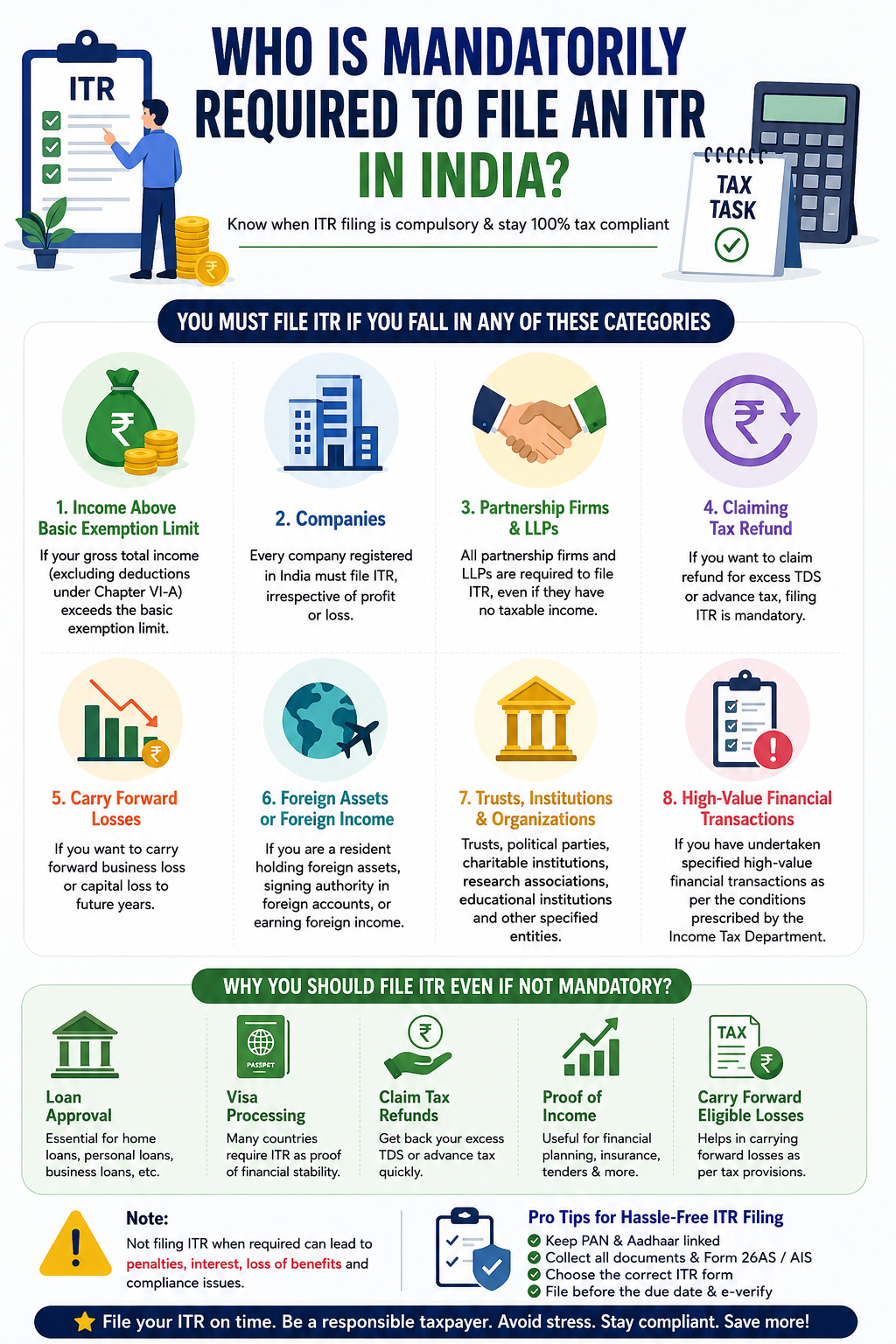
Who Is Mandatorily Required to File an ITR in India? The following categories of taxpayers are generally required to file an Income Tax Return.
- Individuals Whose Income Exceeds the Basic Exemption Limit If your gross total income before claiming deductions under Chapter VI-A exceeds the applicable basic exemption limit under the tax regime you follow, you are generally required to file an ITR.
Your income may include:
Salary
Business or professional income
House property income
Capital gains
Interest income
Rental income
Other sources of income
-
Companies Registered in India Every company registered under the Companies Act is required to file an Income Tax Return, irrespective of whether it has earned a profit or incurred a loss during the financial year.
-
Partnership Firms and LLPs All partnership firms and Limited Liability Partnerships (LLPs) are generally required to file an Income Tax Return, even if they have no taxable income.
-
Individuals Claiming a Tax Refund If excess tax has been deducted through TDS or advance tax, filing an ITR is necessary to claim your income tax refund.
-
Individuals Carrying Forward Business or Capital Losses Taxpayers wishing to carry forward eligible business losses or capital losses to future years generally need to file their return within the prescribed due date, subject to applicable provisions.
-
Residents Holding Foreign Assets or Foreign Income Resident taxpayers who own specified foreign assets, have signing authority in foreign accounts, or earn foreign income may be required to file an Income Tax Return under the applicable provisions.
-
Trusts, Institutions and Certain Organizations Trusts, charitable institutions, political parties, research associations, educational institutions, and other specified entities may be required to file an ITR based on the provisions applicable to them.
High-Value Financial Transactions That Can Trigger Mandatory ITR Filing Apart from income-based criteria, filing may also become mandatory if certain specified financial transactions are undertaken during the financial year. These may include situations such as:
Large cash deposits in bank accounts
High-value deposits in current accounts
Significant expenditure on foreign travel
High electricity consumption
Other notified financial transactions under the Income Tax Rules
The applicable limits and conditions are prescribed by the Income Tax Department and may change from time to time.
Benefits of Filing an ITR Even If It Is Not Mandatory Many taxpayers voluntarily file Income Tax Returns because of the advantages they provide.
Easier Loan Approval Banks often ask for the last two or three years' ITRs while processing home loans, personal loans, education loans, and business loans.
Faster Visa Processing Many countries require ITR acknowledgements as proof of financial stability during visa applications.
Claim Tax Refunds Without filing an ITR, you generally cannot claim a refund of excess TDS or advance tax.
Financial Proof of Income ITRs serve as authentic proof of income when applying for government schemes, tenders, insurance policies, or financial products.
Carry Forward Eligible Losses Timely filing helps taxpayers carry forward eligible business and capital losses in accordance with the Income Tax Act.
Consequences of Not Filing an ITR Failure to file an Income Tax Return when required may result in:
Late filing fees, where applicable
Interest on unpaid tax
Delay in receiving tax refunds
Loss of certain tax benefits
Difficulty obtaining loans or visas
Notices from the Income Tax Department
Timely compliance helps avoid unnecessary complications.
Tips for Hassle-Free ITR Filing Keep PAN and Aadhaar linked.
Collect all Form 16, Form 26AS, and AIS details before filing.
Report all sources of income accurately.
Verify your bank account details.
Choose the correct ITR form.
File before the due date.
E-verify your return after submission.
Frequently Asked Questions (FAQs) Is ITR filing compulsory for salaried employees? It depends on your income level and other applicable conditions. Many salaried individuals are required to file an ITR based on their total income or other prescribed criteria.Can I file an ITR even if my income is below the taxable limit? Yes. Voluntary filing is permitted and can be beneficial for claiming refunds, establishing proof of income, and maintaining financial records.Is ITR mandatory if TDS has already been deducted? TDS deduction does not automatically eliminate the requirement to file an ITR. Your filing obligation depends on your overall tax position and the applicable legal provisions.Can students file an Income Tax Return? Yes. Students with taxable income, tax deducted at source, or those wishing to claim a refund may file an ITR if applicable.Conclusion Knowing who is mandatorily required to file an ITR in India is essential for staying compliant with tax laws and avoiding unnecessary penalties. Whether you are a salaried employee, business owner, freelancer, professional, company, partnership firm, or an individual with specified financial transactions, timely filing ensures peace of mind and financial credibility.If you are unsure about your eligibility or the correct ITR form, consult a qualified tax professional to ensure accurate and timely filing.