


Exporting goods and services from India is generally treated as a zero-rated supply under the GST regime. This means exporters can claim a refund of the GST paid on inputs or receive refunds on the Integrated GST (IGST) paid during the export process. Understanding the GST refund process is essential for maintaining healthy cash flow and avoiding unnecessary delays. In this guide, we'll explain the complete GST refund process for exporters, eligibility criteria, required documents, filing procedure, timelines, and common mistakes to avoid.
GST Refund Process for Exporters: Step-by-Step Guide
What is a GST Refund?
A GST refund is the reimbursement of tax paid by a registered taxpayer when the tax liability is lower than the taxes already paid or when exports qualify as zero-rated supplies.
For exporters, GST refunds help prevent the accumulation of input taxes, making Indian products more competitive in international markets.
Who Can Claim a GST Refund?
The following exporters are eligible:
- Exporters of goods
- Exporters of services
- Businesses supplying goods or services to Special Economic Zones (SEZs)
- Businesses paying tax on inward supplies used for exports
- Exporters claiming Input Tax Credit (ITC)
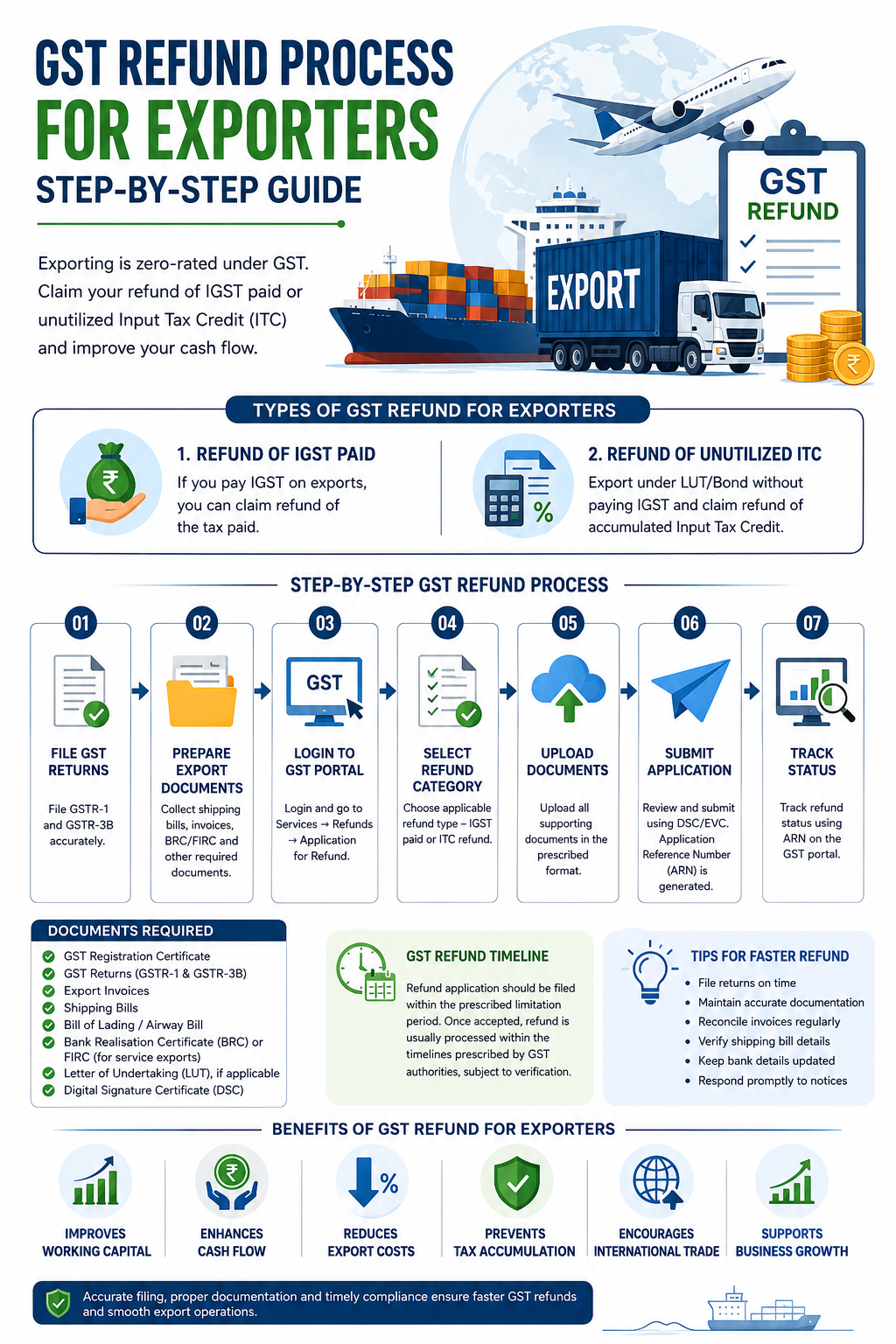
Types of GST Refund Available to Exporters
1. Refund of IGST Paid on Exports
If you export goods after paying IGST, you can claim a refund of the tax paid.
Best For:
- Businesses with sufficient working capital.
- Exporters preferring a straightforward refund route.
2. Refund of Unutilized Input Tax Credit (ITC)
Exporters can export under a Letter of Undertaking (LUT) without paying IGST and later claim a refund of the accumulated Input Tax Credit.
Best For:
- Regular exporters.
- Businesses aiming to preserve working capital.
Documents Required for GST Refund
Keep these documents ready before applying:
- GST Registration Certificate
- GST Returns (GSTR-1 and GSTR-3B)
- Export Invoices
- Shipping Bills
- Bill of Lading or Airway Bill
- Bank Realisation Certificate (BRC) or Foreign Inward Remittance Certificate (FIRC) for service exports
- Letter of Undertaking (LUT), if applicable
- Digital Signature Certificate (DSC), where required
Step-by-Step GST Refund Process for Exporters
Step 1: File GST Returns
Ensure you have correctly filed:
- GSTR-1
- GSTR-3B
Invoice details must match exactly to avoid refund delays.
Step 2: Prepare Export Documents
Collect:
- Shipping Bills
- Export invoices
- E-way Bills (where applicable)
- Bank realization documents
Verify all information before submission.
Step 3: Login to GST Portal
Access your GST account using your credentials.
Navigate to:
Services → Refunds → Application for Refund
Step 4: Select Refund Category
Choose the applicable refund option:
- Refund of IGST paid on exports
- Refund of accumulated Input Tax Credit
Selecting the correct category is essential.
Step 5: Upload Supporting Documents
Attach all required documents in the prescribed format.
Double-check:
- Invoice numbers
- GSTIN
- Shipping details
- Bank account information
Step 6: Submit Refund Application
Review all information carefully.
Submit the application using:
- DSC
- EVC (Electronic Verification Code), where applicable
An Application Reference Number (ARN) will be generated.
Step 7: Track Refund Status
Use the ARN to monitor your refund status through the GST portal.
Possible statuses include:
- Submitted
- Processing
- Deficiency Memo Issued
- Refund Sanctioned
- Refund Credited
GST Refund Timeline
Generally:
- Refund applications should be filed within the prescribed limitation period under GST law.
- Once the application is complete and accepted, refunds are typically processed within the timelines prescribed by the GST authorities, subject to verification.
Incomplete documentation may extend the processing time.
Common Reasons for GST Refund Rejection
Avoid these common mistakes:
- Incorrect GSTIN
- Invoice mismatches
- Wrong bank account details
- Missing export documents
- Filing incorrect GST returns
- Duplicate refund claims
- Incorrect shipping bill details
- Failure to reconcile GSTR-1 and GSTR-3B
Tips for Faster GST Refund Processing
- File GST returns on time.
- Maintain accurate export documentation.
- Reconcile invoices regularly.
- Verify shipping bill details.
- Keep bank account information updated.
- Respond promptly to deficiency notices.
- Maintain proper accounting records.
Benefits of Claiming GST Refund
Claiming GST refunds offers several advantages:
- Improves working capital
- Enhances business cash flow
- Reduces export costs
- Prevents tax accumulation
- Encourages international trade
- Supports business growth
Frequently Asked Questions (FAQs)
Is GST applicable on exports?
Exports are treated as zero-rated supplies under GST, allowing eligible exporters to claim refunds.
Can exporters claim Input Tax Credit?
Yes. Exporters can claim refunds of unutilized ITC when exporting under LUT or Bond, subject to applicable conditions.
Is LUT mandatory?
An LUT is generally used by exporters who wish to export without paying IGST and later claim a refund of accumulated ITC, subject to eligibility.
How can I check my refund status?
You can track the refund using the Application Reference Number (ARN) on the GST portal.
What happens if my refund application is rejected?
The GST department may issue a deficiency memo or seek additional information. After addressing the deficiencies, you can take the necessary steps as permitted under GST rules.
Conclusion
Understanding the GST refund process is essential for every exporter. Filing accurate returns, maintaining proper documentation, and following the correct refund procedure can significantly reduce delays and improve cash flow. Whether you choose to export under LUT and claim an Input Tax Credit refund or pay IGST and claim a refund later, staying compliant with GST requirements ensures smoother export operations and better financial management.
If you need professional assistance with GST registration, GST return filing, export compliance, or GST refund applications, consulting experienced tax professionals can help streamline the process and minimize errors.