
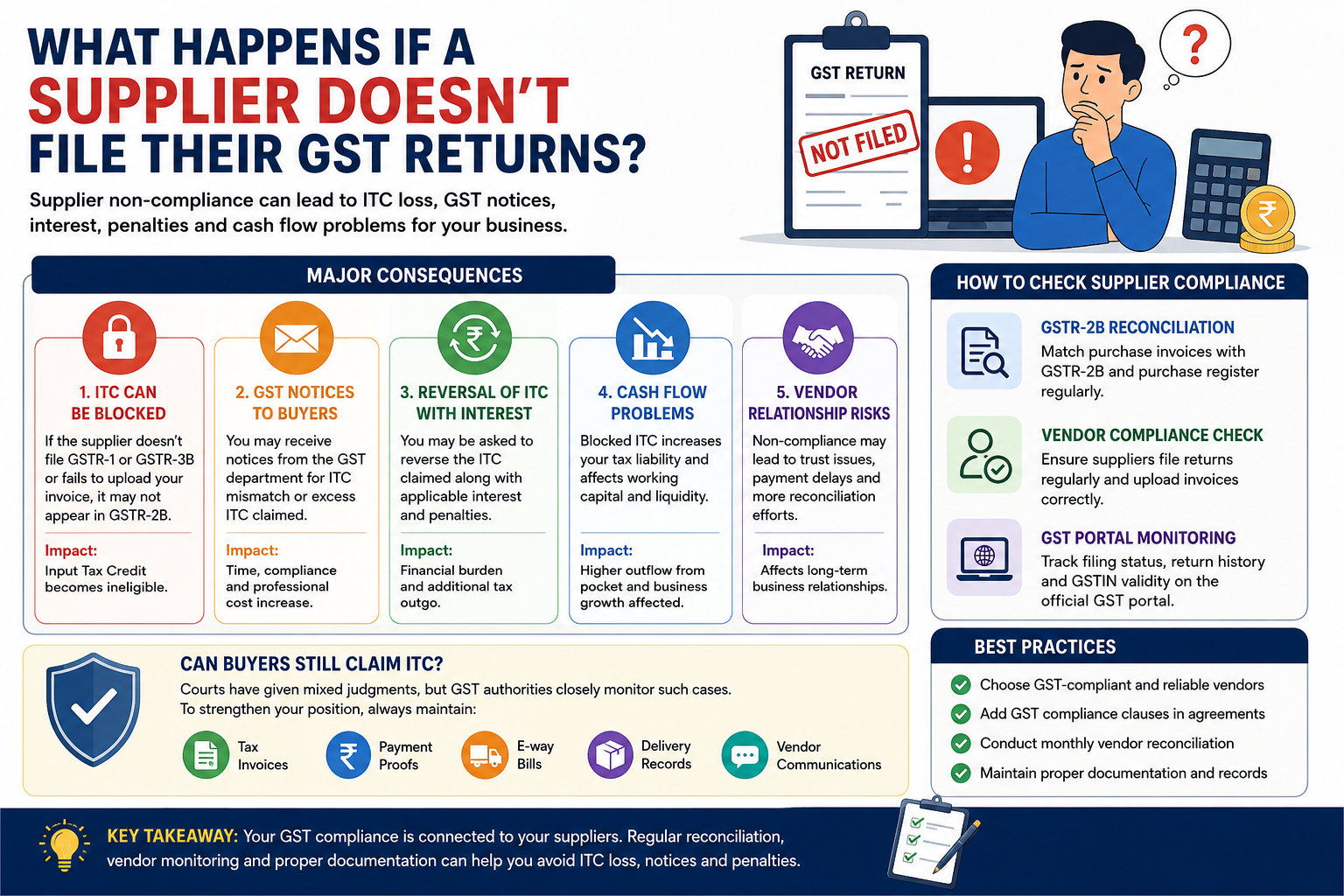
In the GST system, your compliance does not depend only on your own filings. If your supplier fails to file GST returns, it can directly impact your business, especially your Input Tax Credit (ITC), compliance status, and working capital. Many businesses in India receive GST notices simply because vendors or suppliers failed to file their returns on time. Understanding the consequences can help you avoid unnecessary tax disputes and financial losses. Why Supplier GST Filing Matters Under the GST framework, buyers can claim Input Tax Credit only when the supplier: File their GST returns Uploads invoice details correctly If a supplier fails to do this, the buyer may lose ITC eligibility even after making full payment. This is why businesses must regularly verify vendor GST compliance.
Major Consequences If a Supplier Does Not File GST Returns
1. Input Tax Credit (ITC) Can Be Blocked
One of the biggest risks is ITC denial.
If the supplier:
- Does not file GSTR-1
- Does not file GSTR-3B
- Fails to upload your invoice
Then the invoice may not appear in your GSTR-2B, making ITC claim difficult.
Keywords:
- Input Tax Credit blocked
- GST ITC mismatch
- Supplier not filing GST return
- GSTR-2B mismatch issue
2. GST Notices to Buyers
The GST department may issue notices to buyers for claiming ITC from non-compliant suppliers.
Common notices include:
- ITC mismatch notice
- Excess ITC claimed notice
- Vendor mismatch notice
Even genuine businesses can face scrutiny if suppliers are non-compliant.
High Intent Keywords:
- GST notice for ITC mismatch
- GST vendor compliance issue
- Supplier GST default consequences
3. Reversal of ITC With Interest
If ITC is claimed on invoices from a supplier who has not paid tax to the government, authorities may ask the buyer to:
- Reverse the ITC
- Pay interest
- Sometimes pay penalties
This can severely affect cash flow.
4. Business Cash Flow Problems
When ITC gets blocked:
- Tax liability increases
- Working capital gets stuck
- Businesses pay more GST from pocket
This becomes a major issue for SMEs and startups managing limited cash flow.
Keywords:
- GST cash flow issues
- blocked the ITC impact on business
- GST working capital problem
5. Vendor Relationship Risks
Frequent GST non-compliance by suppliers can:
- Delay payments
- Create accounting complications
- Increase reconciliation work
- Affect long-term vendor trust
Businesses now prefer dealing with GST-compliant vendors only.
How To Check Whether a Supplier Filed GST Returns
Businesses should regularly verify:
1. GSTR-2B Reconciliation
Match purchase invoices with:
- GSTR-2B
- Purchase register
- Supplier invoices
2. Vendor Compliance Check
Verify whether suppliers:
- File returns regularly
- Have active GST registration
- Upload invoices correctly
3. GST Portal Monitoring
Use the official GST portal to track:
- Filing status
- Return history
- GSTIN validity
Best Practices To Avoid GST Problems
Choose GST-Compliant Vendors
Before working with any supplier:
- Verify GST registration
- Check filing history
- Review compliance behaviour
Add GST Compliance Clauses in Agreements
Include terms such as:
- The supplier must file GST returns on time
- Supplier responsible for the ITC loss due to default
- Payment hold in case of non-compliance
Monthly Vendor Reconciliation
Conduct monthly checks for:
- Missing invoices
- GSTR-2B mismatches
- Non-filing suppliers
Regular reconciliation reduces future GST disputes.
Can Buyers Still Claim ITC?
Courts in India have given mixed judgments on ITC claims where suppliers defaulted despite genuine purchases. However, GST authorities still closely monitor such cases.
To strengthen your position, maintain:
- Tax invoices
- Payment proofs
- E-way bills
- Delivery records
- Vendor communications
Proper documentation helps during GST assessments and notices.
Final Thoughts
A supplier not filing GST returns can create serious problems for buyers, including blocked ITC, GST notices, interest liabilities, and cash flow issues.
Businesses should not focus only on their own GST compliance. Vendor compliance management is equally important under the GST laws in India.
Regular reconciliation, supplier monitoring, and proper documentation can help protect your business from unnecessary tax complications.