



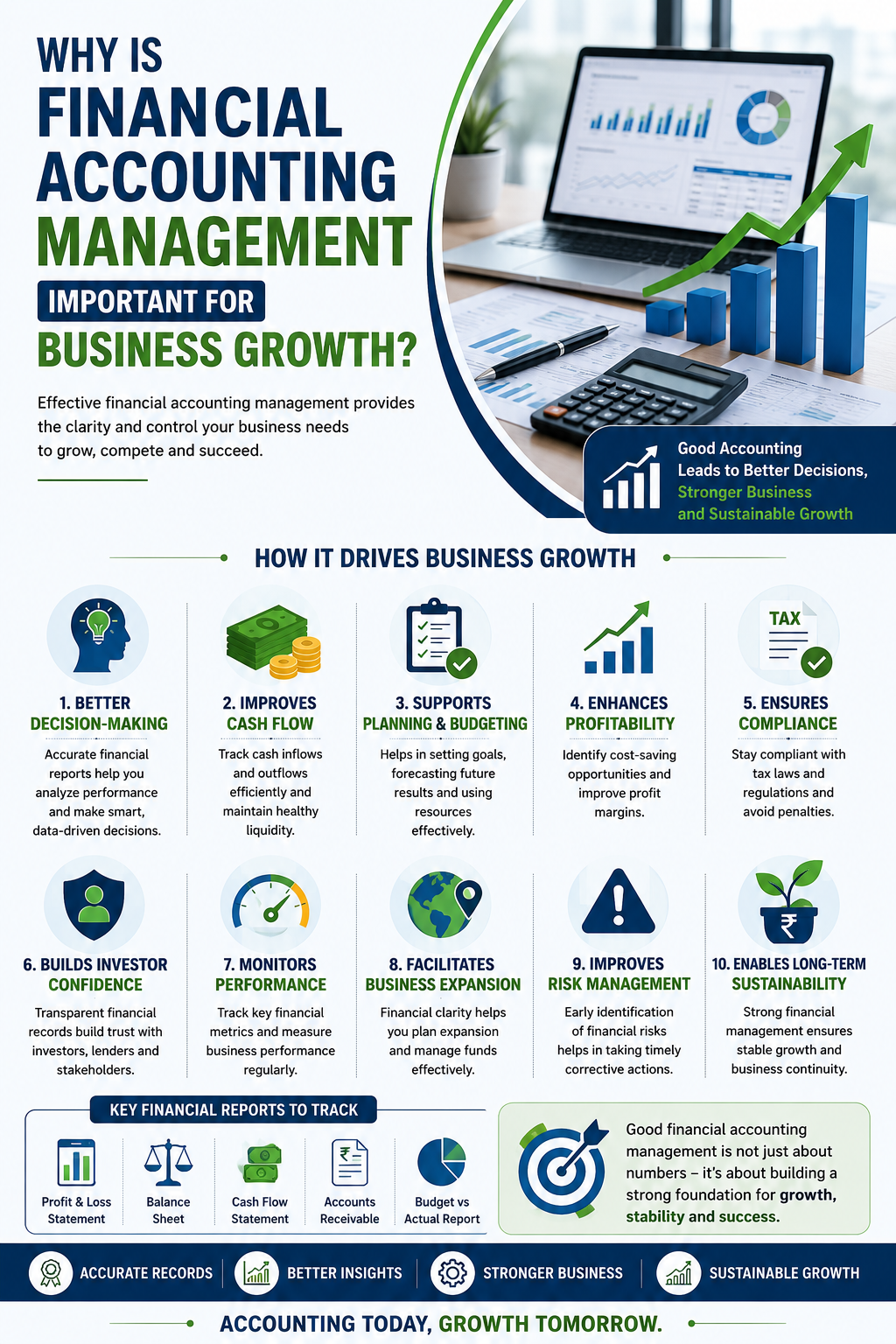
Every successful business relies on accurate financial information to make informed decisions. Whether you're a startup, small business owner, or established enterprise, effective financial accounting management plays a crucial role in achieving sustainable growth. Financial accounting management is more than just recording transactions—it helps businesses understand their financial health, improve profitability, manage risks, and plan for the future. In today's competitive business environment, proper financial management can be the difference between growth and failure.
What Is Financial Accounting Management?
Financial accounting management is the process of recording, organizing, analyzing, and reporting a company's financial transactions. It helps business owners monitor income, expenses, assets, liabilities, and overall financial performance.
Key activities include:
- Bookkeeping
- Financial reporting
- Budgeting
- Cash flow management
- Tax planning
- Financial analysis
- Compliance management
These activities provide valuable insights that support strategic business decisions.
Why Financial Accounting Management Is Important for Business Growth
1. Helps in Better Decision-Making
Business growth requires informed decisions. Financial reports provide accurate data about revenues, expenses, profits, and cash flow.
With proper accounting management, business owners can:
- Identify profitable products or services
- Evaluate business performance
- Allocate resources efficiently
- Plan future investments
Data-driven decisions reduce uncertainty and increase the chances of success.
2. Improves Cash Flow Management
Cash flow is the lifeblood of every business. Many profitable businesses fail due to poor cash flow management.
Financial accounting helps businesses:
- Track incoming and outgoing cash
- Monitor receivables and payables
- Avoid cash shortages
- Maintain liquidity for operations
Healthy cash flow enables businesses to seize growth opportunities and handle unexpected expenses.
3. Supports Budgeting and Financial Planning
A well-prepared budget acts as a roadmap for business growth.
Financial accounting management helps organizations:
- Set realistic financial goals
- Forecast future revenues and expenses
- Control unnecessary spending
- Measure actual performance against budgets
Proper planning ensures resources are used effectively and growth targets remain achievable.
4. Enhances Profitability
Accounting systems help identify areas where costs can be reduced and profits can be increased.
Businesses can:
- Analyze operational expenses
- Monitor profit margins
- Identify cost-saving opportunities
- Improve pricing strategies
Regular financial analysis leads to better profitability and long-term sustainability.
5. Ensures Regulatory Compliance
Every business must comply with tax laws and financial regulations.
Financial accounting management helps maintain:
- Accurate financial records
- GST compliance
- Income tax compliance
- TDS compliance
- Audit readiness
Compliance reduces legal risks, penalties, and reputational damage.
6. Builds Investor and Lender Confidence
Investors and financial institutions require transparent financial information before providing funds.
Well-maintained accounting records demonstrate:
- Financial stability
- Business credibility
- Growth potential
- Risk management capability
Strong financial reporting increases the likelihood of securing investments and business loans.
7. Helps Monitor Business Performance
Accounting reports provide valuable performance indicators such as:
- Revenue growth
- Net profit margin
- Operating expenses
- Return on investment (ROI)
- Debt levels
Regular monitoring helps businesses identify strengths, weaknesses, and improvement opportunities.
8. Facilitates Business Expansion
Expansion requires significant financial planning and resource allocation.
Financial accounting management helps businesses:
- Assess financial readiness
- Evaluate expansion costs
- Forecast future profitability
- Manage funding requirements
Whether opening a new branch, launching a product, or entering a new market, financial data supports successful expansion strategies.
9. Improves Risk Management
Businesses face various financial risks, including:
- Cash flow shortages
- Market fluctuations
- Rising expenses
- Regulatory changes
Accounting systems help identify risks early and implement corrective actions before they become major problems.
10. Enables Long-Term Business Sustainability
Sustainable growth requires continuous monitoring and financial discipline.
Financial accounting management helps organizations:
- Maintain financial stability
- Build reserves for future needs
- Adapt to changing market conditions
- Achieve long-term business objectives
A financially disciplined business is better positioned to survive economic uncertainties and grow consistently.
Key Financial Reports Every Business Should Monitor
Profit and Loss Statement (P&L)
Shows revenues, expenses, and profits over a specific period.
Balance Sheet
Provides a snapshot of assets, liabilities, and equity.
Cash Flow Statement
Tracks cash movement within the business.
Accounts Receivable Report
Monitors customer payments and outstanding invoices.
Budget vs Actual Report
Compares planned spending against actual performance.
Regular review of these reports helps businesses stay on track toward their growth goals.
Best Practices for Effective Financial Accounting Management
Maintain Accurate Records
Record every financial transaction promptly and accurately.
Use Accounting Software
Cloud-based accounting tools improve efficiency and accuracy.
Monitor Cash Flow Regularly
Review cash flow reports frequently to avoid liquidity issues.
Conduct Periodic Financial Reviews
Analyze financial performance monthly or quarterly.
Work with Accounting Professionals
Experienced accountants can provide valuable insights and ensure compliance.
Conclusion
Financial accounting management is the foundation of successful business growth. It provides the financial clarity needed to make informed decisions, improve profitability, manage risks, ensure compliance, and achieve long-term sustainability.
Businesses that invest in strong financial accounting practices gain a competitive advantage and are better equipped to navigate challenges while pursuing growth opportunities.
Whether you're a startup or an established company, effective financial accounting management is not just an administrative function—it's a strategic tool for driving business success.